
By Republic Dispatch Staff
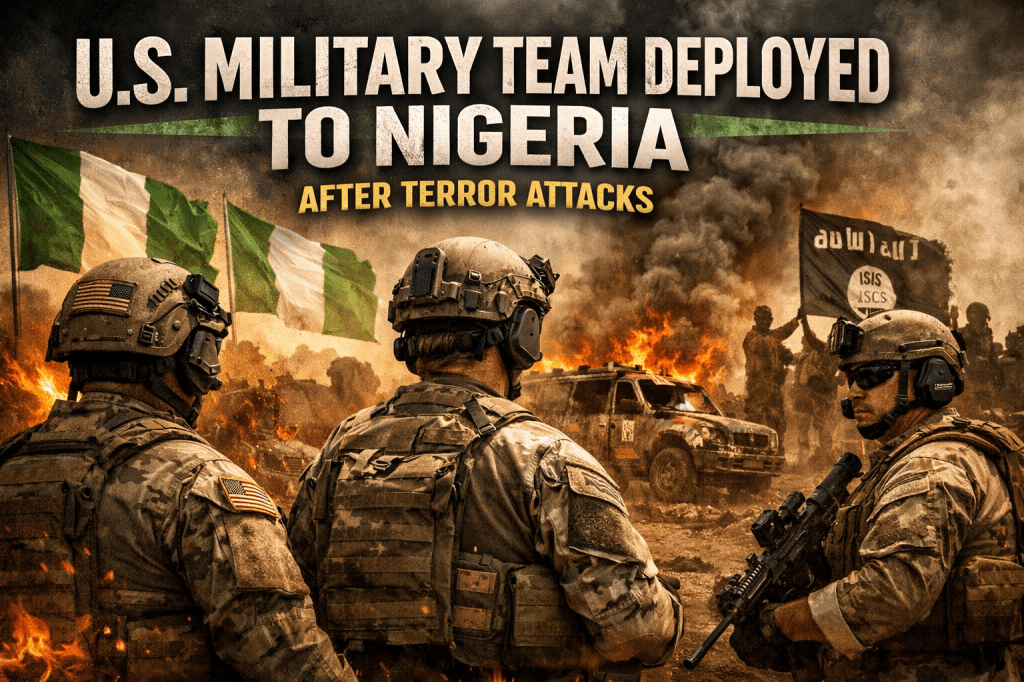
The United States has quietly deployed a small military advisory team to Nigeria following a surge of deadly attacks by extremist groups, underscoring growing security concerns in West Africa and the limits of past “hands-off” counterterrorism strategies.
According to reporting by Military Times, the deployment follows a series of coordinated assaults in northeastern Nigeria that left dozens dead, including civilians and Nigerian security personnel. The violence is attributed primarily to Islamist terror groups such as Boko Haram and its offshoot, the Islamic State West Africa Province (ISWAP), both of which have intensified operations in recent months.
A Targeted Mission, Not a Combat Role
Pentagon officials emphasized that the U.S. presence is limited in scope. The deployed personnel are expected to provide advisory support, intelligence coordination, and assistance with planning and logistics—not engage directly in combat.
This approach mirrors prior U.S. counterterrorism efforts across Africa, where American forces have focused on training and support rather than large-scale troop deployments. Still, the decision to deploy at all reflects growing alarm in Washington about deteriorating security conditions in the region.
Nigeria, Africa’s most populous country and one of its largest economies, has struggled for years to contain insurgencies in the northeast while also dealing with banditry, kidnappings, and sectarian violence elsewhere.
Terrorism Resurging as U.S. Attention Shifts Elsewhere
The deployment comes at a time when critics argue that U.S. counterterrorism efforts have been deprioritized amid a broader foreign policy focus on Ukraine, China, and domestic political battles. Extremist groups across Africa have exploited weak governance, economic instability, and reduced Western engagement to regroup and expand.
West Africa in particular has become a hotspot, with military coups in neighboring countries and declining cooperation with Western partners creating security vacuums. Nigeria’s struggle to contain Boko Haram has regional implications, threatening trade routes, migration stability, and U.S. allies throughout the Sahel.
A Warning Sign for U.S. Security Policy
While the administration frames the deployment as routine, it highlights a deeper issue: terrorist threats do not disappear when Washington looks away. Small advisory missions may help in the short term, but without sustained strategy, accountability, and pressure on extremist networks, they risk becoming symbolic gestures rather than durable solutions.
For American policymakers, Nigeria is a reminder that global security challenges remain interconnected—and that neglecting counterterrorism abroad can carry consequences at home.
Republic Dispatch will continue tracking U.S. military operations and national security developments overseas.
 Republic Dispatch