By Republic Dispatch Staff
A new U.S. move targeting oil shipments bound for Cuba underscores a broader shift in American foreign policy under Donald Trump—one that blends sanctions enforcement, trade leverage, and regional deterrence into a single strategy.
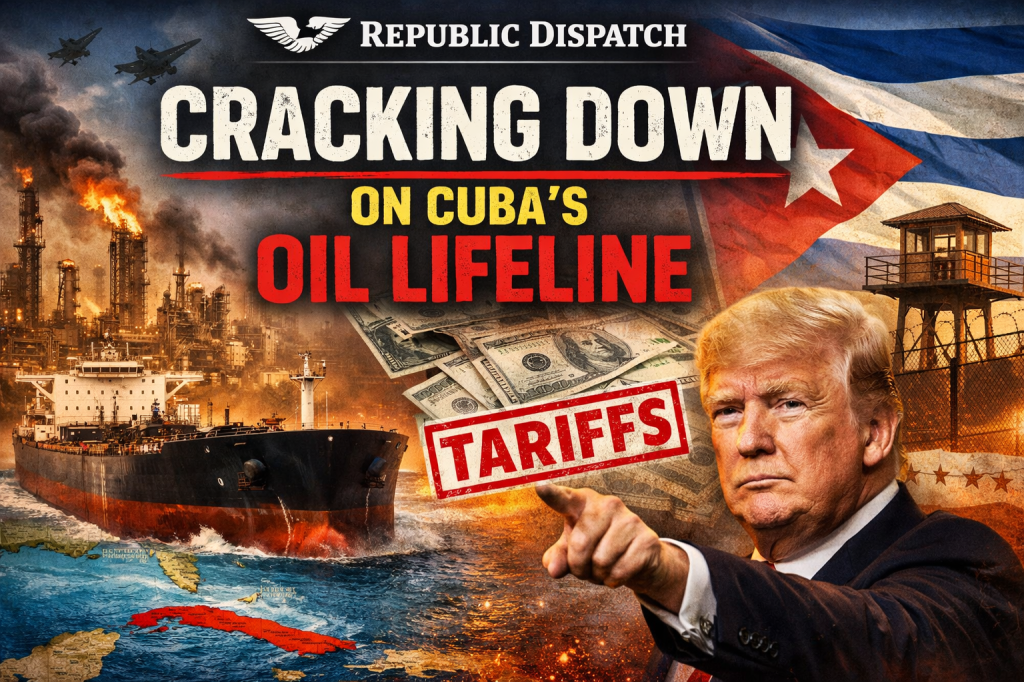
According to reporting by the Associated Press, the administration has imposed tariffs tied to oil flows involving Cuba, a step that raises pressure not just on Havana but on companies and countries facilitating its energy lifeline. The message is unmistakable: the United States is done tolerating sanctions workarounds in its own hemisphere.
Cutting the Regime’s Fuel Line
Cuba’s economy is heavily dependent on imported fuel to keep power plants running and transportation moving. Energy shortages have already produced rolling blackouts and economic stagnation. By tightening scrutiny on oil shipments—and attaching trade consequences—the administration aims to deprive the regime of one of its few remaining economic stabilizers.
From a center-right perspective, this is less about punishment for punishment’s sake and more about accountability. Sanctions mean little if third parties can quietly move oil and cash while U.S. policy looks the other way. This approach closes loopholes rather than inventing new rules.
Trade Leverage as Enforcement Tool
What distinguishes this move is the use of tariffs as an enforcement mechanism. Rather than relying solely on Treasury penalties or diplomatic warnings, the administration is signaling that access to U.S. markets comes with expectations—especially for firms engaged in transactions that prop up hostile or authoritarian regimes.
This reflects a broader philosophy: trade is not neutral when it underwrites repression. If companies want the benefits of the world’s largest consumer market, they must also accept its rules.
Regional Ripple Effects
The policy also places pressure on partners and neighbors involved in energy transit or facilitation, including Mexico. While not the primary target, countries that allow their firms or ports to serve as conduits for sanctioned trade may now face real economic consequences.
That creates an incentive structure aligned with U.S. interests: cooperate on enforcement, or risk friction in trade relations.
A Clearer Line on Cuba
For years, U.S. policy toward Cuba has oscillated between pressure and accommodation, often with little to show for engagement. This move suggests a return to clarity—economic relief will not come without political and structural change.
Critics argue such pressure worsens conditions for ordinary Cubans. Supporters counter that the regime’s mismanagement, not U.S. policy, is the root cause—and that propping up the system only prolongs stagnation.
The Bigger Picture
This is not an isolated tariff tweak. It’s part of a larger effort to reassert American leverage in the Western Hemisphere, discourage sanctions evasion, and signal that energy trade cannot be divorced from national security.
Whether it succeeds will depend on enforcement and follow-through. But strategically, the administration is making its position plain: the era of symbolic sanctions and consequence-free workarounds is over.
 Republic Dispatch