
By Republic Dispatch Staff
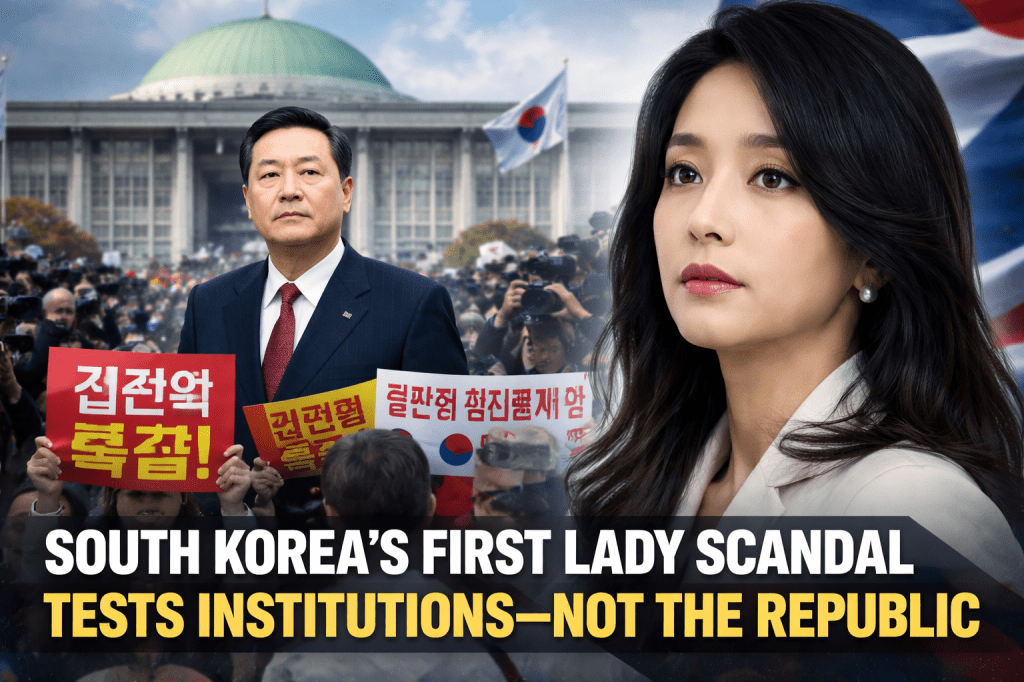
South Korea’s political system is once again under stress—not from North Korea or economic shock, but from an internal credibility test involving the president’s wife, Kim Keon-hee, and allegations that have triggered public anger, opposition pressure, and renewed scrutiny of the country’s investigative bodies.
According to reporting by the Associated Press, prosecutors are weighing how to handle allegations tied to luxury gifts and influence peddling involving Kim, the spouse of President Yoon Suk Yeol. The case has become politically combustible, not only because it touches the first family, but because it revives a long-running South Korean dilemma: whether elites are held to the same standards as ordinary citizens.
A Familiar Pattern in Korean Politics
South Korea is no stranger to high-profile scandals involving presidents and their families. From impeachment to imprisonment, the country has repeatedly demonstrated that no office is theoretically above the law. That tradition—painful as it has been—has also been a pillar of South Korea’s democratic credibility.
What makes the Kim Keon-hee case particularly sensitive is timing and trust. President Yoon campaigned as a reformer, a former prosecutor promising clean government and equal application of the law. Any perception that prosecutors hesitate or slow-walk investigations tied to his wife risks undermining not just his administration, but public faith in the justice system itself.
The Opposition’s Opportunity—and Risk
Opposition parties have seized on the scandal as evidence of hypocrisy, demanding independent probes and accusing the administration of shielding the first lady. Politically, that strategy is understandable. But there is also a risk: turning legitimate accountability into theatrical overreach could further erode public confidence if the issue becomes more about partisan revenge than institutional integrity.
South Korea’s democracy works best when investigations are methodical, transparent, and insulated from political timing. That standard must apply regardless of who stands to benefit.
Why This Matters Beyond Seoul
For allies watching from Washington, Tokyo, and Brussels, this controversy is not merely gossip-column politics. South Korea is a frontline democracy—strategically vital amid tensions with China and North Korea. Institutional stability matters.
A justice system seen as politicized or selective weakens Seoul’s moral authority abroad and complicates alliance politics at a time when unity and credibility are essential.
The Conservative Case for Accountability
From a center-right perspective, this moment calls for restraint and principle, not reflexive defense. Conservatives gain nothing by dismissing legitimate questions or circling wagons around individuals. The rule of law is not a partisan inconvenience—it is the foundation of national strength.
If Kim Keon-hee has done nothing wrong, a transparent process will confirm it. If mistakes were made, accountability—handled lawfully—will ultimately strengthen the republic.
South Korea has faced moments like this before and emerged stronger when institutions were allowed to function. The test now is whether leaders will trust those institutions—or fear what they might reveal.
Republic Dispatch will continue to monitor how South Korea navigates this critical test of democratic credibility.
 Republic Dispatch