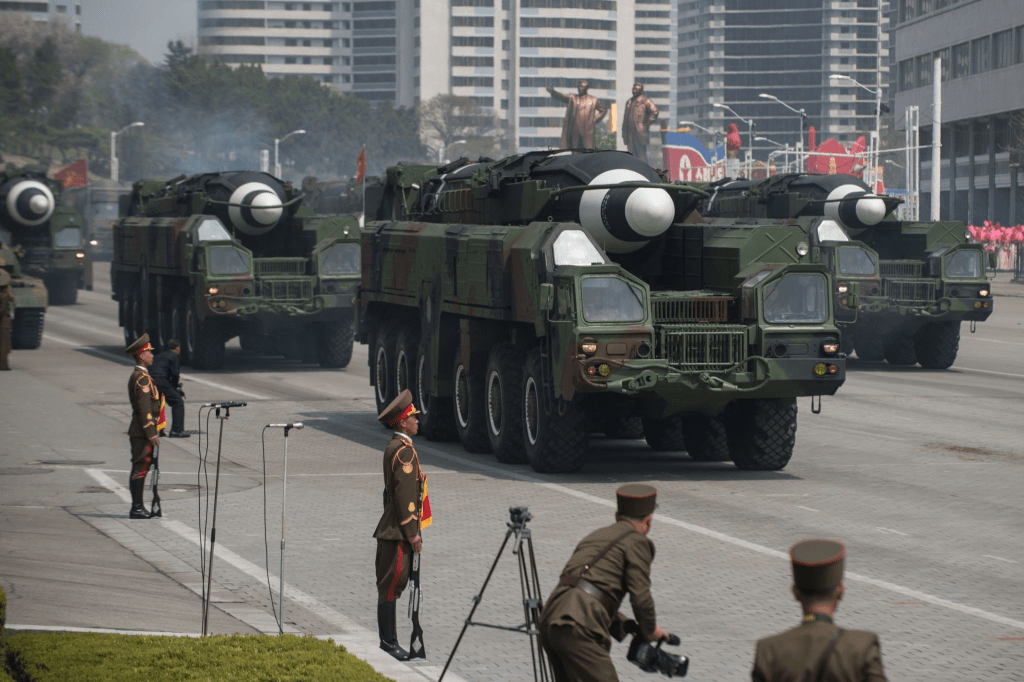
At its latest party congress, North Korea’s ruling elite once again wrapped economic failure and political repression in the language of “deterrence.” According to state media reporting summarized by Reuters, Kim Jong Un unveiled plans to expand the country’s nuclear warfighting capabilities—framed as a necessary shield against external threats. This is a familiar script. It is also a dangerous one.
From a center-right perspective, the takeaway is clear: Pyongyang’s nuclear rhetoric is not about stability or balance; it is about coercion, leverage, and regime survival.
Nuclear Weapons as Regime Insurance
North Korea’s leadership treats nuclear weapons as a multi-purpose tool. They deter intervention, extract concessions, rally domestic elites, and distract from a collapsing economy. The congress language—heavy on “war deterrent” and light on concrete diplomacy—signals continuity, not reform.
This matters because every cycle of nuclear escalation tightens the regime’s grip internally while raising the external cost of containment. The Kim dynasty has learned that missile tests and nuclear threats reliably generate attention, emergency talks, and calls for restraint—often without meaningful consequences.
Deterrence Without Responsibility
True deterrence rests on predictability and restraint. North Korea offers neither. Its doctrine increasingly emphasizes tactical nuclear use, ambiguity, and rapid escalation—precisely the elements that make miscalculation more likely. That is not defensive posturing; it is brinkmanship designed to force adversaries into permanent crisis management.
For the United States and its allies, indulging the fiction that Pyongyang is merely reacting to outside pressure obscures the real problem: a regime that weaponizes instability as policy.
The Cost of Strategic Fatigue
Washington, Seoul, and Tokyo face a familiar dilemma. Sanctions have not compelled denuclearization. Summits have not produced lasting constraints. Meanwhile, the regime advances its arsenal incrementally, banking on global distraction and alliance fatigue.
A center-right approach rejects both naïve engagement and empty theatrics. It prioritizes:
- Credible deterrence through alliance coordination and missile defense.
- Targeted economic pressure focused on elite revenue streams, not humanitarian aid.
- Information exposure that undermines regime narratives rather than legitimizing them.
Why This Matters Now
North Korea’s congress was not a breakthrough—it was a warning shot. As global attention splinters across conflicts, Pyongyang is signaling that it intends to keep pushing the envelope, confident that the world will adapt.
The lesson from decades of this pattern is uncomfortable but unavoidable: nuclear escalation has become North Korea’s most reliable export. Treating it as anything less than deliberate extortion only ensures the cycle continues.
Republic Dispatch will continue to track how allied governments respond—not to the rhetoric, but to the reality it conceals.
 Republic Dispatch