By Republic Dispatch Staff
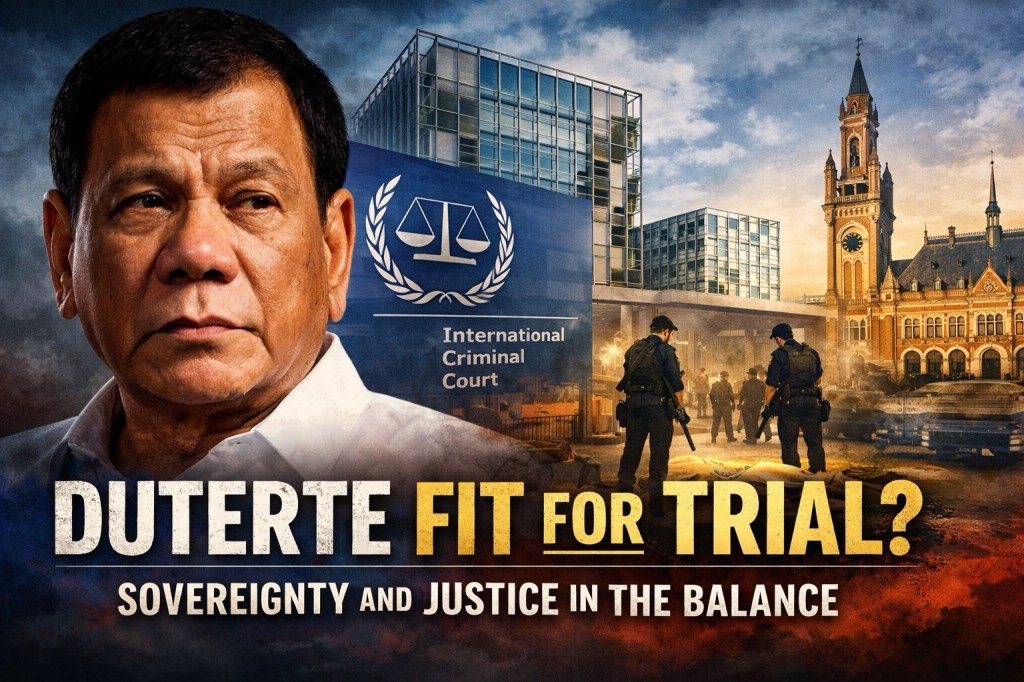
The International Criminal Court (ICC) has ruled that former Philippine president Rodrigo Duterte is fit to stand trial, clearing a procedural hurdle in a case tied to alleged crimes against humanity stemming from his brutal anti-drug campaign. For supporters of international accountability, the decision marks progress. For critics, it revives long-standing concerns about the ICC’s reach, legitimacy, and selective enforcement—especially when applied to countries that have challenged or withdrawn from the court’s authority.
The case centers on allegations that Duterte’s “war on drugs” enabled extrajudicial killings during his tenure. Human rights groups estimate thousands died. Duterte has consistently denied wrongdoing, arguing his policies restored order and deterred crime in a country long plagued by narcotics violence. The ICC’s ruling that he is medically and mentally fit for proceedings does not determine guilt—but it ensures the case moves forward.
Accountability vs. Overreach
The ICC, headquartered in The Hague, was designed as a court of last resort for the gravest crimes when national systems fail. Yet the Duterte case reopens a familiar debate: when does international justice become international overreach?
The International Criminal Court has faced criticism for focusing disproportionately on leaders from developing nations while powerful states remain outside its jurisdiction or effectively insulated. The United States, China, and Russia are not ICC members. This asymmetry fuels skepticism that the court enforces a universal standard—or a selective one.
The Philippines formally withdrew from the ICC in 2019, citing concerns about sovereignty and due process. While the court maintains it retains jurisdiction over alleged crimes committed while the Philippines was a member, critics argue that retroactive pursuit undermines national self-determination and risks politicizing justice.
Due Process Still Matters
From a center-right perspective, the pursuit of accountability must be balanced with respect for due process and national institutions. The ICC’s decision on fitness underscores a procedural safeguard—but broader questions remain. Was the Philippine justice system genuinely unwilling or unable to investigate? Or is the ICC substituting its judgment for that of a sovereign state that contests the facts and the forum?
Duterte’s defenders also warn against conflating aggressive law-and-order policies—however controversial—with crimes against humanity, a threshold meant for systematic atrocities. Expanding that definition risks diluting its moral force and turning the court into an arbiter of domestic policy choices rather than a guardian against genocide and mass crimes.
The Precedent Problem
The implications extend beyond the Philippines. If the ICC proceeds aggressively against former leaders of states that have exited the court, future withdrawals may accelerate—and cooperation may further erode. That outcome would weaken, not strengthen, international justice.
At the same time, dismissing allegations outright would signal impunity. The challenge is legitimacy: a court seen as impartial, restrained, and consistent is more likely to command cooperation than one perceived as selective or politically convenient.
What Comes Next
Declaring Duterte fit for trial keeps the case alive, but it does not settle the deeper debate. The ICC must prove—not assume—its necessity and fairness. For nations weighing cooperation, the lesson is clear: accountability must be real, but so must sovereignty and due process. Without that balance, international justice risks losing the very authority it seeks to assert.
 Republic Dispatch