
By Republic Dispatch Staff
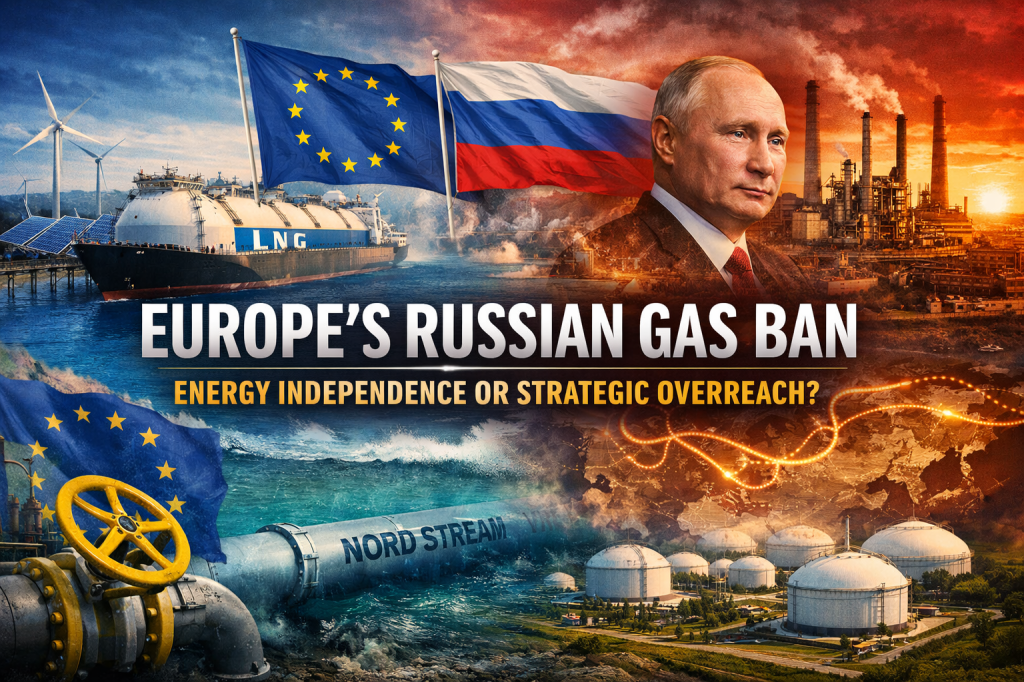
The European Union has agreed to a complete ban on Russian natural gas imports by 2027, marking one of the most consequential energy policy decisions in modern European history. Announced this week, the plan accelerates Europe’s break with Russia, ending decades of deep energy interdependence that once underpinned both economic growth and geopolitical stability.
Supporters hail the move as a necessary step toward energy security and moral clarity. Critics warn it may lock Europe into higher prices, fragile supply chains, and long-term economic self-harm.
The Strategic Rationale
Since Russia’s invasion of Ukraine, the EU has worked aggressively to reduce reliance on Russian energy. Moscow once supplied roughly 40% of Europe’s natural gas; today that figure is below 15%. The 2027 ban formalizes what has already been happening in practice.
EU officials argue that dependence on Russian gas gave the Kremlin leverage—political, economic, and strategic. Ending that dependence, they say, closes a vulnerability that can no longer be tolerated in an era of great-power competition.
From a security standpoint, the logic is straightforward: energy dependence on an adversary is not neutrality—it’s exposure.
The Cost Question Europe Can’t Ignore
What remains unsettled is who pays.
Replacing Russian pipeline gas has required a rapid pivot to liquefied natural gas (LNG), largely imported from the United States, Qatar, and other suppliers. LNG is more expensive, more carbon-intensive to transport, and more vulnerable to global price shocks.
For households and manufacturers alike, energy bills remain elevated compared to pre-war levels. Heavy industry—already struggling under EU climate mandates and global competition—faces mounting pressure to relocate or downsize.
This is where center-right skepticism kicks in: energy independence achieved by pricing out your own middle class is not strategic strength—it’s managed decline.
Winners, Losers, and Unintended Consequences
The ban is a clear win for LNG exporters, especially the U.S., and for renewable energy developers racing to fill supply gaps. It also strengthens Europe’s climate narrative by forcing faster transitions away from fossil fuels.
But it may simultaneously deepen Europe’s reliance on other foreign suppliers—some with questionable records of their own—while eroding domestic competitiveness. Europe risks swapping one dependency for several weaker, costlier ones.
There’s also the geopolitical reality that Russia will redirect gas exports elsewhere, particularly to Asia, potentially strengthening rival economic blocs rather than isolating Moscow.
A Test of Policy Discipline
The EU’s 2027 deadline is ambitious—and politically symbolic. But symbolism doesn’t heat homes or keep factories running.
If European leaders fail to pair this ban with serious deregulation, expanded domestic energy production, and realistic timelines for renewables, voters will pay the price long before geopolitical benefits materialize.
Energy security matters. So does affordability. The challenge ahead is proving Europe can achieve both—without sacrificing its economic base in the process.
Republic Dispatch
Geopolitics. Power. Consequences.
 Republic Dispatch