
By Republic Dispatch Staff
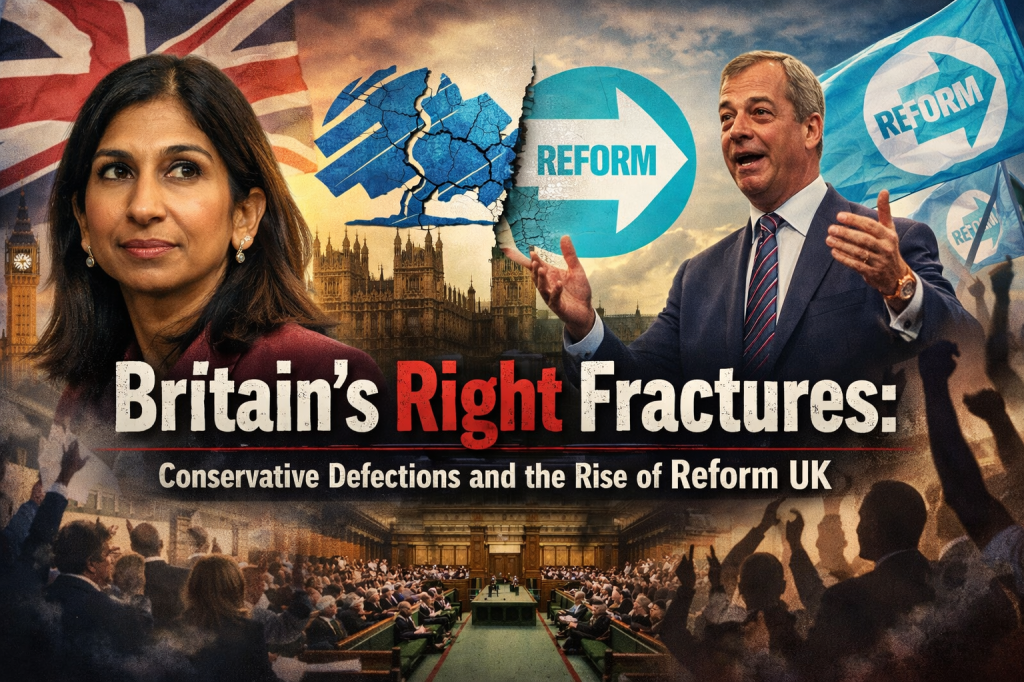
The British right is splintering—and the consequences may be seismic for the United Kingdom’s political future.
According to reporting by the Associated Press, a growing number of figures aligned with Britain’s Conservative movement are openly questioning whether the party still represents voters who care about border control, national sovereignty, and cultural cohesion. Some are no longer merely grumbling. They are defecting—or signaling sympathy—with Reform UK, the insurgent party associated with Nigel Farage.
At the center of this rupture is a basic question: What is the Conservative Party conserving anymore?
A Crisis of Identity, Not Just Leadership
Britain’s Conservative Party—formally Conservative Party—is suffering from more than bad polling or voter fatigue. It is experiencing an identity collapse.
For years, Conservative leaders promised tough immigration enforcement, law-and-order governance, and Brexit sovereignty—only to deliver managerial drift, internal paralysis, and policies that often resemble those of the center-left. The result has been a widening trust gap between party elites and grassroots voters.
Former Home Secretary Suella Braverman has become the most prominent voice articulating that frustration. Her critique is not subtle: the party, she argues, has lost the courage to govern as conservatives. On immigration in particular, she has accused leadership of making commitments it has no intention—or ability—to keep.
Whether one agrees with her rhetoric or not, Braverman is tapping into a real phenomenon: voters who feel systematically ignored by a political class that campaigns on control and governs through compromise.
Reform UK’s Opening
Into that vacuum steps Reform UK.
Once dismissed as a protest vehicle, Reform is increasingly positioning itself as the only party willing to speak plainly about mass immigration, national borders, and the failures of elite consensus politics. Unlike the Conservatives, Reform is unburdened by decades of institutional inertia—or by the need to appease civil service orthodoxy.
The party’s appeal is not primarily ideological sophistication. It is authenticity.
For voters who backed Brexit expecting meaningful change, Reform UK represents unfinished business. And for disillusioned conservatives, it offers a pressure valve: a way to punish a party that, in their view, has taken loyalty for granted.
The Atlantic Parallel
American readers should recognize this pattern.
The dynamic now playing out in Britain mirrors the fracture that reshaped U.S. politics over the last decade: an establishment center-right party losing credibility with its base, followed by insurgent movements accusing it of cowardice, elite capture, and broken promises.
In both cases, the core issue is not extremism—it is trust.
When voters believe elections no longer translate into policy outcomes, they stop caring about party labels and start seeking alternatives, even imperfect ones.
What Comes Next
Short term, this fracture benefits the British left by dividing the right-of-center vote. But long term, it presents a stark choice for the Conservative Party:
- Reassert its governing philosophy with clear, enforceable policies—especially on immigration and national sovereignty; or
- Continue managing decline, ceding voters to Reform UK while insisting the problem is messaging rather than substance.
Political parties can survive losing elections. They do not survive losing meaning.
If the Conservatives fail to decide what they stand for—and demonstrate it in action—Britain’s right will not disappear. It will simply reorganize without them.
Republic Dispatch covers geopolitical realignments, political fractures, and the ideas reshaping Western democracies.
 The Republic Dispatch