
By Republic Dispatch Staff
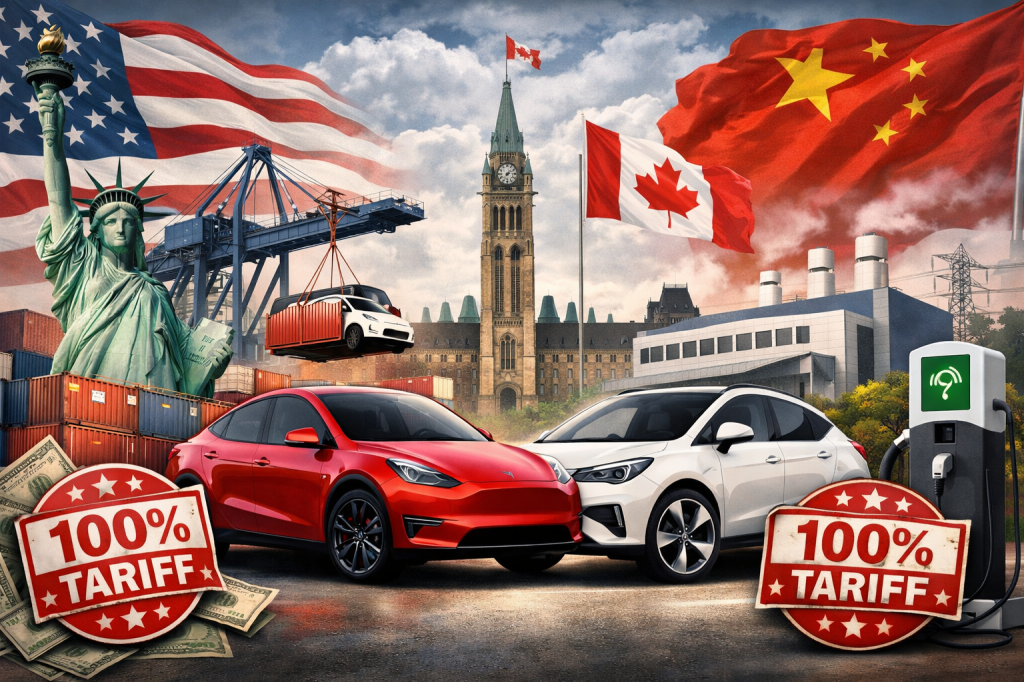
As Washington doubles down on tariffs aimed at blocking Chinese-made electric vehicles from the U.S. market, a new reality is emerging north of the border: Canada is becoming an unintended pressure valve in the global EV trade war.
Recent moves by Ottawa to keep its EV market more open—at least for now—have triggered sharp reactions from U.S. officials, automakers, and labor groups. The result is a three-way standoff between the United States, China, and Canada that highlights a core tension of the green transition: economic nationalism versus affordability and speed.
America’s Hard Line on Chinese EVs
The Biden administration’s strategy is clear. Chinese electric vehicles—often backed by heavy state subsidies—are viewed as an existential threat to domestic auto manufacturing. The U.S. has imposed punitive tariffs exceeding 100% on Chinese-made EVs, effectively banning them from American showrooms.
From a center-right perspective, the policy reflects two priorities that increasingly unite both parties:
- Protecting U.S. manufacturing capacity and jobs
- Preventing China from dominating another strategic industry after steel, solar panels, and rare earths
Supporters argue that allowing subsidized Chinese vehicles into the U.S. would hollow out domestic automakers just as they’re being asked to retool for electrification.
Canada Opens the Door—Carefully
Canada, however, is walking a narrower line.
While Ottawa shares many of Washington’s concerns about China, it has so far avoided mirroring the U.S.’s blanket EV tariffs. That decision could allow Chinese-made EVs—some priced dramatically lower than Western competitors—to enter the Canadian market.
Canadian officials frame the approach as pragmatic:
- EV adoption remains slow due to high prices
- Climate targets require faster consumer uptake
- Supply shortages persist for affordable models
But critics warn that Canada risks becoming a backdoor market, where Chinese automakers establish a North American foothold without facing U.S.-level trade barriers.
Why Tesla Could Be an Early Winner
Ironically, one likely beneficiary of Canada’s more open stance is Tesla.
According to analysts, Tesla is well-positioned to compete against Chinese imports on price and scale—especially as it expands production efficiencies and leverages global supply chains. While some Chinese brands may undercut prices, Tesla’s brand recognition, charging network, and regulatory familiarity give it a strong edge in Canada.
In other words, competition may hurt legacy automakers more than Tesla, which already operates closer to Chinese cost structures than its Detroit rivals.
China’s Long Game
For Beijing, the EV push is not just commercial—it’s strategic.
Chinese automakers are facing slowing domestic demand and intensifying competition at home. Export markets like Europe and Canada offer growth opportunities and geopolitical leverage. Each new market entry builds scale, normalizes Chinese brands, and weakens resistance to broader trade integration.
That’s why U.S. officials are alarmed by any cracks in the tariff wall.
The Real Divide: Speed vs. Security
At its core, the dispute isn’t just about cars—it’s about how fast the West can afford to decarbonize without sacrificing industrial independence.
- Block Chinese EVs, and prices stay higher for consumers
- Allow them in, and domestic manufacturers face brutal competition
- Move too slowly, and climate targets slip further out of reach
Canada’s approach reflects a belief that affordability must come first. The U.S. position prioritizes industrial security, even at higher short-term cost.
A Preview of the Next Trade Fight
The EV tariff dispute is likely a preview of future battles over batteries, grid storage, and clean-energy infrastructure. As green technology becomes a pillar of national power, trade policy will increasingly look like defense policy.
For now, Canada finds itself in the uncomfortable middle—caught between its largest trading partner and the world’s most aggressive industrial competitor.
And as the EV market accelerates, there may be no neutral ground left.
 Republic Dispatch