
By Republic Dispatch Staff
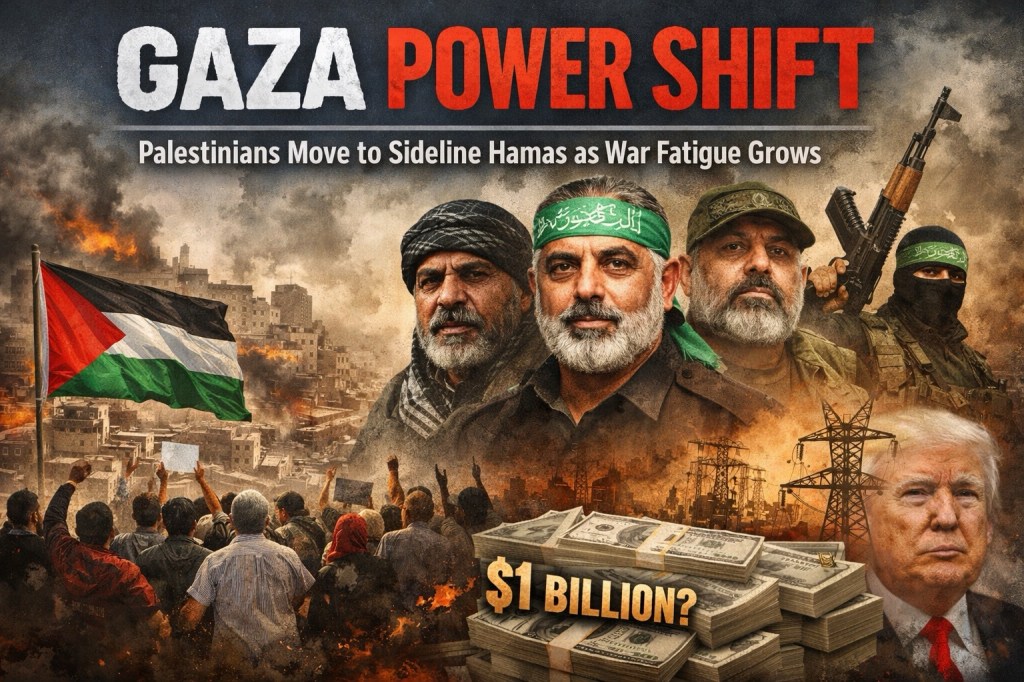
As the war in Gaza grinds on, a political and social shift appears to be underway inside the devastated enclave. According to reporting from the Associated Press, a growing number of Palestinians—exhausted by months of violence, displacement, and economic collapse—are quietly exploring ways to marginalize Hamas and open the door to alternative governance structures once the fighting ends.
This emerging dynamic reflects a broader reality often ignored in Western media coverage: Hamas does not represent all Palestinians, and its continued control over Gaza has come at an enormous cost to civilian life.
War Fatigue Meets Political Reality
AP’s reporting describes behind-the-scenes discussions among Palestinian professionals, tribal leaders, and civic figures who believe Hamas’s grip on power has become unsustainable. The destruction of infrastructure, mass displacement, and the near-total collapse of Gaza’s economy have left many residents questioning whether Hamas’s strategy of perpetual confrontation has delivered anything beyond suffering.
Public dissent inside Gaza has historically been dangerous, but the scale of the devastation has changed the calculus. For many families, survival now outweighs ideological loyalty.
While Hamas still maintains coercive control, its legitimacy—already weakened before the war—has been further eroded by the humanitarian toll and the prospect that Gaza could face years of isolation if Hamas remains in charge.
A Vacuum Waiting to Be Filled
The question, however, is not simply whether Hamas can be sidelined—but what replaces it.
Potential post-war governance models being discussed include:
- A technocratic Palestinian administration backed by Arab states
- A restructured Palestinian Authority role in Gaza
- An interim international or regional oversight mechanism
Each option carries risks, but the common denominator is growing recognition that Gaza cannot rebuild under Hamas rule without remaining permanently cut off from investment, aid, and normalization.
Israel, Egypt, Gulf states, and Western donors have all signaled—explicitly or implicitly—that Hamas-led Gaza is a nonstarter.
Trump’s $1 Billion Reality Check
Adding pressure to this conversation is former President Donald Trump, who has reportedly floated a blunt figure for Gaza’s future: $1 billion—roughly the minimum cost he estimates the U.S. and allies would face just to stabilize and rebuild basic infrastructure.
From a center-right perspective, Trump’s framing cuts through diplomatic abstraction. Reconstruction is not theoretical. It is expensive, politically risky, and contingent on one central condition: who controls Gaza afterward.
Trump allies argue that American taxpayers should not be expected to fund rebuilding efforts if Hamas—or any Iran-backed proxy—remains in power. In this view, governance reform is not a humanitarian afterthought; it is the prerequisite.
The Quiet Palestinian Calculation
Perhaps the most overlooked element of this moment is that many Palestinians appear to understand this reality themselves.
The AP reports growing acknowledgment among Gazans that international legitimacy, economic recovery, and even basic electricity and water access are impossible under the current power structure. That realization—not Israeli pressure or U.S. rhetoric—may ultimately be the most powerful force reshaping Gaza’s political future.
This does not mean Gaza is on the verge of democratic reform or immediate stability. Power vacuums are dangerous, and Hamas is unlikely to step aside willingly. But the psychological shift matters. Once a population stops believing its rulers can deliver survival, let alone prosperity, the clock starts ticking.
What Comes Next
For Washington, Jerusalem, and regional partners, the emerging Palestinian pushback against Hamas presents both an opportunity and a dilemma. Supporting alternatives without imposing them will require restraint, coordination, and realism—qualities often lacking in Middle East policy.
But one thing is increasingly clear: Gaza’s future will not be decided by slogans or ceasefire statements alone. It will be decided by governance, money, and the willingness of Palestinians themselves to break with a model that has brought them ruin.
And as Trump’s $1 billion price tag underscores, no one is lining up to write checks unless Hamas is finally removed from the equation.
 The Republic Dispatch