
By Michael Phillips | Republic Dispatch
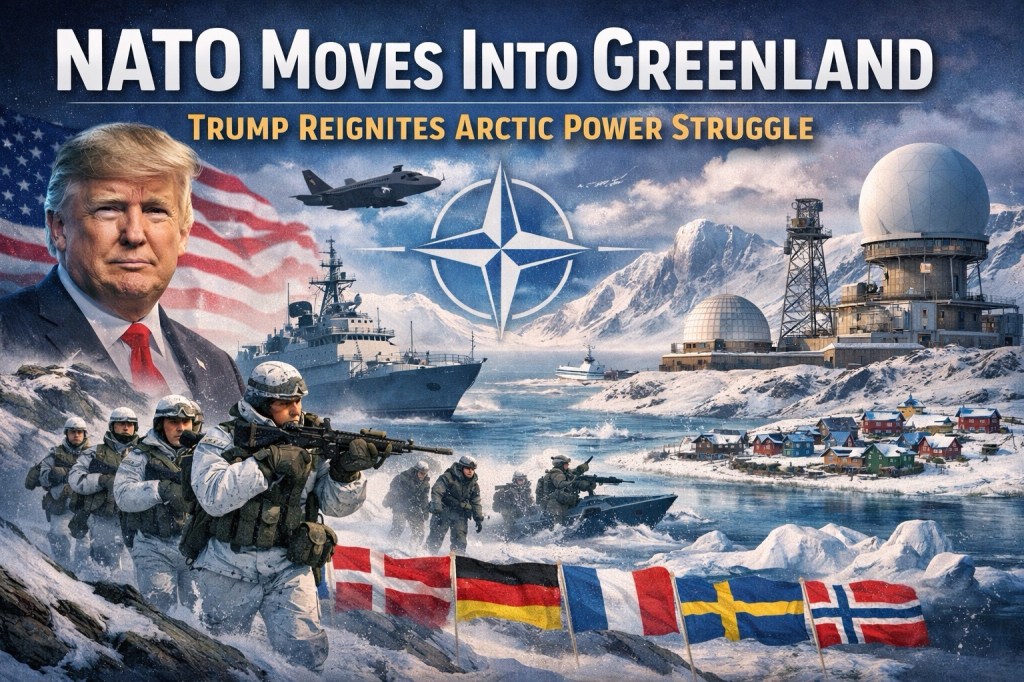
NATO allies are deploying troops to Greenland under a Danish-led exercise known as Operation Arctic Endurance, a move that underscores rising geopolitical tension in the High North following renewed U.S. pressure to secure control of the strategically vital Arctic island.
The deployments—announced after tense White House talks this week—include small military contingents from Denmark, Germany, France, Sweden, and Norway. While officials describe the operation as a routine joint exercise focused on Arctic readiness and interoperability, its timing is anything but routine.
President Donald Trump has again argued that the United States “needs Greenland for national security,” reviving a long-standing strategic debate that now risks testing alliance unity inside NATO.
A Diplomatic Rift Goes Public
The exercise follows a January 14 meeting in Washington between U.S. officials—including Vice President JD Vance and Secretary of State Marco Rubio—and Danish and Greenlandic leaders. Danish Foreign Minister Lars Løkke Rasmussen described the talks as “frank but constructive,” while acknowledging a “fundamental disagreement” over Greenland’s future.
“We didn’t manage to change the American position,” Rasmussen said afterward. “It’s clear that the president has this wish of conquering over Greenland. We made it very, very clear that this is not in the interest of the kingdom.”
Greenland’s foreign minister, Vivian Motzfeldt, echoed that message, pointing to overwhelming public opposition among Greenlanders to any form of U.S. annexation and strong support for eventual independence from Denmark.
A trilateral working group between the U.S., Denmark, and Greenland has been established, but no breakthrough emerged from the meeting.
What Is Operation Arctic Endurance?
Operation Arctic Endurance is formally described as a Danish-led joint military exercise designed to strengthen Arctic defense cooperation and readiness. Denmark, which is responsible for Greenland’s defense as part of the Kingdom of Denmark, has committed billions of dollars in recent years to High North security, including new Lockheed Martin F-35 fighter jets, naval patrols, and infrastructure protection.
Participating nations include:
- Denmark – Leading the operation, with aircraft, naval assets, troops, and critical-infrastructure protection.
- Germany – A 13-person Bundeswehr reconnaissance team deployed to Nuuk to assess future maritime-surveillance contributions.
- France – President Emmanuel Macron confirmed French military elements are en route.
- Sweden – Officers arrived to prepare multinational components.
- Norway – Sending a limited number of personnel.
While the deployments are small and largely preparatory, the multinational nature of the exercise sends a clear political signal: Greenland is covered by NATO solidarity through Denmark, and its sovereignty is not an open question.
Why Greenland Matters
Greenland’s importance is not theoretical. The island sits astride the GIUK Gap (Greenland-Iceland-United Kingdom), a critical chokepoint for Russian submarines entering the Atlantic. It also hosts Pituffik Space Base (formerly Thule Air Base), which anchors U.S. missile-warning systems, space surveillance, and Arctic domain awareness.
As Arctic ice recedes, new shipping routes and access to critical minerals—particularly rare earth elements—are transforming the region into a front line of great-power competition involving Russia and China. From a U.S. strategic standpoint, Greenland is indispensable.
From a European perspective, however, that strategic reality does not override sovereignty or alliance norms.
Alliance Unity Under Strain
The irony is difficult to miss: NATO allies are deploying forces not to deter Russia or China, but to quietly reinforce the principle that territorial integrity applies even among allies.
For European governments, Operation Arctic Endurance is about showing capability, commitment, and unity—without openly confronting Washington. For the Trump administration, the Arctic remains a national-security priority where traditional diplomatic boundaries may be tested.
The risk is not an imminent military clash, but a slow erosion of trust inside the alliance at a moment when NATO faces external threats on multiple fronts.
Greenland, long a quiet outpost of Cold War defense planning, has become a symbol of a larger question confronting the West in 2026: how to balance hard security interests with alliance discipline—and whether power politics can coexist with partnership in an increasingly competitive world.
 Republic Dispatch