
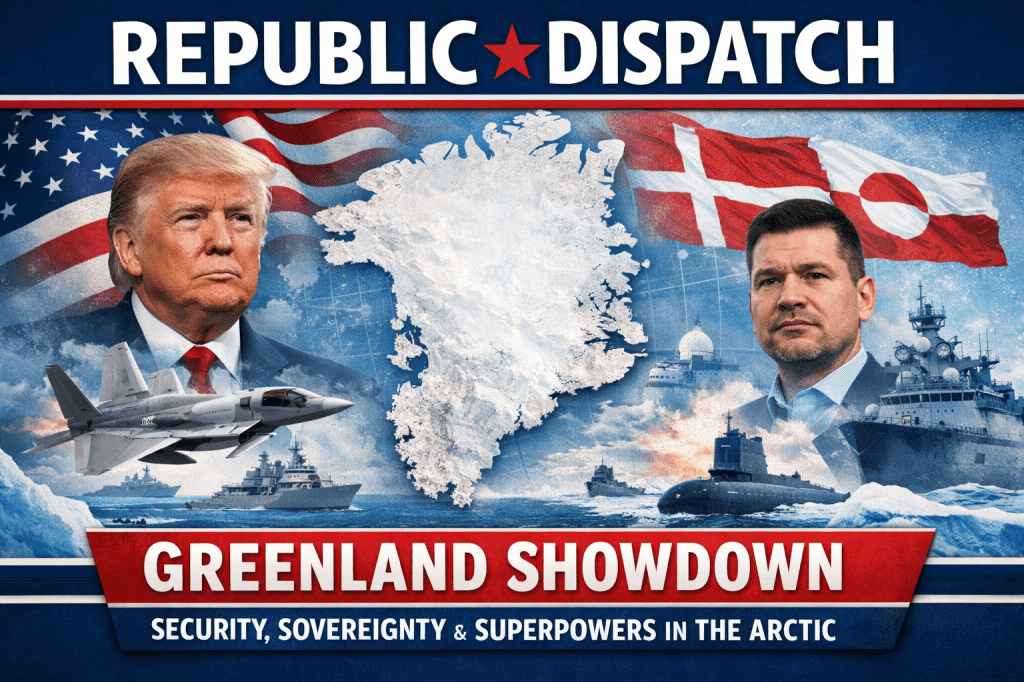
By Michael Phillips | Republic Dispatch
As of mid-January 2026, Greenland—the world’s largest island and an autonomous territory within the Kingdom of Denmark—has become the focal point of a fast-escalating geopolitical dispute involving the United States, NATO allies, and the future of Arctic security.
At the center of the controversy is Donald Trump, who has renewed and sharpened his long-standing argument that the United States must gain decisive control over Greenland to counter Russian and Chinese influence in the Arctic.
A Strategic Flashpoint, Not a New Idea
U.S. interest in Greenland is not new. During the Cold War, Washington viewed the island as a critical early-warning and missile-defense outpost against the Soviet Union, culminating in the 1951 U.S.–Denmark defense agreement and the establishment of Pituffik Space Base (formerly Thule Air Base). That base remains a cornerstone of U.S. missile-warning and space-tracking operations today.
The idea of outright acquisition has surfaced periodically—most famously in 1946, when President Harry Truman offered Denmark $100 million, and again in 2019, when Trump publicly floated the idea during his first term. What is different in 2026 is the intensity of the rhetoric and the broader Arctic context.
What Changed This Week
Over the past several days, President Trump has repeatedly stated that the U.S. will “do something” about Greenland, insisting that continued reliance on existing defense agreements is insufficient. He has framed the issue as urgent, citing:
- Expanding Russian military activity in the Arctic
- China’s growing interest in Arctic shipping routes and rare-earth minerals
- Climate change opening new sea lanes and exposing strategic resources
Trump has emphasized that he prefers a negotiated solution but has refused to rule out economic or military pressure—language that has unsettled allies and fueled speculation about U.S. intentions.
In response, senior Trump administration officials, including Secretary of State Marco Rubio, are scheduled to meet this week with Danish officials and representatives from Greenland to discuss U.S. interests and next steps.
Firm Pushback From Greenland and Denmark
The response from Greenland has been unusually unified. Leaders from all five parliamentary parties issued a joint statement rejecting any U.S. takeover, declaring that Greenlanders intend to decide their own future.
Denmark’s government has echoed that stance, stressing that Greenland “is not for sale” and warning that any use of force against a NATO ally would have severe consequences for the alliance itself. European governments—including Nordic countries and key EU states—have publicly signaled support for Denmark, underscoring the alliance risks of escalation.
Divisions Inside the United States
While some Republicans support Trump’s assertive posture—arguing that decisive action is needed to counter China’s dominance in critical minerals and Russia’s Arctic militarization—others have urged caution.
Several lawmakers, including Republicans from Arctic-adjacent states, have warned that threats against Denmark could fracture NATO unity and undermine U.S. credibility at a time when allied cooperation is essential against Moscow and Beijing.
So… Are We Going to Invade Greenland?
Short answer: No—there is no indication of an imminent U.S. invasion of Greenland.
Despite the heated rhetoric, there are no signs of military mobilization, no congressional authorization, and no NATO or Pentagon planning suggesting an invasion is underway. Any use of force against Greenland would almost certainly trigger a NATO crisis and face overwhelming legal, political, and diplomatic resistance.
What is happening appears to be a high-pressure negotiating strategy—using blunt language to force concessions, increase U.S. leverage, or expand American influence short of formal annexation. Possible outcomes include:
- Expanded U.S. military presence or basing rights
- Greater U.S. investment in Greenland’s infrastructure and mining sector
- New economic or defense compacts short of sovereignty
The Bigger Picture
The Greenland dispute is less about real estate and more about the future of the Arctic. As ice melts and competition intensifies, the region is becoming a central theater of great-power rivalry. The question is not whether the U.S. has vital interests there—it clearly does—but whether those interests are best secured through cooperation with allies or coercive pressure that risks fracturing them.
For now, diplomacy—not invasion—remains the likely path forward. But the rhetoric alone has already strained alliances and ensured that Greenland will remain a geopolitical fault line well beyond this week’s talks.
 Republic Dispatch