
Operation Hawkeye Strike signals renewed resolve against jihadist remnants
By Michael Phillips | Republic Dispatch
The United States carried out large-scale airstrikes against ISIS targets across Syria on Saturday, marking a significant escalation in Washington’s ongoing campaign to prevent the terrorist group’s resurgence in the post-Assad era.
According to U.S. officials and reporting from ABC News, the strikes took place around 12:30 p.m. ET and were conducted by U.S. Central Command (CENTCOM) forces alongside allied partners. The operation is part of Operation Hawkeye Strike, a retaliatory campaign launched after a deadly ISIS attack last month killed three Americans.
Retaliation for a Deadly Attack
The renewed offensive follows a December 13, 2025 ambush near Palmyra, Syria, in which an ISIS-affiliated gunman opened fire on U.S. personnel. Two soldiers from the Iowa National Guard—Sgt. Edgar Torres-Tovar and Sgt. William Howard—were killed, along with a U.S. civilian interpreter. Three additional American service members were wounded. The attacker was killed during the incident.
The ambush marked the first U.S. military fatalities in Syria since the collapse of the Assad regime in late 2024 and underscored concerns that ISIS cells are attempting to exploit Syria’s political transition and lingering security gaps.
President Donald Trump vowed “very serious retaliation” following the attack. Within days, the United States—working with regional allies—launched an initial wave of strikes on December 19, hitting more than 70 ISIS-linked weapons depots, supply routes, and operational hubs in central Syria.
Scale and Scope of the January Strikes
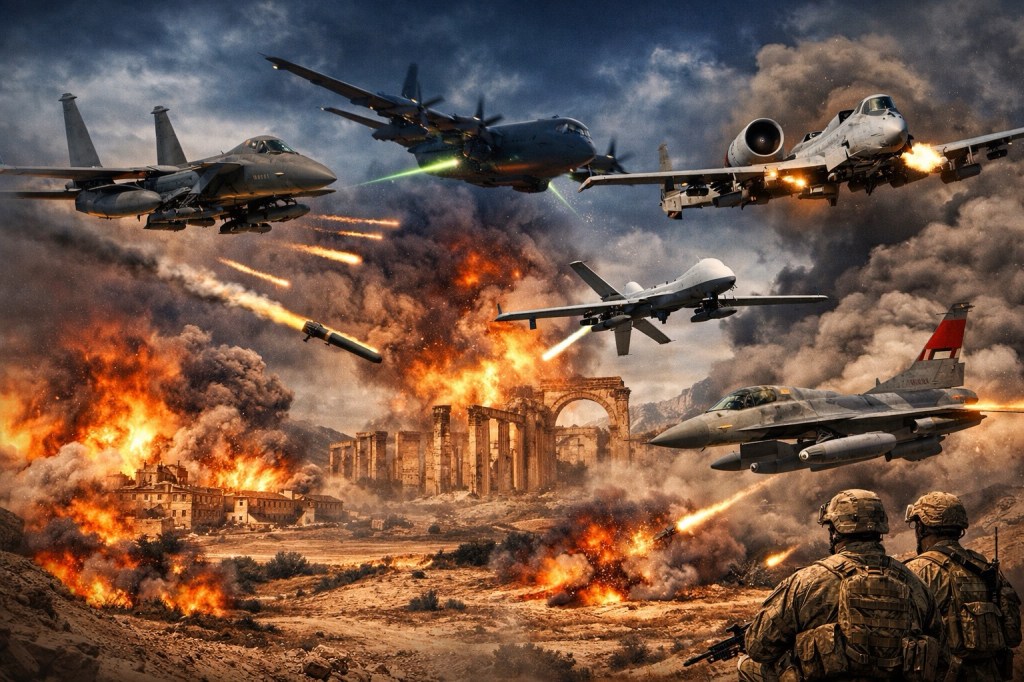
Saturday’s strikes were described by defense officials as “large-scale,” involving more than 20 aircraft and over 90 precision-guided munitions. Assets reportedly included F-15E Strike Eagles, A-10 Thunderbolt II attack aircraft, AC-130J gunships, MQ-9 Reaper drones, and allied fighter jets.
While CENTCOM did not release specific casualty figures or exact target locations, officials confirmed that dozens of ISIS sites across Syria were hit, including weapons caches, logistics nodes, and transit corridors used by remaining cells.
In a statement, CENTCOM emphasized the mission’s focus:
“The strikes today targeted ISIS throughout Syria as part of our ongoing commitment to root out Islamic terrorism against our warfighters, prevent future attacks, and protect American and partner forces in the region.”
Regional Support, Limited Backlash
Unlike previous U.S. military actions in Syria, the latest strikes have drawn relatively muted international criticism. Regional partners have largely expressed support, particularly Jordan, which has actively participated in earlier phases of the campaign using its F-16s and views ISIS as a direct threat to regional stability.
Syria’s transitional government has also signaled cooperation on counterterrorism efforts, seeking to demonstrate that post-Assad Syria will not serve as a safe haven for jihadist groups. The Syrian Democratic Forces likewise welcomed the strikes, noting that sustained U.S. airpower remains critical to preventing ISIS from regrouping in remote desert areas.
Notably absent so far are sharp condemnations from Russia, Iran, or Turkey—countries that have previously objected loudly to U.S. operations in Syria. Analysts suggest the narrow focus on ISIS, a shared enemy, and coordination with local authorities have helped blunt immediate diplomatic backlash.
A Clear Message
From a center-right perspective, Operation Hawkeye Strike reflects a clear and necessary posture: attacks on U.S. forces will be met with decisive force, even in complex theaters like Syria. With roughly 1,000–2,000 U.S. troops still deployed to advise and assist local partners, the strikes aim to deter future attacks while avoiding a return to large-scale ground combat.
As ISIS remnants continue to test the resolve of the international coalition, the Trump administration appears determined to ensure that Syria’s instability does not become the breeding ground for another wave of global jihadist violence.
 Republic Dispatch