By Michael Phillips | Republic Dispatch
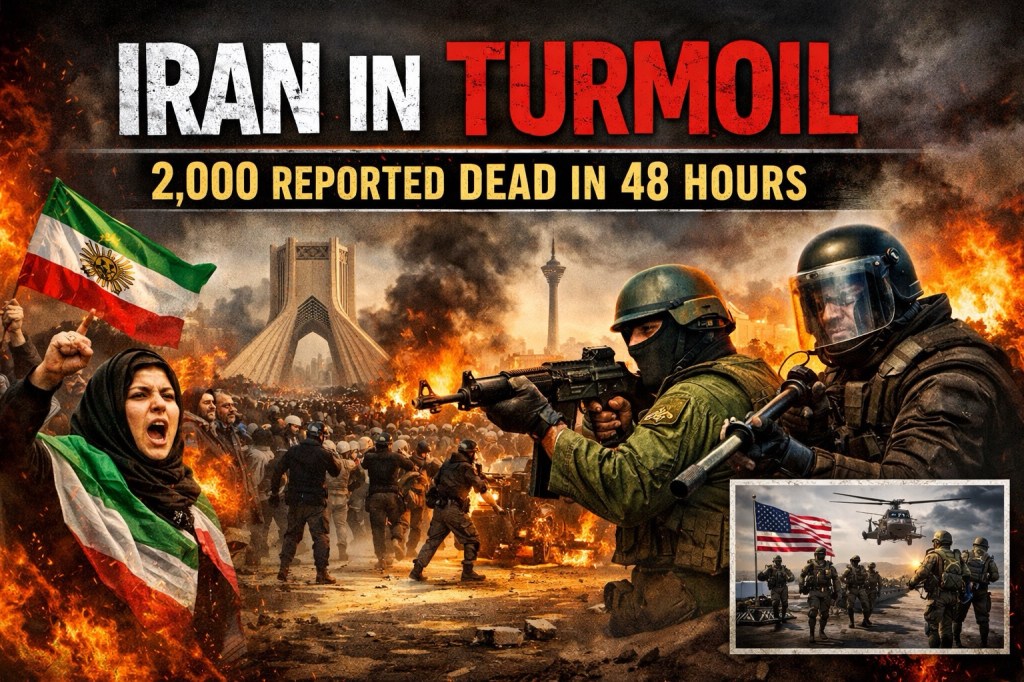
Iran is facing one of the most volatile moments since the 1979 revolution, as nationwide protests that began over economic collapse have escalated into a direct challenge to the Islamic Republic itself. Over the past 48 hours, opposition-linked outlets have circulated claims that as many as 2,000 Iranians may have been killed by regime security forces—figures that, while unverified, underscore growing fears of a large-scale crackdown hidden behind a near-total communications blackout.
The claim originated with Iran International, a Persian-language outlet based outside the country, and has been amplified on social media by accounts such as Tousi TV. According to the outlet, the estimate is “conservative,” citing eyewitness reports of live ammunition being used against crowds, overwhelmed hospitals, and mass casualties in Tehran and other major cities. Independent verification remains extremely difficult, as the Iranian regime has shut down internet and mobile communications nationwide for more than 48 hours.
A Revolt Fueled by Economic Collapse—and Something More
The protests began in late December 2025 amid hyperinflation, currency collapse, and deepening poverty. What initially resembled earlier waves of economic unrest has since transformed into a broad anti-regime uprising. Demonstrators in Tehran, Isfahan, Mashhad, Shiraz, Tabriz, and minority regions have openly chanted “Death to Khamenei,” burned symbols of the Islamic Republic, and disabled surveillance cameras.
Notably, protesters are no longer demanding reform—they are calling for an end to the system itself. Chants and imagery supporting exiled Crown Prince Reza Pahlavi and the pre-1979 Lion and Sun flag have reemerged, signaling a rejection of clerical rule rather than a plea for incremental change.
Conflicting Death Tolls—and Why the Gap Matters
Here is where caution is essential. While Iran International reports at least 2,000 killed in the last two days alone, established human rights organizations currently document far lower confirmed totals for the broader unrest:
- Iran Human Rights and HRANA report roughly 50–80 confirmed deaths so far, with hundreds injured and more than 2,600 arrests.
- Amnesty International and Human Rights Watch have verified dozens of killings in the early phase of the protests.
- Wikipedia’s ongoing entry on the 2025–2026 protests cites Iran International’s figure alongside reports from Western media describing widespread gunfire and mass casualties.
The discrepancy is not necessarily evidence of fabrication—it reflects the reality of an enforced blackout. Nobel Peace Prize laureate Shirin Ebadi and other activists warn that Iran has historically used communication shutdowns to conceal large-scale violence. Reports of foreign militias, including Hezbollah-linked elements, assisting Iranian forces have only heightened those concerns.
The Regime’s Response: Threats, Force, and No Retreat
Iran’s leadership has responded with unmistakable escalation. Supreme Leader Ali Khamenei has blamed the unrest on foreign interference, particularly the United States, and vowed that the Islamic Republic will not back down. Officials have threatened protesters with capital charges such as moharebeh (“enmity against God”), a charge that carries the death penalty.
The Islamic Revolutionary Guard Corps (IRGC) and regular army units have been deployed to protect infrastructure, while security forces reportedly shifted from crowd control to sustained live fire in several cities.
The U.S. Angle: Strong Words, Unclear Next Steps
President Donald Trump has publicly warned Tehran against killing protesters, stating that the United States is “watching closely” and “locked and loaded” if the violence continues. While reports suggest the U.S. military is reviewing contingency options, there is no confirmed evidence of imminent intervention or force deployment as of January 10.
For now, Washington appears to be signaling deterrence rather than action—issuing warnings, amplifying international pressure, and leaving the door open to escalation if the situation deteriorates further.
A Moment of Truth for Iran—and the World
From a center-right perspective, two truths can coexist. First, extraordinary casualty claims emerging from opposition media must be treated with caution until independent verification is possible. Second, the Iranian regime’s long record of repression, information control, and lethal force against civilians makes the fears driving those claims entirely plausible.
What is clear is that Iranians on the ground are displaying remarkable courage in the face of overwhelming risk. Whether this uprising becomes another brutally suppressed revolt—or a genuine turning point—may depend less on social media estimates and more on whether the blackout lifts, the world sees what is happening, and the regime calculates that the cost of continued violence has finally become too high.
 Republic Dispatch