By Michael Phillips | Republic Dispatch
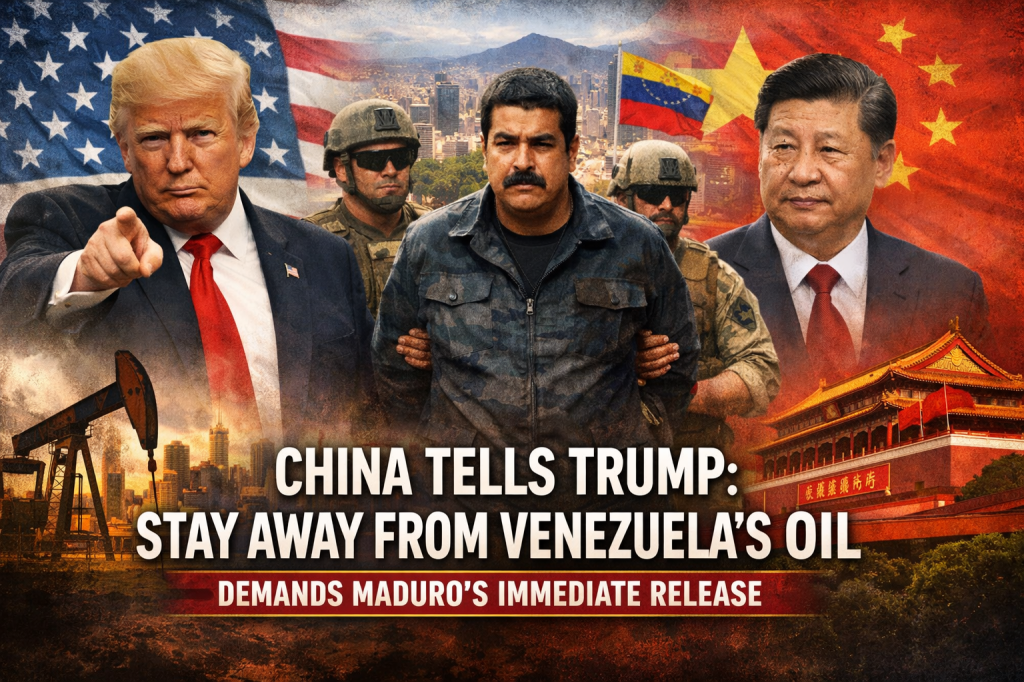
China has issued a sharp warning to President Donald Trump, urging him to stay out of Venezuela’s oil sector and demanding the “immediate release” of detained Venezuelan leader Nicolás Maduro, following a dramatic U.S. military operation that has reshaped the geopolitical balance in the Western Hemisphere.
The confrontation underscores a growing U.S.–China clash not just over ideology or diplomacy, but over energy, influence, and the future of a resource-rich state long aligned with Beijing.
A Shock Operation in Caracas
On January 3, U.S. forces carried out a surprise operation in Caracas that included targeted airstrikes and a raid culminating in the capture of Maduro and his wife, Cilia Flores. Both were flown to New York, where Maduro is being held on longstanding U.S. charges related to narco-terrorism, cocaine trafficking, and weapons offenses.
President Trump described the action as a law-enforcement operation rather than a war, but his follow-up comments went much further. Trump stated that the United States would temporarily oversee Venezuela’s transition and help “run” the country while restoring its shattered oil infrastructure.
Venezuela holds the world’s largest proven oil reserves—more than 300 billion barrels—making the move instantly global in consequence.
China’s Furious Response
Beijing reacted with unusual speed and intensity. China’s Foreign Ministry said it was “deeply shocked,” condemning the U.S. action as a “blatant use of force,” “hegemonic behavior,” and a violation of international law and the UN Charter.
By January 4, China escalated its rhetoric, formally demanding Maduro’s immediate release and guarantees for his personal safety. On January 5, Chinese Foreign Minister Wang Yi warned that no country has the right to act as the world’s “judge” or “police”—language widely interpreted as a direct rebuke of Trump’s doctrine.
China, alongside Russia, pushed for an emergency UN Security Council session, framing the U.S. action as a dangerous precedent for sovereignty worldwide.
The Oil Issue Beijing Won’t Say Quietly
While China’s public statements emphasize international law, the real anxiety lies beneath the surface: oil.
China has poured an estimated $60–100 billion into Venezuela since the Chávez era, much of it repaid through discounted oil shipments. Venezuela currently supplies roughly 600,000 to 700,000 barrels per day to China—about 4–5% of Beijing’s total imports—often routed through sanctions-dodging “shadow fleets.”
Trump’s comments about redirecting Venezuelan crude toward U.S. Gulf Coast refineries alarmed Beijing. Venezuelan heavy crude is ideally suited to American infrastructure, and analysts say U.S. imports could surge rapidly under a post-Maduro government, cutting China off from cheap supply.
Chinese media have stressed that existing oil contracts are “protected by law,” a thinly veiled warning against U.S. interference. A widely circulated headline captured the mood bluntly: China telling Trump to “stay away from Venezuela’s oil.”
Timing That Stung Beijing
China’s anger was intensified by timing. Just hours before the U.S. raid, Maduro met with senior Chinese envoy Qiu Xiaoqi, highlighting what Caracas described as “unbreakable bonds” with Beijing.
The sudden removal of Maduro immediately after that meeting was widely viewed in Beijing as a direct challenge to China’s influence in Latin America.
A Broader Geopolitical Signal
China has so far confined its response to diplomacy and rhetoric—no sanctions, no military signals—but the episode is being closely watched. Chinese commentators have drawn parallels to other sovereignty disputes, including Taiwan, even if experts say the Venezuela operation does not immediately change Beijing’s military calculus.
The alignment lines are also clear: China, Russia, Iran, Cuba, and several left-leaning Latin American governments condemned the U.S. action, while right-leaning governments in the region expressed cautious support or relief.
What Comes Next
As of January 5, Maduro remains detained in New York awaiting a court appearance. Venezuela is under interim leadership by Delcy Rodríguez, who has publicly rejected U.S. authority. Caracas remains tense but largely calm.
For Washington and Beijing, the stakes extend far beyond Venezuela. At issue is whether the United States will reclaim strategic influence in its own hemisphere—and whether China is willing, or able, to stop it.
Trump insists there will be “no problem” with China. Beijing clearly disagrees.
 Republic Dispatch