By Michael Phillips | Republic Dispatch
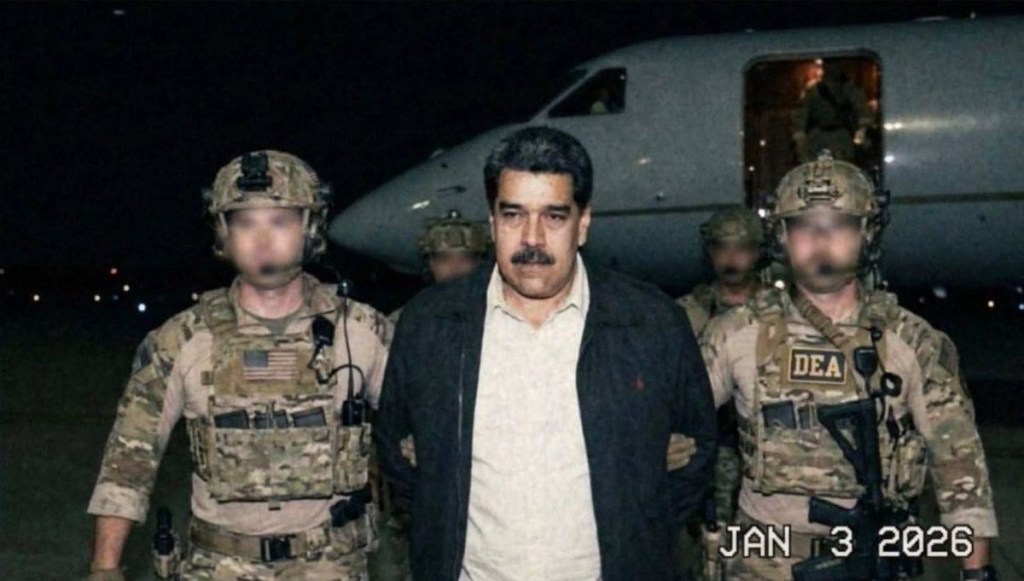
In a dramatic escalation of U.S. power in Latin America, Nicolás Maduro has been captured by U.S. special forces following a pre-dawn military operation in Caracas—an action President Donald Trump framed as the enforcement of long-standing federal arrest warrants against what his administration describes as a “narco-terrorist regime.”
According to U.S. officials and initial media reporting, Maduro and his wife, Cilia Flores, were extracted from Venezuela’s main military complex, Fuerte Tiuna, and flown out of the country. They are expected to face charges in the Southern District of New York tied to narco-terrorism, cocaine trafficking conspiracies, and related indictments first unsealed in 2020 and reaffirmed this week by Attorney General Pam Bondi.
Operation Southern Spear
The raid capped months of escalating U.S. counter-narcotics activity under “Operation Southern Spear,” which, according to administration statements, has included more than 35 strikes on alleged drug-trafficking vessels, tanker seizures, and targeted actions against Venezuelan military-linked networks.
Residents of Caracas reported explosions and low-flying aircraft beginning around 2–3 a.m. local time, with strikes hitting military sites, airfields, and port facilities. U.S. officials said the objective was limited and precise: capture Maduro, suppress air defenses, and exit. Trump said he watched the operation in real time and described it as an “amazing success,” reporting no U.S. fatalities but acknowledging some injuries, including damage to a helicopter.
There are unconfirmed reports of Venezuelan military and civilian casualties, as well as power outages and fires in parts of Caracas, though independent verification remains limited.
Several outlets reported that after extraction Maduro was transferred by helicopter to a U.S. naval vessel—identified by some sources as the USS Iwo Jima—before onward transport toward the United States. The administration has not publicly detailed the full chain of custody.
Secretary of State Marco Rubio and several Republican lawmakers indicated no further military action is anticipated now that Maduro is in custody.
Divided Global Reaction
International response has split sharply along ideological and geopolitical lines.
Right-leaning governments in the Americas welcomed the move. Argentina’s President Javier Milei declared that “liberty advances,” while Ecuador’s President Daniel Noboa praised the targeting of what he called “narco-chavista criminals.”
By contrast, left-leaning governments and U.S. adversaries condemned the action. Brazil’s President Luiz Inácio Lula da Silva warned the U.S. had crossed an “unacceptable line.” Mexico, Colombia, Cuba, Russia, Iran, and China accused Washington of violating sovereignty and international law, though none signaled concrete retaliatory steps.
European leaders struck a more cautious tone, urging restraint and calling for a democratic transition while seeking clarity on the facts and legal basis of the operation.
Inside Venezuela: Relief, Fear, and Uncertainty
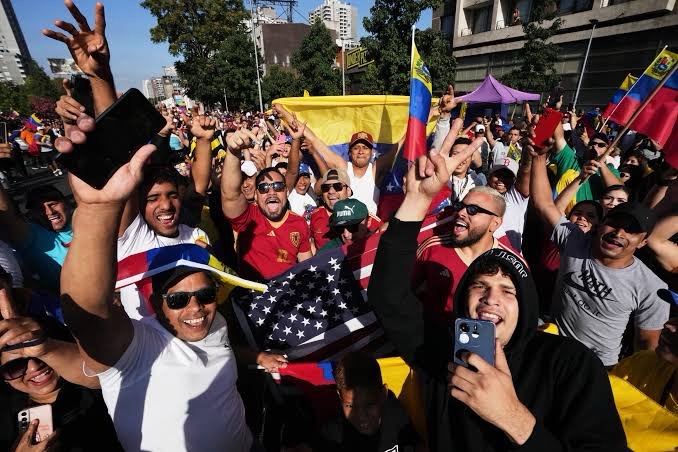
Reactions within Venezuela were mixed. In opposition-leaning neighborhoods of Caracas, some residents celebrated openly, viewing Maduro’s removal as the end of years of repression, economic collapse, and disputed elections. In pro-government strongholds, smaller rallies demanded Maduro’s return and denounced the U.S. action as “kidnapping” or “imperialist aggression.”
Much of the capital remained quiet through the day, with security patrols, limited movement, and a sense of uncertainty as institutions adjusted to a sudden power vacuum.
The Venezuelan diaspora—particularly in the United States, Argentina, and Chile—responded more uniformly with celebration, holding spontaneous gatherings and expressing hope for return and rebuilding.
Opposition leader María Corina Machado called for calm, national unity, and a rapid democratic transition. She urged recognition of opposition candidate Edmundo González Urrutia as the legitimate president based on opposition tallies from the disputed 2024 election.
A Turning Point—and a Debate
For supporters of the administration, the operation represents a decisive reassertion of U.S. leadership in the Western Hemisphere, often compared to the 1989 capture of Manuel Noriega in Panama. Center-right voices argue that removing Maduro advances regional stability, weakens organized crime networks, and reduces the influence of Russia, China, and Iran in South America.
Critics counter that the move risks long-term instability, potential migration surges, and dangerous precedent for unilateral regime change. Legal scholars and some lawmakers from both parties have raised concerns about the lack of explicit congressional authorization and the implications under the War Powers Resolution.
What Comes Next
No formal transitional government has been established or internationally recognized. U.S. officials acknowledge that “day-after” planning has focused on Venezuelan-led governance, new elections, and economic restructuring, including significant U.S. involvement in Venezuela’s oil sector.
Machado and González are pushing for rapid international recognition based on the opposition’s claimed 2024 mandate, while analysts watch closely for signs of military realignment or resistance from remaining Chavista power centers.
For now, the administration says its primary objective—removing Maduro—has been achieved. Whether January 3, 2026, becomes the start of democratic renewal or a period of heightened instability will depend on how quickly Venezuelan institutions, regional actors, and global powers converge around a peaceful transition.
 Republic Dispatch