
By Michael Phillips | Republic Dispatch
CARACAS — A series of loud explosions and reports of low-flying aircraft over Caracas early Friday morning has triggered intense international scrutiny, as unverified claims circulate suggesting possible U.S. military involvement in Venezuela’s capital. As of this writing, neither the United States nor the Venezuelan government has confirmed airstrikes or military operations.
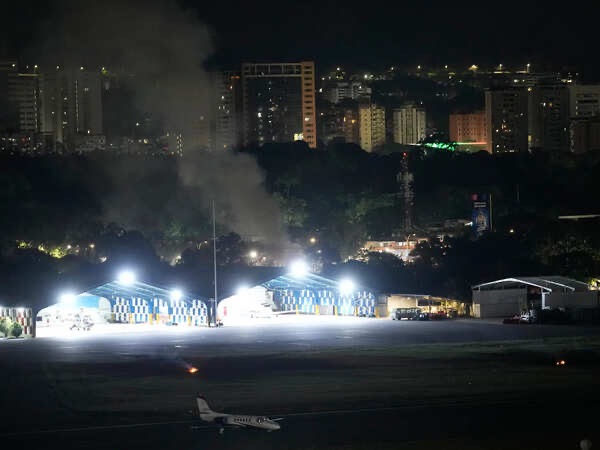
According to multiple mainstream outlets — including The New York Times, Reuters, CNN, The Guardian, and the Associated Press — residents and journalists on the ground reported between seven and twelve explosions beginning around 1–2 a.m. local time. Witnesses described flashes in the sky, plumes of smoke near major military installations, and power outages in parts of southern Caracas.
What Is Confirmed So Far
Verified reporting indicates smoke near sensitive sites such as La Carlota air base and Fort Tiuna, Venezuela’s primary military complex. Some residents also reported secondary explosions, which analysts say can indicate ammunition or fuel storage facilities being hit — though no official damage assessments or casualty figures have been released.
Multiple outlets confirm consistent reports of aircraft noise overhead. However, no mainstream media organization has identified the aircraft as belonging to the U.S. military, nor has any footage conclusively shown U.S. markings.
Social Media Claims and the “Night Stalkers” Narrative
On social media platform X, widely shared videos purport to show military helicopters flying low over the city. Many posts claim the aircraft were U.S. Army Chinooks — often incorrectly labeled “CH-67G.” Military analysts note the correct designation for the special operations variant is the MH-47G Chinook, operated by the elite 160th Special Operations Aviation Regiment, commonly known as the “Night Stalkers.”
These claims remain unverified. Most videos are dark, low-resolution, and recorded at night, making aircraft identification unreliable. Defense experts caution that helicopter sounds and silhouettes alone are insufficient to confirm nationality or unit.
No Confirmation From Washington or Caracas
U.S. officials have acknowledged awareness of the reports but have offered no confirmation or denial of airstrikes. The Pentagon, White House, and State Department have so far declined to comment. Venezuelan authorities, including officials aligned with President Nicolás Maduro, have not issued a detailed public statement explaining the cause of the explosions.
Pro-Maduro and Russian-linked outlets have claimed a full-scale U.S. invasion or amphibious operation, but these assertions have been widely dismissed by independent analysts as exaggerated and politically motivated.
Strategic Context
The incident comes amid heightened tensions between Washington and Caracas. Over the past several months, the U.S. has increased pressure on the Maduro regime through sanctions, maritime interdictions targeting alleged drug-smuggling operations, and a visible U.S. naval presence in the Caribbean. The administration has repeatedly accused Maduro’s government of narco-trafficking and regional destabilization.
If confirmed as U.S. action on Venezuelan soil, the events in Caracas would mark a significant escalation beyond prior offshore or interdiction-focused operations — with major implications for regional stability, energy markets, and relations with Venezuela’s backers, including Russia and China.
Fog of War Remains Thick
At this stage, the situation remains fluid and highly uncertain. No party has claimed responsibility, no casualties have been confirmed, and the precise cause of the explosions is unknown. Analysts warn that disinformation is spreading rapidly alongside legitimate reporting.
Republic Dispatch will continue monitoring official statements from the U.S. Department of Defense, the White House, and Venezuelan authorities as more facts emerge.
 Republic Dispatch