By Michael Phillips | Republic Dispatch
The U.S. response to China’s latest military exercises near Taiwan was deliberately restrained—but it should not be mistaken for indifference.
In a brief January 1 statement, the U.S. Department of State, speaking through Principal Deputy Spokesperson Thomas Pigott, urged Beijing to cease military pressure, exercise restraint, and return to dialogue. The message reaffirmed long-standing U.S. policy: support for peace and stability across the Taiwan Strait and opposition to unilateral changes to the status quo by force or coercion.
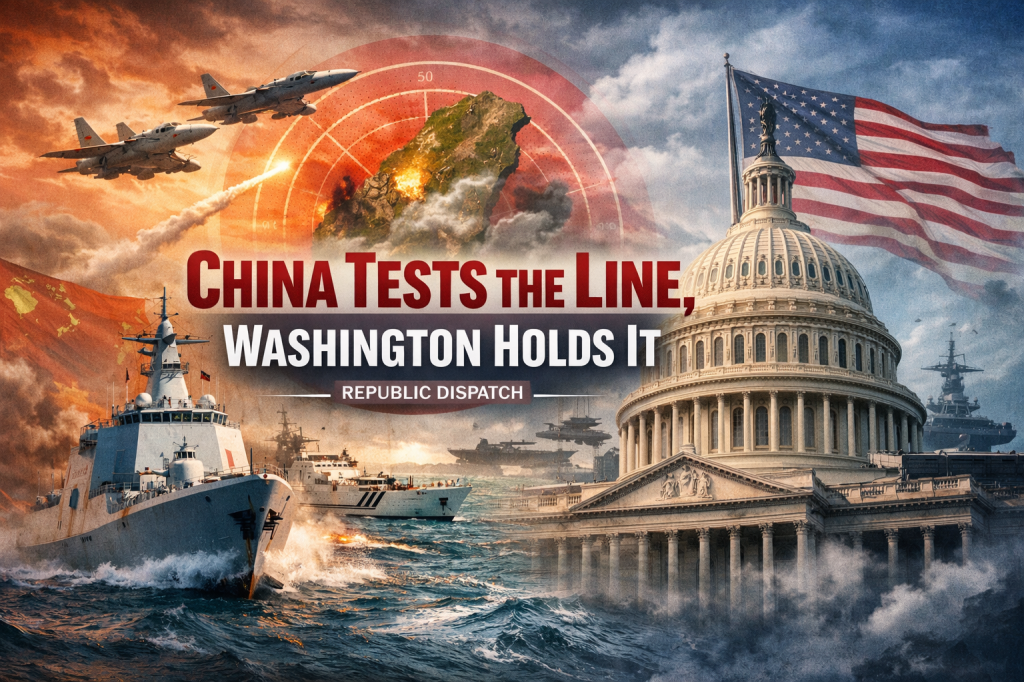
The timing matters. The statement followed China’s largest and most explicit military drills around Taiwan to date—“Justice Mission 2025”—conducted December 30–31. These were not symbolic flyovers. They were operational rehearsals.
What Beijing Actually Practiced
China’s People’s Liberation Army deployed a multi-domain force—naval, air, rocket, ground, and coast guard—simulating a blockade of Taiwan’s major ports, energy interdiction, and deterrence of outside intervention. Live-fire rocket launches landed close to Taiwan’s contiguous zone, and flight paths were disrupted across the region, affecting tens of thousands of civilians.
Just as notable was the integration of the China Coast Guard, signaling a preference for “gray-zone” coercion: quarantine-style enforcement actions that stop short of declared war while strangling trade and energy imports. This is a lower-risk, lower-threshold strategy—far more plausible than a full amphibious invasion.
In short, Beijing wasn’t rattling sabers. It was running scenarios.
Why Washington’s Calm Was Intentional
Critics often complain that measured statements project weakness. In reality, the State Department’s language reflects strategic discipline. The U.S. has no interest in validating Beijing’s narrative that external forces are driving escalation. Nor does it benefit from rhetorical overreaction that narrows diplomatic off-ramps.
At the same time, restraint does not equal concession. The U.S. arms package to Taiwan—reportedly exceeding $11 billion—signals continued commitment to deterrence. President Trump’s public comments downplaying invasion risk reflect a transactional, deal-first posture, not abandonment. Strategic ambiguity remains the policy—not paralysis.
The Underreported Risk: Blockade Over Blitzkrieg
Most coverage fixates on invasion timelines. The more immediate risk is economic coercion. Taiwan imports roughly 97 percent of its energy. A sustained maritime quarantine—enforced by coast guard vessels rather than destroyers—could grind the island’s economy without triggering an automatic military response.
That reality explains both Beijing’s confidence and Washington’s caution. A blockade challenges alliance cohesion, tests political will, and exploits legal gray areas. It is exactly the kind of pressure campaign the PLA appeared to rehearse last week.
A Center-Right Reality Check
From a center-right perspective, two truths must be held at once.
First, China is the clear aggressor. Simulating blockades, firing rockets near civilian airspace, and intimidating a democratic neighbor are not defensive acts. They are coercive by design.
Second, deterrence works best when paired with discipline. Reckless rhetoric, symbolic provocations, or abandoning strategic ambiguity would make conflict more likely—not less. Peace through strength requires strength and judgment.
The State Department’s statement was not meant to dominate headlines. It was meant to hold the line—quietly, firmly, and without giving Beijing exactly the confrontation it wants.
That may be unsatisfying to those craving tougher talk. But in the Taiwan Strait, steadiness is strategy.
 Republic Dispatch