By Michael Phillips | Republic Dispatch
The Trump administration is sharply escalating pressure on Venezuela’s authoritarian government, signaling a more aggressive phase in Washington’s long-running confrontation with President Nicolás Maduro following the country’s disputed 2024 election.
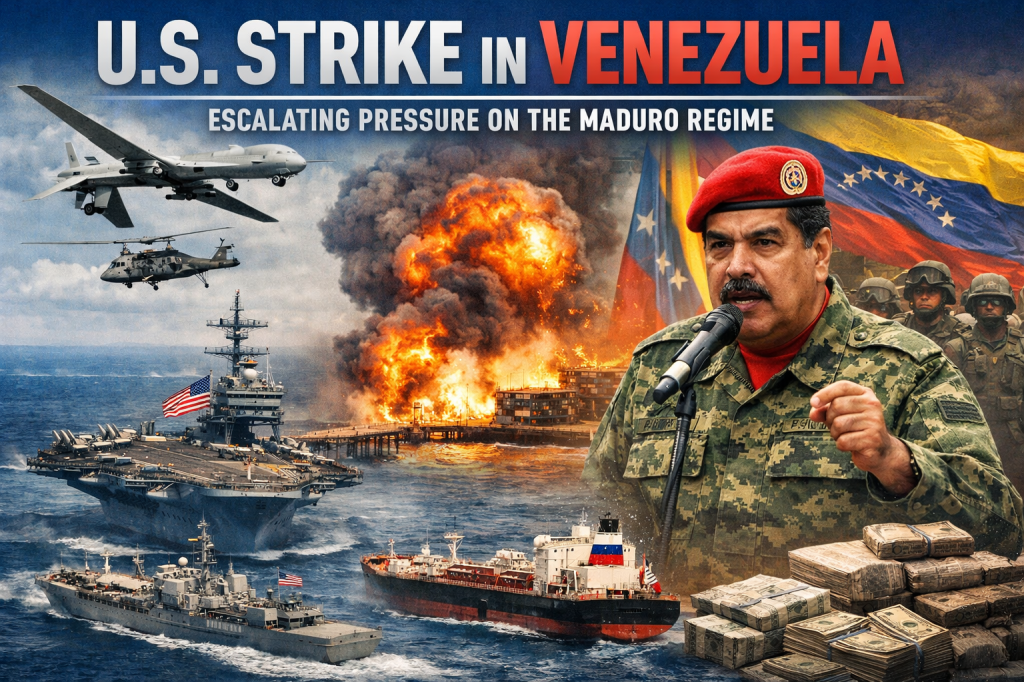
According to a December 30 report aired on PBS NewsHour, U.S. intelligence agencies carried out a covert drone strike inside Venezuelan territory earlier this month, targeting a coastal facility allegedly tied to international drug trafficking. The strike—reportedly conducted by the CIA—marks the first known U.S. attack on Venezuelan soil during this campaign and represents a significant escalation beyond prior interdictions in international waters.
A Shift From Containment to Direct Pressure
President Donald Trump publicly referenced the strike in late December, describing it as a blow against infrastructure used to load narcotics onto boats bound for international markets. U.S. officials assert the facility was linked to Tren de Aragua, a Venezuelan criminal organization designated by Washington as a foreign terrorist group and increasingly blamed for transnational crime and migrant-related gang activity.
The reported strike follows more than 30 U.S. interdictions of suspected drug-trafficking vessels in the Caribbean and eastern Pacific since September, as well as the seizure of Venezuelan oil tankers accused of violating sanctions. The administration has also ordered the largest U.S. naval buildup in the Caribbean in decades, underscoring its intent to apply sustained military and economic pressure without launching a conventional invasion.
Supporters of the strategy argue it reflects a long-overdue shift from symbolic sanctions to tangible enforcement.
The Case for Aggressive Action
Former Trump administration Venezuela envoy Elliott Abrams, now affiliated with the Council on Foreign Relations, defended the approach during the PBS segment. Abrams argued that cutting off illicit revenue streams—particularly drug trafficking—could destabilize Maduro’s inner circle and force meaningful political change.
With more than eight million Venezuelans having fled economic collapse and repression, proponents say the regime’s survival depends on external cash flows, oil smuggling, and criminal networks. Weakening those pillars, they argue, could accelerate internal pressure leading to a negotiated exit, military defections, or a democratic transition under opposition leader Edmundo González, whom the opposition claims won the 2024 election.
From a center-right national security perspective, the campaign is also framed as a regional containment effort. The Maduro government maintains close ties with Cuba, Iran, Russia, and China—alliances that U.S. officials view as a strategic threat in the Western Hemisphere.
Legal and Strategic Concerns
Critics warn the escalation carries serious risks. Daniel Hellinger, a professor emeritus at Webster University, characterized the strike as an unlawful territorial intervention reminiscent of Cold War-era U.S. adventurism. He questioned claims that Venezuela plays a central role in major U.S. drug flows and warned that a sudden regime collapse could trigger violent instability in an already heavily armed society.
Human rights groups and international observers have also raised alarms about civilian casualties from maritime interdictions and the lack of publicly released evidence tying specific targets directly to Maduro’s government. The administration insists the operations are lawful acts of self-defense and counternarcotics enforcement, but the secrecy surrounding intelligence assessments has fueled skepticism abroad.
Maduro’s Calculated Silence
Notably, Maduro has avoided directly acknowledging the reported strike, opting instead for broad rhetoric about national defense and U.S. “imperialism.” Analysts suggest the silence is strategic—meant to avoid legitimizing U.S. action or provoking further escalation.
At the same time, Caracas has used the rising tensions to justify internal crackdowns, increased military deployments, and the arrest of dissidents labeled as collaborators or traitors. This dynamic highlights a core dilemma: external pressure can weaken authoritarian regimes, but it can also give them cover to tighten domestic control.
A Shadow War, Not an Invasion—Yet
Despite the escalation, most analysts agree the United States is not on the brink of a full-scale war with Venezuela. The current posture—targeted strikes, sanctions enforcement, naval pressure—appears calibrated to coerce rather than conquer. A ground invasion would require far greater force levels and political consensus than currently exists.
For now, the confrontation remains a high-stakes shadow war—one that reflects the Trump administration’s belief that prolonged tolerance of Maduro’s rule has failed, and that only sustained, credible pressure can alter the regime’s calculus.
Whether that pressure leads to democratic change or dangerous miscalculation remains one of the most consequential foreign-policy questions heading into 2026.
 Republic Dispatch