
By Michael Phillips | Republic Dispatch
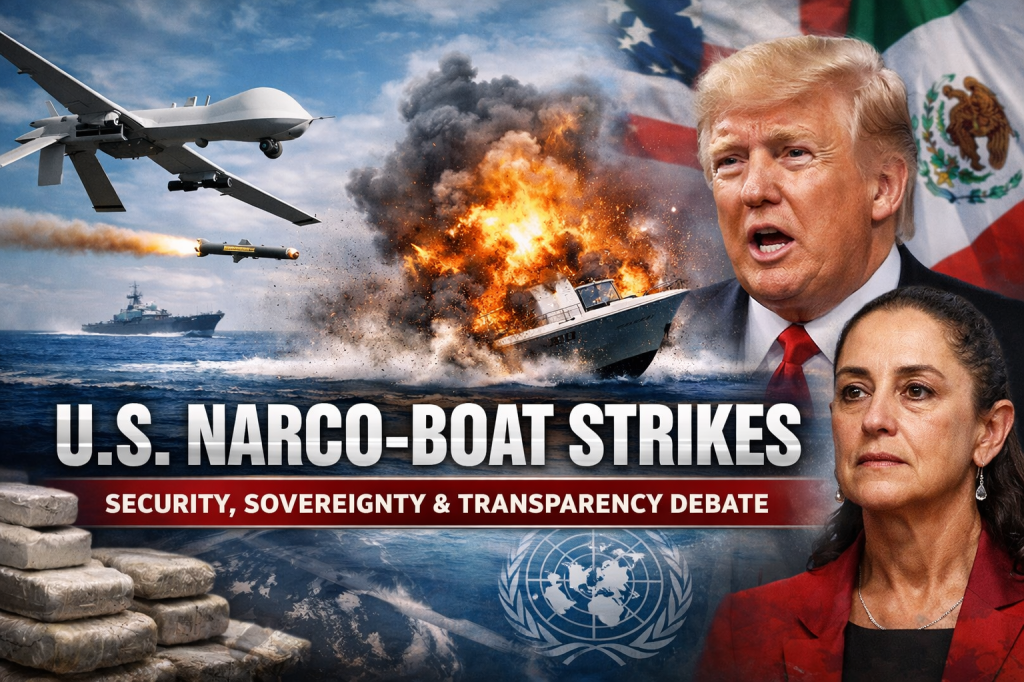
A recent report by the progressive outlet Democracy Now! has thrust renewed attention on a controversial U.S. military campaign targeting suspected drug-trafficking vessels in international waters, raising sharp questions about transparency, international law, and the limits of American power—even as supporters argue the strikes are a necessary response to transnational criminal threats.
Since September, U.S. forces operating under U.S. Southern Command have carried out dozens of airstrikes against small boats allegedly carrying narcotics in the eastern Pacific and Caribbean. According to Pentagon statements, more than 100 suspected traffickers—described as “male narco-terrorists”—have been killed across roughly 28 strike operations. The most recent incident, on December 18, involved two boats and resulted in five deaths, according to U.S. officials.
The campaign, widely referred to as Operation Southern Spear, has been justified by the administration of Donald Trump as a counter-terrorism and self-defense effort. Officials argue that designated cartels function as foreign terrorist organizations whose activities directly contribute to mass overdose deaths in the United States, particularly from fentanyl and cocaine.
The Administration’s Case: Deterrence and Defense
Defense Secretary Pete Hegseth and senior military leaders have framed the strikes as a decisive break from what they describe as years of ineffective interdiction. By destroying vessels before drugs reach land, the administration claims it is disrupting supply chains and sending a deterrent message to traffickers operating along known maritime routes.
Supporters on the center right argue that traditional law-enforcement approaches have failed to stem the flow of narcotics and that the scale of overdose deaths justifies a more aggressive posture. Some Republicans liken the strikes to post-9/11 counterterrorism operations, asserting that the president’s Article II powers provide sufficient legal authority when U.S. security is at stake.
Critics Question Evidence and Escalation
Yet even outside left-leaning media, concerns are growing about the lack of publicly released evidence supporting the Pentagon’s claims. To date, the Defense Department has released short aerial videos showing explosions but has not presented recovered drugs, vessel manifests, or independent verification that those killed were cartel operatives rather than fishermen or smugglers unconnected to terrorist activity.
International criticism has been particularly pointed. United Nations human rights officials have warned that drug trafficking, while criminal, does not automatically constitute armed conflict under international law—raising the risk that the strikes could be viewed as unlawful killings rather than legitimate acts of war.
Mexico has been especially vocal. President Claudia Sheinbaum, speaking last week, reiterated her country’s constitutional commitment to non-intervention and warned against foreign military actions in the region. While Mexico cooperates with the U.S. on maritime interdiction near its coasts, Sheinbaum has firmly rejected broader U.S. military operations, emphasizing diplomacy over force.
A Divided Center Right
While most Republicans continue to back the administration’s hard-line stance, a small but notable faction has called for greater congressional oversight. Senator Rand Paul and a handful of House members have questioned whether “double-tap” follow-up strikes on survivors cross legal or moral lines, urging classified briefings to be supplemented with clearer public accountability.
This internal tension reflects a broader center-right dilemma: how to balance an assertive national-security posture with constitutional limits, international norms, and the long-term consequences of militarizing drug enforcement.
An Unsettled Question
For now, Operation Southern Spear continues, with additional strikes reported as recently as this week. The administration maintains that the campaign is saving American lives by cutting off narcotics before they reach U.S. shores. Critics counter that without transparency and clear legal grounding, the policy risks alienating regional partners and setting dangerous precedents.
As congressional scrutiny intensifies and international pressure mounts, the debate is no longer just about drugs or boats in distant waters—it is about how far the United States should go, and what rules it should follow, when confronting transnational crime in an increasingly unstable world.
 Republic Dispatch