
By Michael Phillips | Republic Dispatch
As the war in Ukraine approaches its fourth year, U.S. efforts to broker a negotiated settlement are showing incremental movement—but no breakthrough. That was the clear message this week from Secretary of State Marco Rubio, who warned that the “hardest issues” in the Ukraine-Russia conflict remain unresolved despite recent diplomatic activity.
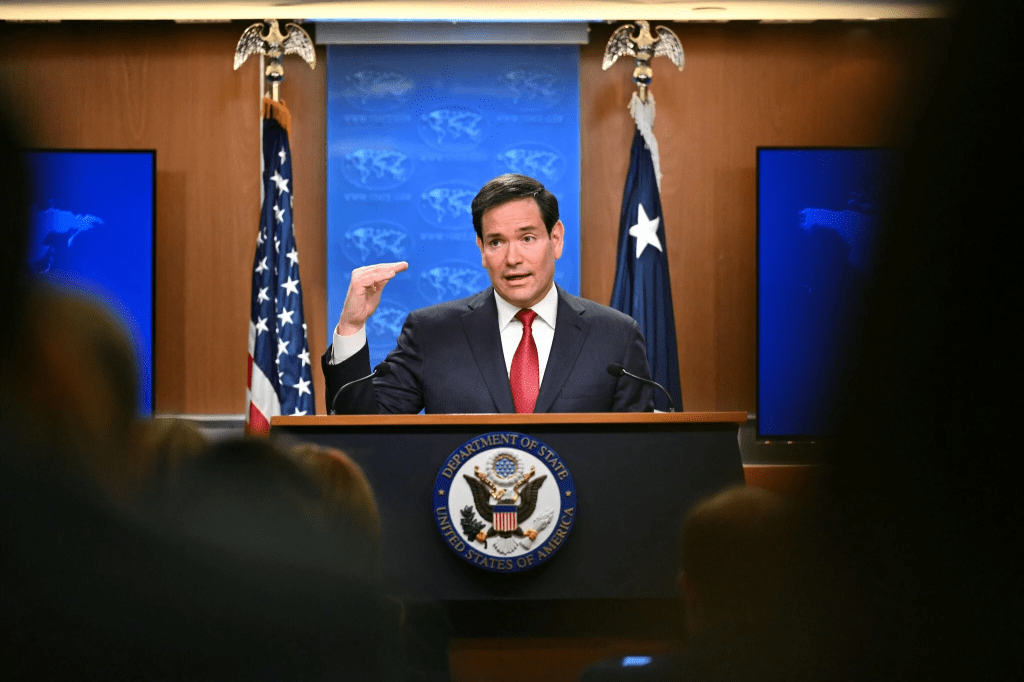
Speaking at a State Department briefing, Rubio acknowledged that discussions have made progress but stressed realism over optimism. “We’ve made progress, but we have a ways to go,” he said, underscoring that the most contentious questions—territorial control and long-term security guarantees—are still on the table.
His measured tone stood in contrast to recent statements from President Donald Trump, who said earlier this week that a peace deal was “closer than ever” following U.S.-Ukraine talks in Berlin. Rubio, by comparison, emphasized uncertainty, noting that an agreement could come “this week, next month, in a few months—or not at all.”
Donbas and Security: The Core Obstacles
According to the Politico report, two issues continue to block any path to resolution.
First is the fate of the Donbas region in eastern Ukraine. Ukrainian President Volodymyr Zelenskyy has floated the idea of converting the roughly 15 percent of Donbas still under Ukrainian control into a demilitarized “free economic zone,” rather than ceding it outright. Moscow, however, claims the entire region as Russian territory.
Russian President Vladimir Putin has made clear that Russia views the issue as settled. In a lengthy year-end press conference on December 19, Putin reiterated that any remaining Ukrainian-held territory in Donbas would ultimately be taken “by force” if necessary.
The second major hurdle is Ukraine’s demand for credible security guarantees. Kyiv insists that any peace deal must include strong, enforceable protections to prevent renewed Russian aggression. The U.S. has proposed “Article 5–like” guarantees—modeled on NATO’s mutual defense clause—but without formal NATO membership.
Russia has flatly rejected the presence of Western troops or NATO-style commitments inside Ukraine, leaving negotiators with little room to maneuver.
The U.S. as Facilitator, Not Enforcer
Rubio was careful to frame Washington’s role as a mediator rather than an imposer of terms. “What we are trying to figure out here is what can Ukraine live with and what can Russia live with,” he said, signaling that the U.S. will not dictate an outcome simply to claim a diplomatic win.
That approach reflects a broader Trump administration strategy: pushing hard for an end to the conflict while shifting the long-term burden of security and reconstruction toward Europe. European leaders have discussed leading a multinational force in Ukraine after any deal, but those plans remain contingent on Russian acceptance—something that currently appears unlikely.
Talks Continue, Expectations Tempered
Russian officials are expected to continue discussions with U.S. envoys Steve Witkoff and Jared Kushner in Miami this weekend, with Rubio indicating he may attend. Yet Putin’s recent remarks, boasting of Russian battlefield momentum and demanding that the “root causes” of the war—such as NATO expansion—be addressed, suggest Moscow is in no rush to compromise.
For now, Rubio’s comments offer a dose of realism amid heightened rhetoric. The talks are ongoing, but the gulf between Ukraine’s security needs and Russia’s maximalist demands remains wide. For concerned citizens watching the conflict, the message is clear: diplomacy is active, but peace is still far from guaranteed.
 Republic Dispatch