
By Michael Phillips | Republic Dispatch – Palmyra, Syria
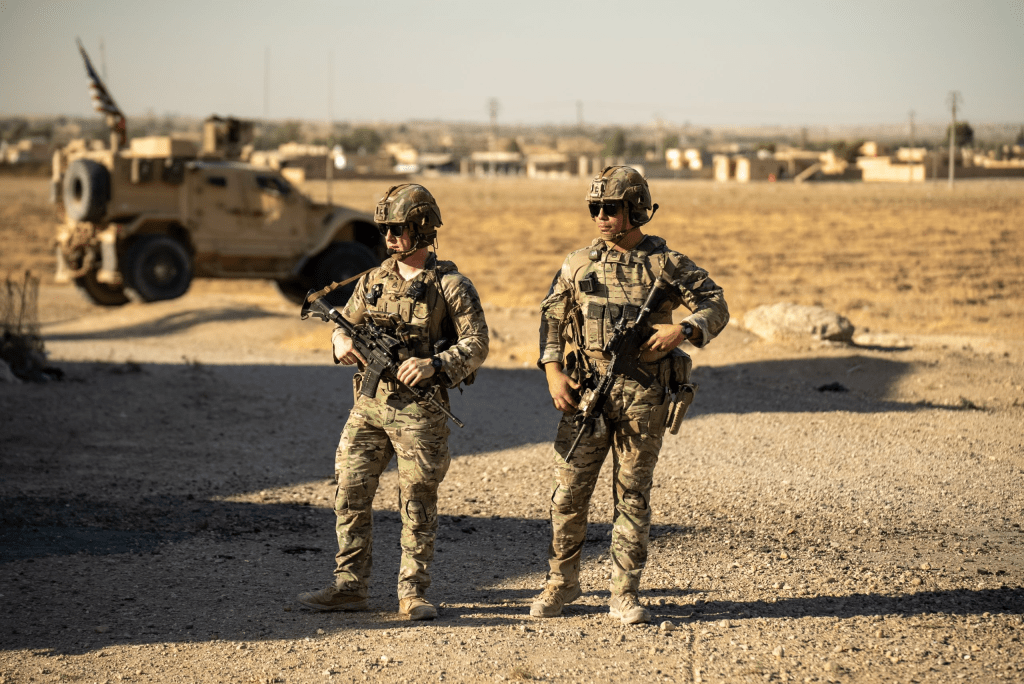
Three Americans—two U.S. Army soldiers and one civilian interpreter—were killed Friday in an ambush during a joint U.S.-Syrian counterterrorism operation in the ancient city of Palmyra, underscoring the persistent threat posed by ISIS and the risks facing U.S. forces operating alongside newly reconstituted Syrian security partners.
The attack occurred during what U.S. officials described as a joint patrol or “key leader engagement” with Syrian forces in central Syria’s Homs province. A lone gunman opened fire at close range, killing the Americans and wounding three additional U.S. service members, along with two Syrian security personnel. The attacker was killed on the scene by Syrian partner forces.
U.S. helicopters evacuated the wounded Americans to the al-Tanf garrison, while U.S. aircraft conducted a visible show of force over the area, including low-altitude flights by F-16s and A-10s.
President Donald Trump swiftly attributed the attack to ISIS, calling it an “ISIS attack against the U.S. and Syria” and pledging “very serious retaliation.” Defense Secretary Pete Hegseth echoed that message, warning that those who target Americans would be “ruthlessly hunted down.”
“This happened in a very dangerous part of Syria that is not fully controlled,” President Trump said, adding that Syria’s interim president, Ahmed al-Sharaa, was “extremely angry and disturbed” by the attack.
Insider Threat Raises Red Flags
While ISIS has not formally claimed responsibility, U.S. officials say initial assessments point to an ISIS-linked or ISIS-inspired attacker. More troubling, Syrian authorities confirmed the gunman was himself a member of Syria’s security forces under the new post-Assad government.
According to Syrian officials, the attacker had been flagged just days earlier, on December 10, for suspected extremist views and was reportedly scheduled for dismissal on December 14—one day after the ambush. Several additional suspects were arrested in follow-up raids in Palmyra.
This insider threat aspect has received less attention in early coverage but raises serious questions about vetting standards within Syria’s transitional security apparatus, which includes former rebel elements absorbed after the fall of Bashar al-Assad’s regime in late 2024. For U.S. forces, the incident highlights a familiar and dangerous “green-on-blue” risk seen previously in Iraq and Afghanistan.
First U.S. Fatalities Since Assad’s Fall
The ambush marks the first U.S. combat deaths in Syria since 2019 and the first since the collapse of Assad’s regime. Roughly 2,000 U.S. troops remain deployed in Syria as part of efforts to prevent an ISIS resurgence, working in coordination with Syrian and coalition partners.
The attack also comes amid growing concern about ISIS’s continued strength. Recent United Nations estimates suggest between 5,000 and 7,000 ISIS fighters remain active across Syria and Iraq, with attacks increasing in areas outside firm government control, including the central Syrian desert region known as the Badiya.
Palmyra, while symbolically reclaimed from ISIS years ago, remains a volatile area—far from the more secure northeastern regions where U.S. forces typically operate.
American Lives Lost
One of the fallen soldiers was identified by family as William Nathaniel “Nate” Howard, 29, of Marshalltown, Iowa, an Iowa Army National Guard member with more than 11 years of service. Howard was the son of a local police chief and had deep ties to his community. The name of the second soldier, also from the Iowa Guard, has not yet been officially released. The civilian interpreter’s identity is being withheld pending notification.
Their deaths have begun to resonate across Iowa and beyond, putting a human face on a mission that often fades from public view.
Debate Over U.S. Presence Intensifies
The attack is already fueling renewed debate in Washington over America’s continued presence in Syria. Some critics argue that the U.S. deployment functions as a “tripwire” rather than a true deterrent, while others warn that a rapid withdrawal would invite an ISIS comeback.
From a center-right perspective, the incident reinforces several hard realities: ISIS remains a lethal threat; U.S. troops continue to pay the price of unfinished business in the Middle East; and partnerships with transitional governments—however necessary—carry serious risks when security vetting is incomplete or rushed.
For now, U.S. officials say the mission continues, investigations are ongoing, and retaliation against ISIS networks is likely to be targeted rather than indiscriminate. But the Palmyra ambush stands as a stark reminder that even after regime change, stability in Syria remains fragile—and American forces remain in harm’s way.
 Republic Dispatch