By Michael Phillips
In 2020, New York launched a supposedly groundbreaking oversight office designed to hold police accountable: the Law Enforcement Misconduct Investigative Office (LEIMIO), housed within the Attorney General’s Office under Executive Law § 75.
By 2021, the New Rochelle Police Department (NRPD) began sending formal referrals about Officer Lane Schlesinger—a known repeat offender, flagged by internal affairs, restricted from court appearances, and removed from public-facing duty.
Between 2021 and 2023, at least five misconduct referrals were submitted to the AG’s office.
At least three of them included documentation, video evidence, supervisor memos, and witness reports.
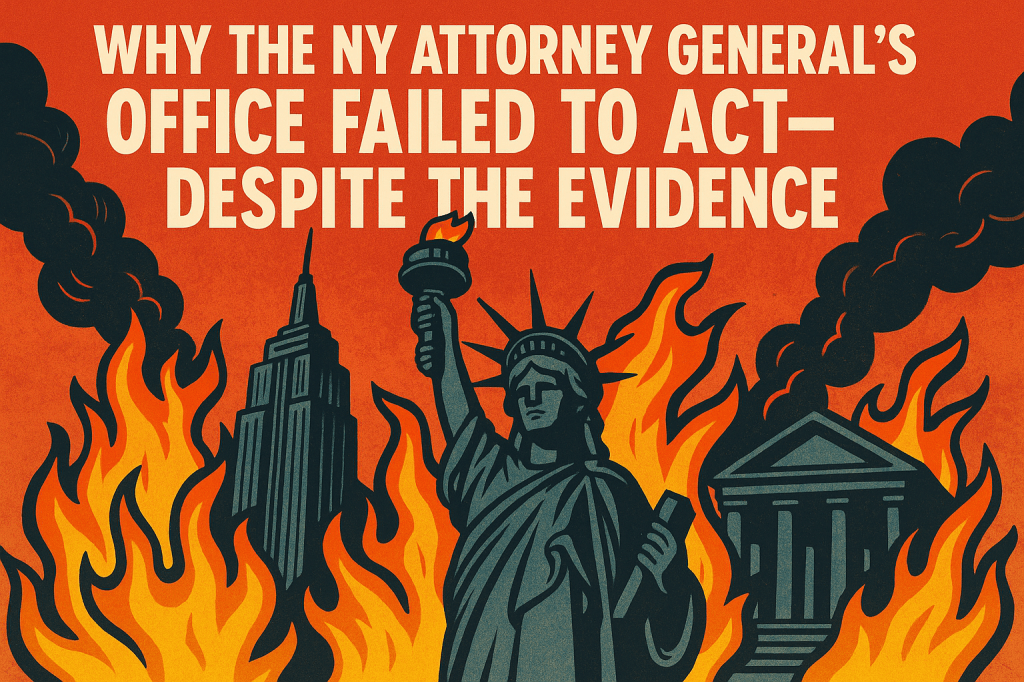
So why, in 2024, did the AG’s “pattern misconduct” report on Schlesinger omit key incidents, recommend no discipline, and shield everyone involved from further accountability?
The answer lies in institutional protection, political caution, and a willful failure to act.
The Evidence They Had
According to FOIL records reviewed by The Republic Dispatch, the Attorney General’s office had access to:
- Bodycam violations and noncompliance reports
- Sustained internal affairs complaints
- A documented breach of hospital COVID protocols in 2021
- A false arrest based on contradicted testimony and video evidence
- Referrals by Lt. Robert Wenzler, head of discipline at NRPD
- Statements from victims and officers corroborating misconduct
- A pattern of insubordination, dishonesty, and report falsification
In short: They had everything.
But still—no criminal charges, no decertification, no push to vacate wrongful convictions tied to Schlesinger’s actions.
Three Theories Behind the AG’s Inaction
1. Political Liability Management
The AG’s office may have calculated that fully exposing Schlesinger’s misconduct—especially the COVID ICU incident and the false arrest of Marc Fishman—would trigger civil litigation against:
- New Rochelle PD
- Westchester County
- The State of New York
- The DA’s Office that used Schlesinger’s testimony in court
By omitting the most egregious details, the report could claim oversight without creating legal consequences.
2. DA Relationship Preservation
Multiple victims of Schlesinger’s misconduct, including Fishman, were prosecuted by the Westchester District Attorney’s Office, led by Mimi Rocah.
The AG’s office and DA offices often share information, political alliances, and public relations priorities. Calling Schlesinger’s misconduct what it truly is—a pattern of prosecutable dishonesty—would raise serious questions about tainted prosecutions, including those still on the books.
Rather than risk implicating local DAs, the AG’s office seems to have narrowed the scope of wrongdoing to protect the legal status quo.
3. Protecting the System, Not the Public
Finally, there’s the simple truth of most government oversight bodies:
They weren’t built to challenge the system.
They were built to preserve it while appearing responsive to the public.
Letitia James’ office has made public statements about police accountability and racial justice, but her LEIMIO unit has produced only a handful of reports since its creation, many of them delayed for years and lacking follow-through.
In the Schlesinger case, the AG had a clean shot at setting precedent.
They passed.
What Was the Cost?
The cost of inaction wasn’t theoretical.
- Marc Fishman remains burdened by a wrongful conviction based on a false police report—one sworn by Schlesinger himself and filed without grand jury review.
- Hospital workers and ICU patients were endangered by Schlesinger’s reckless behavior in 2021.
- Other officers who raised concerns were demoralized and, in some cases, retaliated against.
- Public trust was eroded, once again, by the realization that government “oversight” is often a brand—not a mechanism for justice.
AG James Had a Choice
- She had evidence.
- She had witness statements.
- She had a paper trail.
- She had a high-profile officer with a retirement pending.
She could have:
- Referred Schlesinger for criminal charges
- Called for statewide pension reform for sustained misconduct
- Demanded DA reviews of convictions linked to his testimony
- Publicly exonerated victims like Marc Fishman
Instead, she signed off on a toothless, incomplete report, then closed the file.
Final Word
New Yorkers were promised accountability.
They got omission.
They were promised justice.
They got press releases.
Why did the AG’s office fail to act?
Because in New York politics, protecting the system is often the only thing that truly matters.
 Republic Dispatch
[…] 📎 Related article: Why the NY Attorney General’s Office Failed to Act Despite the Evidence (Republic Dispatch, June 1… […]
LikeLike