
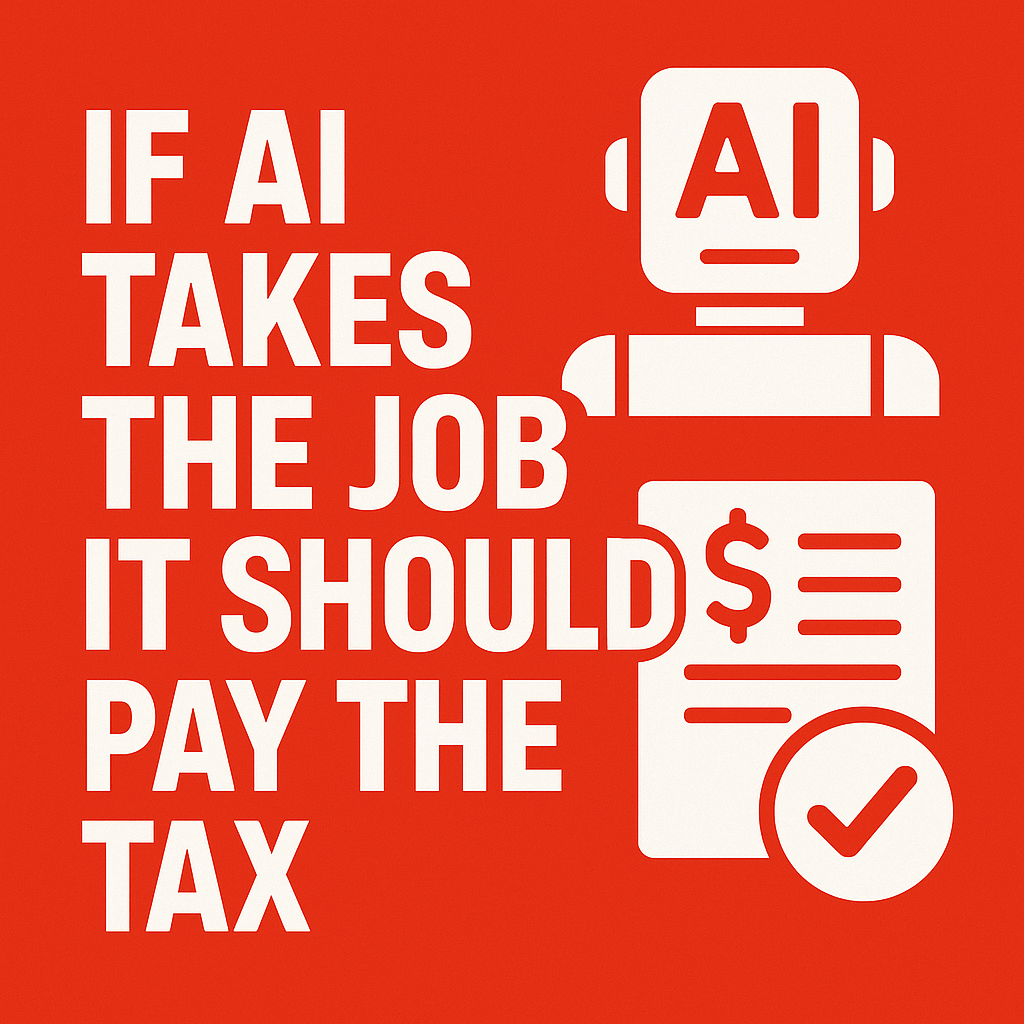
As artificial intelligence rapidly replaces human workers across industries—from call centers and copywriting to customer service and coding—a question of fundamental fairness emerges:
If human intelligence pays Social Security taxes, why doesn’t artificial intelligence?
Under current U.S. law, workers and employers each contribute 7.65% of wages to fund Social Security and Medicare. It’s a pillar of the American social contract: contribute now, receive support later in retirement, disability, or survivor benefits.
But that contract is breaking down. Not because Americans have stopped working—but because they’re being replaced by machines that don’t pay in.
When Machines Do Human Work, Humans Lose Human Benefits
Let’s say a graphic designer earning $80,000 is replaced by a subscription to an AI design tool. That designer and employer used to pay $12,240 per year in FICA taxes. But once AI steps in, that contribution vanishes.
Now imagine that happening millions of times over—in journalism, legal research, bookkeeping, translation, transcription, customer service, diagnostics, and education. The jobs go away. So does the funding.
The AI doesn’t file a W-2. It doesn’t pay into the system. It doesn’t retire, get sick, or raise kids. It doesn’t contribute to a safety net that it will never need.
Yet it benefits from everything that system made possible: infrastructure, the internet, a trained workforce, and the legal protections that allow companies to deploy it without consequences.
This isn’t innovation. It’s extraction.
A Simple Solution: AI-Payroll Parity
We propose a straightforward policy:
If AI replaces a human worker, it should pay the same Social Security tax that the worker would have.
This isn’t about slowing innovation—it’s about preserving civilization. A society that taxes only people, but not the robots replacing them, is cannibalizing its future.
Here’s how an AI-contribution model could work:
- Automated Labor Assessment
When a company replaces a job with AI, it must report the estimated market value of that role and remit FICA-equivalent taxes on that amount. - AI Payroll Tax
A 15.3% levy—mirroring the combined employee/employer FICA rate—on AI-generated labor value would go directly into the Social Security Trust Fund. - Exemption Thresholds
Small businesses could be exempt for limited use; the focus should be on large-scale automation and enterprise-level cost-cutting that eliminates workforces. - Annual AI Labor Reports
Just like employee tax filings, firms would report annual productivity metrics from AI systems replacing full-time roles.
If we don’t take steps like these, we’re heading toward a two-tiered society—one where human labor is taxed into extinction while AI labor generates untaxed wealth for a shrinking elite.
This Isn’t Anti-Tech—It’s Pro-Survival
Some critics will scream that this proposal “punishes innovation.” But it’s no more a punishment than asking humans to pay taxes is a punishment.
We’re not Luddites. We both support technological advancement—but not at the cost of the very system that sustains human life.
Social Security isn’t a luxury. It’s the bare minimum safety net. And if we let automation gut it without replacing the lost revenue, we’re not heading toward utopia—we’re heading toward feudalism with Wi-Fi.
Big Tech Gets Rich While the Safety Net Collapses
Right now, companies can lay off workers, replace them with code or bots, and pocket the difference—without contributing a dime to the system that made their success possible.
It’s time to end that free ride.
If AI can take the job, fine. But it should also take the tax bill.
Conclusion: Automation Without Obligation Is a Social Bomb
We’re not anti-progress. We’re pro-fairness. We believe in the dignity of work, the value of shared contributions, and a society that doesn’t abandon its people just because a machine can do it faster.
So let’s rewrite the rulebook.
Let’s tax AI labor the same way we tax human labor.
Let’s make the system sustainable again—for real people, not just profitable algorithms.
Because if AI takes your job but doesn’t pay your taxes, then what exactly is progress for?
Co-authored by Michael Phillips and Greg Visscher
For more on tech policy, economic justice, and how we build a society that serves people—not just platforms—follow our work and join the conversation.
 Republic Dispatch