
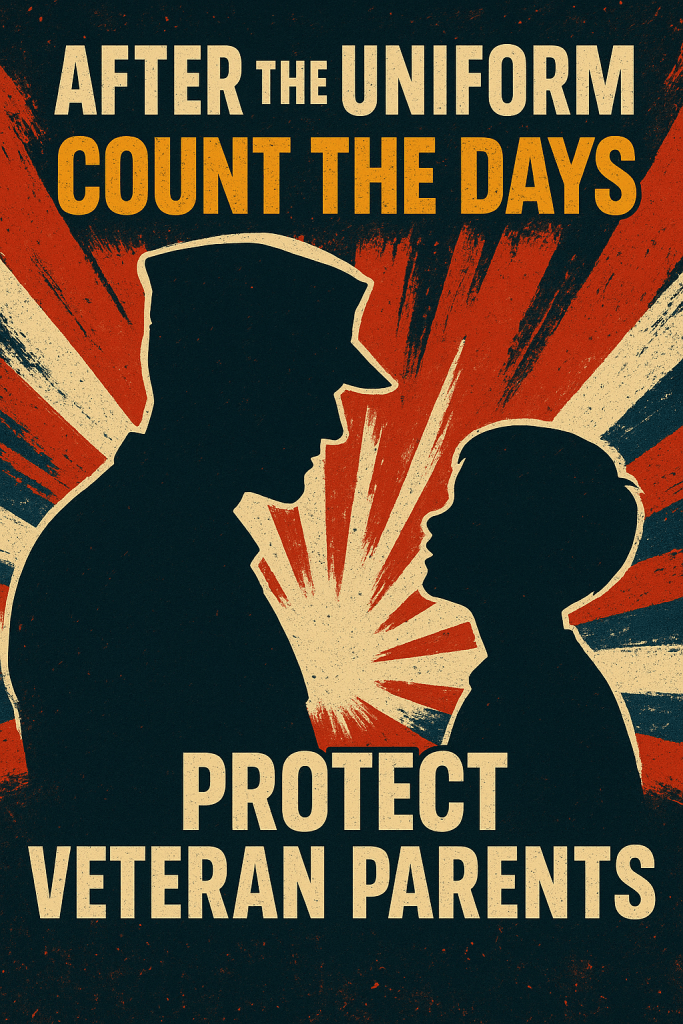
Following our Memorial Day piece on the silent battlefield of family court, I was moved by the responses—particularly one that crystallized what so many veteran parents live with every day: the brutal, measured silence of separation. One reader wrote: “Everyone knows, with precision, how long it’s been since they’ve last held their child.” That’s a line I won’t forget.
Because if there’s one thing we don’t do well in this country, it’s accounting for grief when it’s not accompanied by a headline, a flag-draped coffin, or a military funeral. We know how to honor the dead—but we struggle to protect the living.
This follow-up is dedicated to those still fighting. To the veteran parents, not only living with PTSD or physical wounds, but also the long-lasting trauma of having their parental rights stripped, ignored, or quietly erased.
“Thank You for Your Service” Rings Hollow Without Action
Let’s be blunt: if we say we support the troops, then we better support their rights when they come home. That includes their right to be a parent.
What good is a folded flag if the system folded on them first?
One reader pointed to the work of journalist Kerry Byrne, who noted that the absence of concrete data on veteran suicides tied to family court struggles is not an accident—it’s a result of systemic indifference. If we’re not counting the cost of family destruction, how can we claim to value family values?
The Clock Is Always Ticking for These Parents
There’s a haunting metric every erased parent can tell you without hesitation: “It’s been 489 days since I last saw my son.”
Or: “It’s been 3 years since I was allowed to hug my daughter.”
They know the day count because that’s how time lives in their body. It doesn’t pass—it pounds. Every milestone missed is another memory turned ghost.
So why isn’t the government keeping track?
We track Sea Duty days, deployment rotations, and even the deploy-to-dwell ratio to optimize our military efficiency. But we don’t track the cost of service when it comes to a veteran’s bond with their child?
A reader’s proposal makes this painfully clear:
“We should have Undersecretary-level offices within DoD and VA that track parent-child separation days, with the goal of minimizing them. It’s not just the veteran who serves—it’s their children too. And those children never got a choice.”
Three Bold Policy Solutions We Must Consider
Let’s put these solutions on the record—because they deserve far more attention than any empty politician’s speech about “supporting military families.”
1. Affirmative Statutory Preference for Parenting Time
There should be a legal presumption in all family law cases involving servicemember or veteran parents that favors preserving parenting time, unless there is clear and convincing evidence not to. These are parents who were separated for deployments, training, and war. They should not face further separation from their own government in a courtroom.
2. Federal Court of Appeals for Servicemember Family Rights
Create a specialized federal appellate body within the Department of Defense (or in cooperation with DOJ) tasked with mandatory review of all state court decisions involving military-connected children. State family courts operate without oversight, and many veteran parents are at the mercy of judges unfamiliar with military culture, trauma, or rights. This court could set precedent, supervise abuse of discretion, and enforce accountability.
3. Counting the Days: A Separation Metric for Veteran Families
Establish a Separation Burden Index—a metric tracked by both DoD and VA—for all military and veteran families impacted by custody loss or family court actions. This would quantify days lost to false accusations, delayed hearings, visitation interference, and court-ordered alienation. Government can’t fix what it refuses to count.
What We Measure Reveals What We Value
America knows how to count bullets, ballots, and budgets. But we don’t count the most devastating number of all—the days stolen from a parent and their child.
Until we do, Memorial Day will continue to expand—not just with those who died in combat, but with those who perished in silence. Those who served this country, then were destroyed by it in a courtroom.
We must do better. Because behind every veteran grave we honor on Memorial Day is someone who might still be alive if they had been allowed to simply be what they fought to protect: a parent.
Join the effort.
If you’re a veteran, advocate, or affected parent, share your story. Contact us to submit testimony, support legislative change, or collaborate on media efforts to bring accountability to family courts.
#CountTheDays #ProtectVeteranParents #FamilyCourtReform #YouAreNotAlone
 Republic Dispatch