
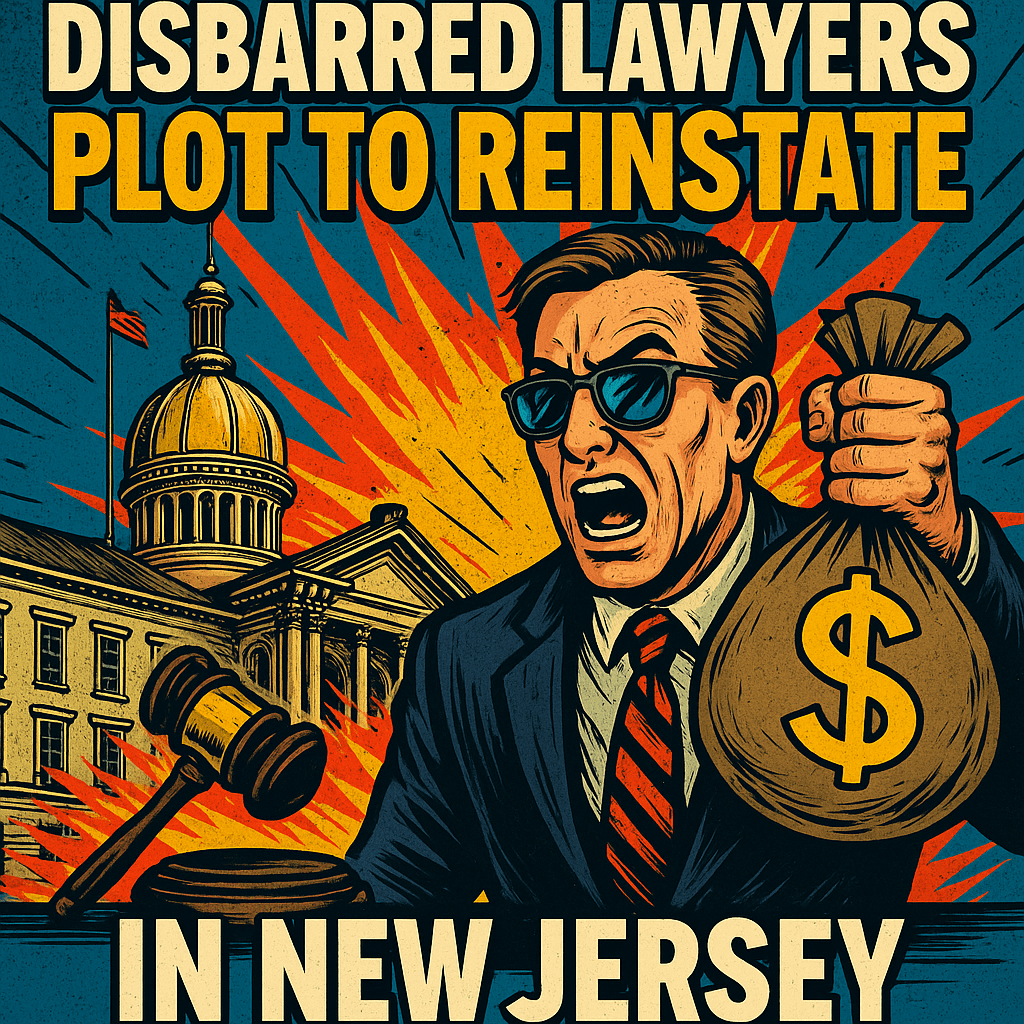
Imagine stealing thousands of dollars from a client and getting caught. Not only do you avoid prison time, but—after a few years—you’re handed a shot at getting your job back.
Now imagine being a parent who misses one child support payment, or gets falsely accused of domestic abuse—and losing your job, your child, your rights, and never getting them back.
Welcome to the legal profession in New Jersey, where double standards are the rule, not the exception.
In October 2024, the New Jersey Supreme Court quietly overturned 45 years of precedent by allowing disbarred lawyers to apply for reinstatement after a five-year waiting period. Two attorneys have already cleared the first hurdle by passing the bar exam again. These aren’t innocent rookies who made clerical errors. These are attorneys disbarred for theft, fraud, and misappropriation of client funds.
And now they’re being invited back to the table.
Who Are We Talking About?
One is Nicole Tierney, disbarred in 2007 for knowingly misappropriating more than $10,000 from clients’ trust accounts. She now works as a mental health counselor and wants her license back—not to run a full law practice, she claims, but to represent “causes she believes in” and possibly refer legal clients to her counseling practice.
The other is Layne S. Gordon, disbarred in 2011 after being convicted of second-degree theft by deception. He runs a digital advertising business now and says he misses helping clients.
Both passed the bar exam this February—two out of nine disbarred attorneys who tried.
The argument from the legal establishment is predictable:
“People change. They deserve second chances. This is a narrow and rigorous path back.”
But let’s be honest: the bar is not looking to protect the public. It’s looking to protect itself.
When Professionals Police Themselves, the Public Loses
The same system that punishes parents for missed filings, bankrupts families through prolonged litigation, and labels the falsely accused as “abusers” for life has no problem giving white-collar felons a path to return to power—as long as they’re part of the club.
It’s a rigged game, and the public is losing.
Let’s break it down:
- Most people disbarred were disbarred for theft—of client funds, of partner money, of public trust. In any other profession, that’s career-ending.
- The victims? Forgotten. Swept aside while former lawyers build redemption narratives about wanting to “help the underserved” or “get closure.”
- The public interest? Apparently satisfied with a bar exam and a few CLE courses.
- The judiciary? Silent, complicit, and happy to let time wash away the damage.
Meanwhile, ordinary Americans who make far less egregious mistakes are locked out of systems forever.
A Tale of Two Justice Systems
Let’s compare:
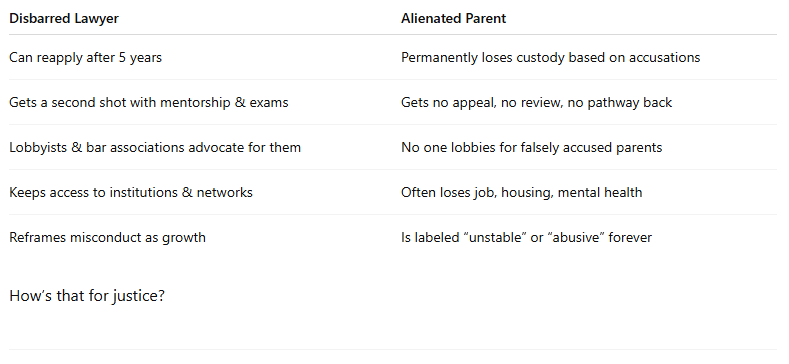
How’s that for justice?
The Real Problem: Professional Immunity
The most dangerous part of this ruling isn’t just that disbarred lawyers are getting a second shot. It’s that it reveals how elite professions shield their own while holding everyone else to impossible standards.
In New Jersey, a parent who challenges the system is punished. A pro se litigant is mocked. A disabled litigant is ignored. A traumatized veteran is erased.
But a lawyer who stole from clients?
Just wait it out, retake the test, say the right things—and you’re welcome back.
It’s not rehabilitation. It’s a license to keep stealing—this time with better PR.
What Needs to Happen
We need to stop treating the legal profession like it’s a sacred priesthood. It’s a job. One that holds tremendous power—and should require tremendous accountability.
If New Jersey insists on reinstating disbarred attorneys, then the public must demand:
- Full transparency of every reinstatement application
- Victim testimony and community impact reviews before reinstatement
- Automatic public hearings for disbarred applicants
- Prohibitions on reinstated attorneys profiting from their prior misconduct
- And an independent civilian review board—not the bar association—overseeing reinstatement decisions
Because if we don’t?
The message is clear: You can steal from clients, betray the court, and walk back into power. But if you’re a parent, a veteran, or just an everyday citizen—you’ll never recover from a single false step.
One Last Thought
This ruling doesn’t just offend justice. It reeks of class privilege.
It’s a message to every disillusioned parent, every falsely accused partner, every wrongfully convicted individual:
“The rules don’t apply to us the way they apply to you.”
And until we expose it, challenge it, and change it—that stink will only grow stronger.
Michael Phillips is the founder of REBUILT and the editor-in-chief of The Republic Dispatch and Father & Co., where he writes about family court reform, legal injustice, and systemic abuse with the voice of a survivor and the heart of a journalist.
Author’s Note:
Special thanks to Bruce Eden whose research, caselaw review, and personal insight into family law helped shape the foundation of this article. Your work continues to educate and inspire those fighting for transparency and reform. Bruce is the Director of Dads Against Discrimination (DADS)–NJ & NY.
 Republic Dispatch