Welcome to Corporate Rule
When the Berlin Wall fell and the Cold War ended, Americans were told democracy had triumphed. What they weren’t told was that a new empire was already forming — not built by nations, but by corporations. In the decades that followed, private companies would quietly replace traditional government functions: fighting wars, running prisons, gathering intelligence, even managing diplomacy. All under the banners of “efficiency,” “freedom,” and “privatization.”
But the real story was far darker.
By the 2000s, the rise of private contractors had created a new world order — one where loyalty belonged to profit, not the public.
Part 1: From Soldiers to Mercenaries
September 11, 2001 changed everything. As America launched its “War on Terror,” the Pentagon quickly realized it couldn’t deploy fast enough with its existing force structure. The solution? Outsourcing.
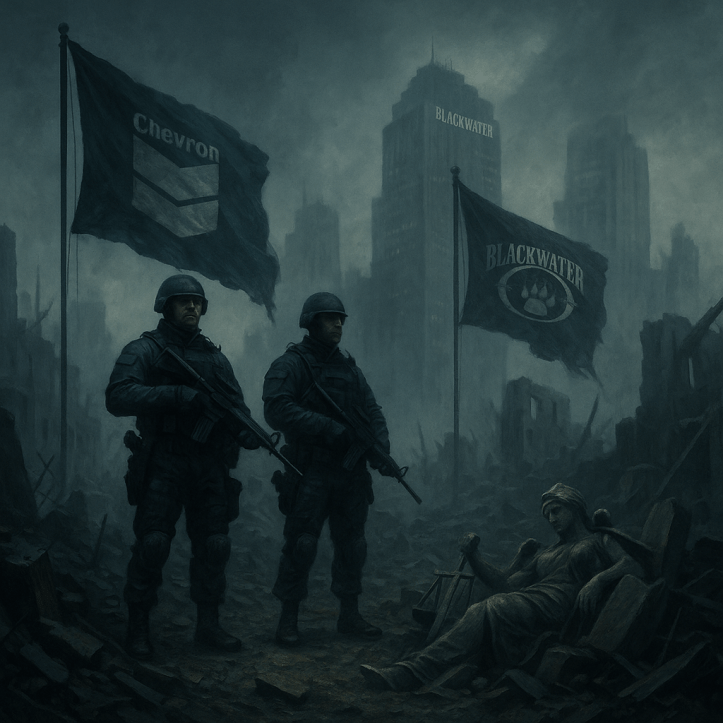
Private military contractors like Blackwater USA (later rebranded as Academi) exploded into prominence. These companies:
- Provided armed security for U.S. diplomats.
- Conducted covert operations.
- Trained foreign militaries and police forces.
By 2007, there were more contractors than U.S. soldiers in Iraq.
And these contractors operated with near-total immunity. When Blackwater operatives killed 17 Iraqi civilians in Nisour Square in 2007, it sparked outrage — but little accountability. Private forces had become “warlords for hire,” operating outside both U.S. and international law.
Part 2: The Prison Industrial Complex Goes Global
While private prisons boomed in the 1990s, the 2000s saw companies like GEO Group and CoreCivic expand beyond domestic incarceration.
They moved into:
- Immigration detention centers.
- Overseas prison management contracts.
- Surveillance and monitoring services for parole and probation.
The model was simple: lock more people up, for longer, at higher daily rates — with taxpayer money footing the bill.
Under the guise of “efficiency,” these companies created systems where human beings became commodities, and justice became secondary to profitability.
Part 3: Corporate Intelligence – Spying for Profit
After 9/11, the U.S. government massively expanded its intelligence gathering. But much of this wasn’t handled by the CIA or NSA directly.
Instead, companies like Booz Allen Hamilton, SAIC, and CACI International took over key roles:
- Data collection and analysis.
- Cybersecurity operations.
- Surveillance program development.
When Edward Snowden revealed the existence of the NSA’s mass surveillance programs in 2013, he wasn’t a government employee.
He worked for Booz Allen Hamilton.
Private companies had become the new intelligence agencies — with less oversight, greater profits, and little to no public accountability.
Part 4: The New Colonialism – Corporate Empire Building
The privatization wave didn’t stop at America’s borders.
Around the world, U.S.-based corporations began taking over critical infrastructure projects:
- Water systems.
- Electrical grids.
- Oil and mineral extraction.
- Ports and shipping lanes.
Through “public-private partnerships” and World Bank-backed projects, corporations secured control over resources that once belonged to sovereign nations.
In many cases, these deals were enforced not by diplomacy, but by private security forces — effectively corporate armies operating on foreign soil.
Part 5: The Death of Democratic Oversight
Everywhere you looked, public functions were being outsourced to private entities:
- Prisons.
- Police equipment procurement.
- Military logistics.
- Healthcare (via Medicare contractors).
- Education (via charter school corporations).
And with each outsourcing, a layer of public accountability disappeared.
Elected governments became little more than middlemen, brokering deals between corporations and the people they were supposed to serve.
Citizens lost the ability to meaningfully influence policies that shaped their lives. Real power shifted into boardrooms, not voting booths.
Early-Stage Feudalism, Not Late-Stage Capitalism
The truth is, we are not simply living in “late-stage capitalism.”
We are living in the early stages of neo-feudalism — a system where loyalty is owed to private power, not public good; where justice is sold to the highest bidder; where wars are fought for corporate contracts, not national defense.
And unless citizens reclaim the tools of governance, transparency, and public accountability, the new warlords will rule not just the battlefields, but every corner of human life.
Because they already do.
And they have for decades.
(This investigative report is part of an ongoing series examining the privatization of American governance and the hidden networks of power that profit from it.)
 Republic Dispatch