
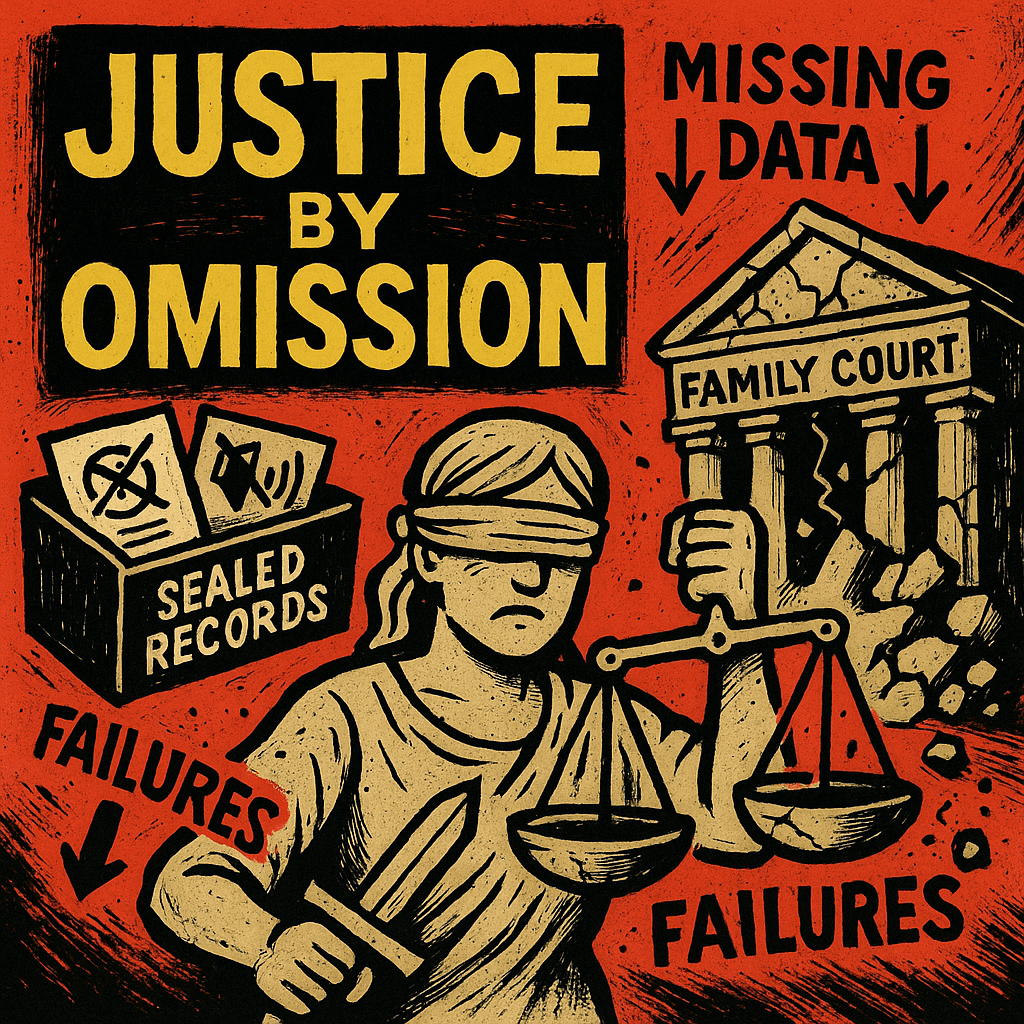
In family court, the most dangerous lies aren’t always the ones spoken aloud.
They’re the ones buried in silence, wrapped in sealed records, and erased from the data we’re told to trust.
If The Survivorship Bias of Family Court taught us anything, it’s that we cannot measure the system’s effectiveness by the parents who “make it out alive.” The survivors do not tell the whole story. But what makes it worse is this: family court doesn’t just ignore the evidence of failure — it actively hides it.
This isn’t just bias.
It’s omission as policy.
What’s Missing — and Why It Matters
Ask your local court system for the following:
- How many protective orders were later dismissed as false or unproven?
- What percentage of custody decisions are reversed on appeal?
- How often does the same judge deny motions from one party while granting all motions for the other?
- How many parents are alienated from their children for more than six months?
- How many unrepresented litigants lose custody without ever getting a trial?
You won’t get answers. Not because the data is unclear — but because it’s never been collected.
That’s not a bug. That’s the design.
Family court thrives on anecdotal justification and vague language like “the best interest of the child” while refusing to implement metrics of success or accountability. If it tracked its own damage, it would have to answer for it.
Instead, it erases the very proof of its failures — one sealed record, one denied motion, one gag order at a time.
Omission Is the Ultimate Defense Mechanism
In corporate America, when something fails, there’s a postmortem. A debrief. Data. Metrics. Audits. Root cause analysis.
In family court? There’s none of that.
No audits of judges who never grant motions from fathers.
No review boards for therapists weaponized as “experts” with no real oversight.
No recourse when a custody evaluator uses a parent’s disability diagnosis to justify alienation.
No investigation into why thousands of parents report identical stories of being erased from their child’s life without cause.
You cannot reform what you refuse to examine.
And family court refuses to examine itself.
Why Would a System Hide Its Own Failure?
Because the entire structure depends on a carefully curated image:
- An image of fairness.
- An image of neutrality.
- An image of resolution.
But the truth is often the opposite.
Behind the scenes, parents are coerced into settlements they don’t want, denied access to evidence, or forced into costly “reunification” programs just to see their own children. Some judges rely on personal biases and unchecked discretion more than any law on the books. And when things go wrong — when a parent is falsely accused, bankrupted, or loses a child they love — the records are sealed. The transcripts are denied. The cries for help are framed as aggression.
There is no record of the system failing, because failure has been made unrecordable.
The Silence Is Strategic
It’s no accident that family court cases are often “confidential,” even when the parties want transparency.
Confidentiality is used as a shield for misconduct and a sword against the powerless. It prevents public scrutiny of abusive rulings. It protects unethical attorneys and biased evaluators. It gives judges impunity to behave more like arbitrators than constitutional officers.
And it allows those in power to say:
“See? There’s no evidence of widespread problems.”
Because they’ve made sure there’s no evidence at all.
What Needs to Change
To fix family court, we must first force it to look at what it has tried hardest not to see.
Here’s how:
- Mandate public reporting of key family court metrics — including case outcomes by party representation, gender, disability status, and judge.
- Create independent oversight boards to audit judges, GALs, custody evaluators, and court-appointed therapists.
- Open the books on sealed cases where parties allege judicial misconduct or civil rights violations.
- Require courts to track motion data — who is filing, who is winning, and which judges are ruling in patterns.
- Empower litigants to file grievances that are actually investigated — not automatically dismissed.
Until we do this, family court will continue to claim it’s working — because it has scrubbed the crash sites clean.
The Data Is the Canary
We don’t need more reform panels run by insiders.
We need a reckoning.
Because the parents who disappear from their children’s lives — not by choice, but by court order, coercion, or bias — are the missing data points in a system built on selective memory.
They’re the bullet holes in the engine.
And unless we look there, we will never know why so many families never make it home.
About the Author:
Michael Phillips is a writer, investigative journalist, and advocate for family court reform. He is the founder of Father & Co. and REBUILT, platforms dedicated to exposing systemic injustice, supporting erased parents, and rebuilding lives after trauma.
 Republic Dispatch