While the media obsessed over courtroom dramas, campaign clashes, and social media feuds, a monumental shift in executive power quietly occurred last Friday—one that could fundamentally reshape the balance between the American people and their government.
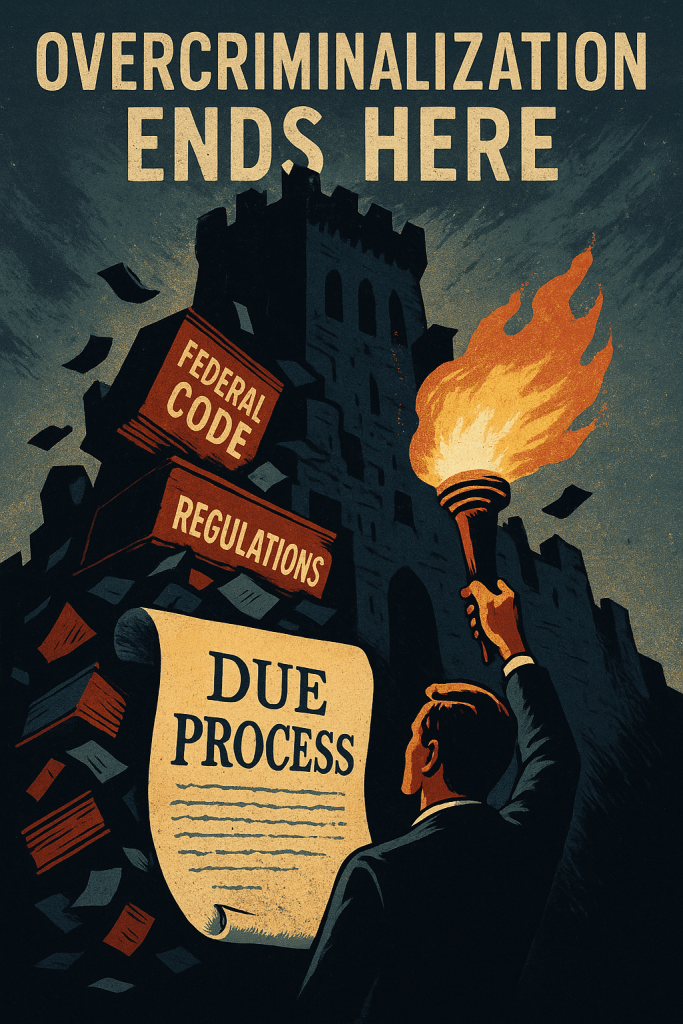
On May 10, 2025, President Donald Trump signed an executive order titled “Fighting Overcriminalization in Federal Regulations.” Despite its far-reaching implications, it received little public attention. But make no mistake: this order may be one of the most consequential legal reforms in modern U.S. history—especially for those who believe America’s “fourth branch” of government, the administrative state, has grown dangerously powerful.
The Problem: Americans Can Be Prosecuted for Breaking Rules They Never Knew Existed
America’s federal regulatory system is massive—over 175,000 pages long, with more than 48,000 sections scattered across dozens of agencies. Many of these rules carry criminal penalties. And in many cases, intent doesn’t matter.
You can be convicted of a federal crime without even knowing you broke a rule—simply because an unelected agency wrote it down and published it somewhere in the Federal Register. That’s not just inefficient government. Critics argue it’s a violation of due process.
As Laura Powell, attorney and founder of Californians for Good Governance, put it:
“This lack of clarity violates the due process requirement of fair notice… The administrative state functions as an unaccountable fourth branch, bypassing Congress’s legislative authority.”
What the Order Does: Transparency, Intent, and Accountability
Trump’s executive order does three things:
- Demands Transparency: All federal agencies must publicly identify any regulations that carry a criminal penalty—within 365 days.
- Requires Intent: It disfavors prosecuting Americans who violate regulations unknowingly, shifting focus to cases where individuals clearly acted with bad intent.
- Calls for Legislative Restraint: It signals a return to constitutional norms, emphasizing that laws—especially criminal ones—should be clear, limited, and passed by elected officials, not bureaucrats.
The executive order also echoes a warning from James Madison himself:
“It will be of little avail to the people that laws are made by men of their own choice if the laws be so voluminous that they cannot be read, or so incoherent that they cannot be understood.”
Why It Matters: The War on the Administrative State
For decades, both libertarians and constitutional conservatives have argued that the federal regulatory system operates like an extra-constitutional government—issuing rules with the force of law, enforcing them with criminal penalties, and bypassing the checks and balances of Congress.
This order doesn’t dismantle that system—but it kneecaps its most dangerous feature: the ability to punish citizens without clear laws or criminal intent.
Libertarian Party Chair Steven Nekhaila praised the move:
“This is a commendable step toward restoring individual liberties and curbing governmental overreach… But it must be the beginning, not the end.”
The Media Missed the Moment—But the People Shouldn’t
Despite its gravity, this executive order flew under the radar. Few headlines. No prime-time debates. No viral Twitter threads. In the 24/7 chaos of American politics, it’s easy to overlook quiet reforms—especially when they restore freedom rather than expand power.
But make no mistake: this is a shot across the bow of the administrative state.
By demanding clarity, transparency, and intent, Trump’s order reminds Washington—and the public—that the rule of law must serve the people, not entrap them. It’s a legal philosophy rooted in constitutional restraint—and a long-overdue pushback against bureaucratic overreach.
Whether it stands the test of time, or a future administration reverses course, remains to be seen. But for now, a major lever of unaccountable power just got checked.
And few even noticed.
Support Independent Journalism That Fights for Accountability
If this kind of reporting matters to you—cutting through the noise, exposing power, and defending liberty—consider supporting my work.
Your donation helps keep independent writing alive, ad-free, and fearless.
➡️ Click here to donate and fuel the mission.
Thank you for reading. Your voice—and your support—makes all the difference.
 Republic Dispatch