By Republic Dispatch Staff
The opening ceremony of the 2026 Winter Olympics was intended to showcase unity through culture, sport, and pageantry. Instead, it unfolded against a backdrop of political protest, diplomatic sensitivity, and growing public unease—both inside the stadium and across the host city.
Protests Target U.S. Immigration Enforcement Presence
On Friday, a series of protests took place in Milan’s city center, with additional demonstrations planned throughout the weekend. The protests were aimed at opposing the presence of analysts from a U.S. government department that falls under U.S. Immigration and Customs Enforcement (ICE).
Demonstrators accused the Olympic security framework of quietly importing controversial U.S. immigration enforcement practices into Europe. The claims quickly gained traction on social media, despite limited factual grounding.
Italy’s government pushed back strongly, calling the controversy unfounded.
Officials emphasized that no ICE agents were operating on Milan’s streets during the Games and that any U.S. personnel present were limited to analysts from Homeland Security Investigations working out of U.S. diplomatic missions—standard practice during large international events.
The U.S. Olympic and Paralympic Committee also issued a statement clarifying that no ICE personnel were providing security for Team USA.
Stadium Moment Highlights Diplomatic Friction
The protests outside the stadium were mirrored by a tense moment inside it.
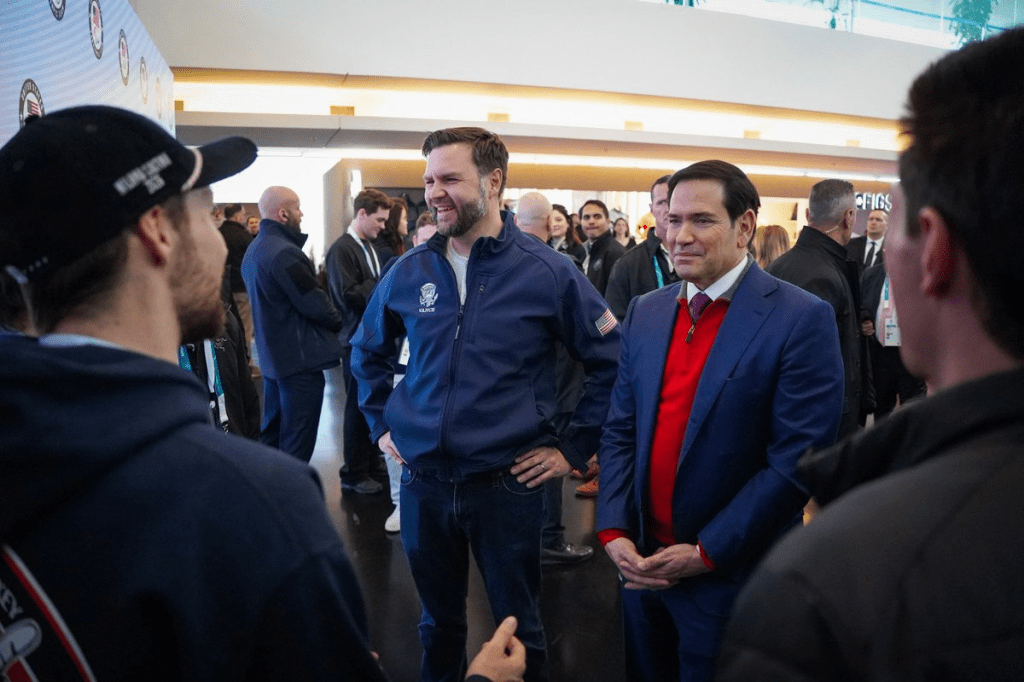
U.S. Vice President JD Vance and Secretary of State Marco Rubio were among those attending the opening ceremony at Milan’s iconic soccer stadium for Armonia (“Harmony”), a three-and-a-half-hour performance designed to celebrate cultural unity.
When an image of Vice President Vance waving the U.S. flag appeared on the stadium’s big screen, sections of the crowd responded with audible jeers. The reaction contrasted sharply with the ceremony’s theme and underscored the sensitivity surrounding U.S.–European relations.
Vance has been openly critical of Europe on issues including defense spending, migration policy, and economic reliance on American security guarantees—positions that have resonated domestically in the United States but drawn skepticism abroad.
Secretary Rubio did not appear to provoke a similar response.
Local Frustrations Add Fuel
Beyond geopolitics, local issues also contributed to the unrest. School closures, street shutdowns, and transportation disruptions tied to Olympic logistics have frustrated many Milanese residents, particularly in neighborhoods far removed from Olympic venues.
City officials defended the measures as temporary and necessary, but critics argue that the economic and social burdens are falling unevenly on locals while international institutions reap the benefits.
The Olympics as a Pressure Test
Organizers have worked hard to preserve the Olympics’ image as a politically neutral space. Yet the combination of protests, diplomatic symbolism, and crowd reaction suggests that neutrality is increasingly difficult to maintain.
The Milano Cortina Games are already functioning as a pressure test for transatlantic relations—revealing how deeply politics now permeates global sport, even when no one is officially speaking.
As competition begins, attention will shift to the athletes. But the opening days have made one thing clear: in 2026, the Olympics are no longer insulated from the world’s political fractures—they reflect them.
What’s Actually True About ICE’s Role at the Milano Cortina Olympics
Despite claims circulating online and fueling protests in Milan, official statements from both Italian and U.S. authorities paint a far narrower picture of U.S. immigration enforcement involvement.
Here’s what is confirmed:
- No ICE agents are conducting enforcement operations in Italy.
Italian officials have stated clearly that U.S. Immigration and Customs Enforcement personnel are not operating on the streets, conducting arrests, or engaging in immigration enforcement during the Olympics. - No ICE personnel are providing security for Team USA.
The U.S. Olympic and Paralympic Committee confirmed that Team USA’s security is handled through standard Olympic and host-nation arrangements—not by U.S. immigration authorities. - Limited U.S. presence is confined to analysts working through diplomatic channels.
Any U.S. personnel present are understood to be Homeland Security Investigations (HSI) analysts—a component of ICE—working out of U.S. diplomatic missions, not public venues. Their role is advisory and intelligence-based, typical for major international events. - This arrangement is standard practice.
Similar coordination has occurred at past Olympics, World Cups, and G7 summits, involving intelligence-sharing related to terrorism, organized crime, and transnational threats—not immigration enforcement.
Bottom line:
There is no evidence that U.S. immigration enforcement operations are taking place in Milan or that ICE has any public-facing or policing role connected to the Games. The controversy appears driven more by symbolism and political mistrust than by the operational reality on the ground.
 Republic Dispatch
When political leaders refuse to take a stand then the people who give them the power to rule over them. Have every right to overrule their leaders by speaking out, protesting and jeering even the Vice President of the United States at the Olympics.
Especially when America’s political leaders dare to lecture other nations regarding human rights abuses. When they themselves are committing those very same human rights abuses at home and in other less powerful nations.
America’s chickens have come home to roost and is paying the price, for its outright refusal to live up to its own standards while demanding others do so.
LikeLiked by 1 person