
By Republic Dispatch Staff
On January 29, 2026, Venezuela’s acting president signed into law a sweeping reform of the country’s hydrocarbon regime — a dramatic pivot from the state-controlled socialist model that has dominated Caracas for more than two decades. This change, designed to attract foreign capital and expertise into Venezuela’s battered oil sector, could become one of the most consequential economic policy shifts in Latin America this decade. Its success, however, depends on economic realism, institutional integrity, and a firm embrace of market principles.
The Collapse and Modest Recovery of Production
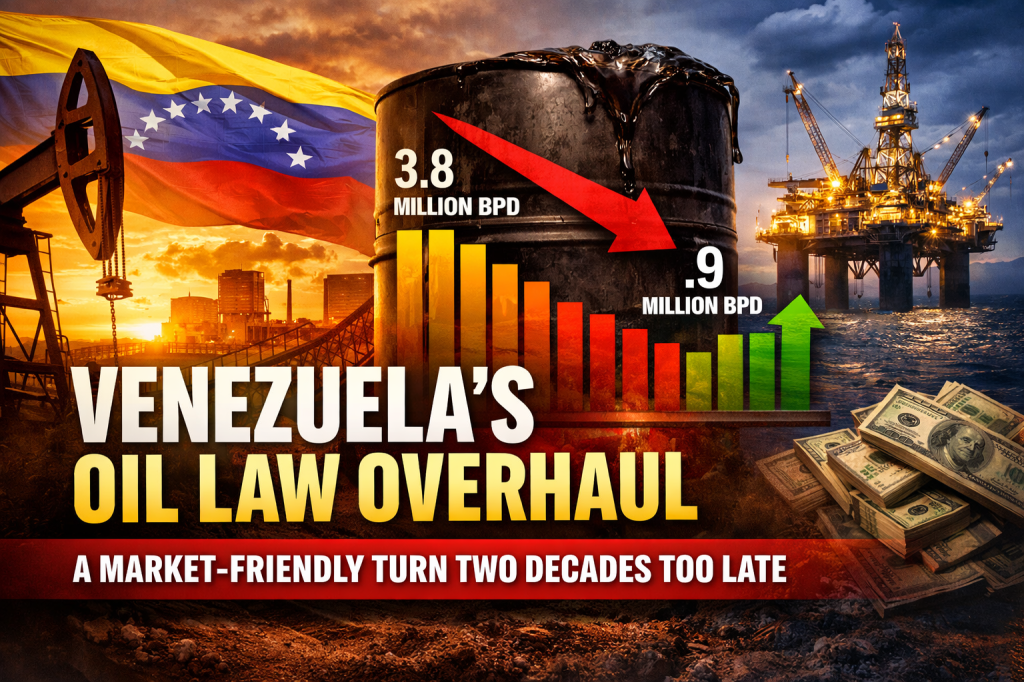
To grasp the magnitude of this moment, consider Venezuela’s oil production trajectory. At its peak in the 20th century, the country pumped as much as 3.8 million barrels per day, making it one of the world’s top producers. Today, output languishes at under 1 million barrels per day — barely enough to register as a third-tier producer on the global stage despite holding the world’s largest proven oil reserves (around 303 billion barrels).
Key Historical Oil Production Trends (Barrels per Day):
- 1970s peak: ~3.8 million bpd
- Late 1990s (Chávez era start): ~3 million bpd
- 2020 dip (pandemic + sanctions): ~0.5 million bpd
- 2024–25 stabilization: ~0.9–1.0 million bpd (with short-term variation)
This trajectory isn’t just a by-product of market forces; it reflects decades of state monopoly, mismanagement, corruption, and capital flight. Nationalization and the expulsion of foreign energy partners in the early 2000s severed the industry from global best practices, while sanction regimes further stifled investment.
Why the New Law Matters
For all of its oil wealth, Venezuela has been unable to convert reserves into sustainable revenue, jobs, or infrastructural development. Allowing private companies — both Venezuelan and foreign — greater control over production and sales is fundamental to reversing this decline. The law’s provisions for independent arbitration and lowered tax burdens signal a willingness to reduce political risk, a prerequisite for credible investment.
From a center-right perspective, the message is clear: markets must lead the revival where state dirigisme failed. Private capital, when properly regulated and protected by transparent legal frameworks, can revitalize fields that have sat idle for years. It can also create avenues for revenue inflows that help stabilize the Venezuelan economy.
Current Production Realities
The modest recovery in recent years is worth noting. Production has climbed back toward just under 1 million barrels per day, up from pandemic lows, and has shown incremental improvement with logistical adjustments and some relaxation of sanctions.
But there’s a stark gap between this and Venezuela’s historic capacity — a gap that reveals the scale of unrealized economic potential.
Challenges Remain
Supporters of the reform must confront several structural obstacles:
- Institutional Weakness: Markets flourish only when the rule of law, contract enforcement, and property rights are credible. Without these, any reform risks being superficial.
- Infrastructure Decay: Years of underinvestment have left refineries, pipelines, and rigs in disrepair, requiring billions in upfront capital.
- Political Risk: Foreign firms remain wary of abrupt policy reversals, as past expropriations have left lingering legal disputes.
- Global Energy Dynamics: Even with structural reform, Venezuela will compete in a global market gradually shifting toward diversification of energy sources.
What This Means for the U.S. and Global Energy Markets
The timing of this shift combined with recent U.S. policy adjustments — including eased sanctions that allow select American companies to engage in trade and refining of Venezuelan crude — presents a strategic opportunity. Reintegrating Venezuelan crude into global supply chains could benefit energy markets and provide U.S. refiners with discounted heavy crude access.
Conclusion: Policy Over Rhetoric
Venezuela’s new oil law represents a long-overdue pivot toward economic pragmatism. For the center right, the reform embodies the essential truth that markets, not bureaucratic control, unlock value — especially in a sector as capital-intensive and globally integrated as oil.
Success will not be instant. Rebuilding an industry once capable of producing millions of barrels per day will require serious legal protections, transparent governance, and a sustained invitation to private capital. But if this law fosters genuine reform — not just cosmetic change — Venezuela can begin the long journey from economic failure toward productivity and prosperity.estors, Venezuelan workers, and the broader population.
In conclusion, Venezuela’s oil reform law is far from a panacea. But it is a necessary corrective to years of failed economic dogma. If implemented with transparency and reinforced by institutional reforms, it can help pull Venezuela back from the brink. Free markets applied wisely — not abandoned — are the most reliable engine for prosperity. That is true in Caracas just as it is in Washington or any capital that seeks to balance opportunity with freedom.
 Republic Dispatch
What remains to be seen is whether Venezuela’s oil profits actually benefit the common people.
Or end up in the hands of Billionaires and/or the bank accounts of the members of the current authoritarian government installed at gunpoint.
Which highly suggest that the people of Venezuela will once again watch as their national resources are deliberately stolen from them.
This is after all the dirty little secret of Capitalist’s hide under the rug:
That Capitalism is based on outright theft.
LikeLike