By Republic Dispatch Staff
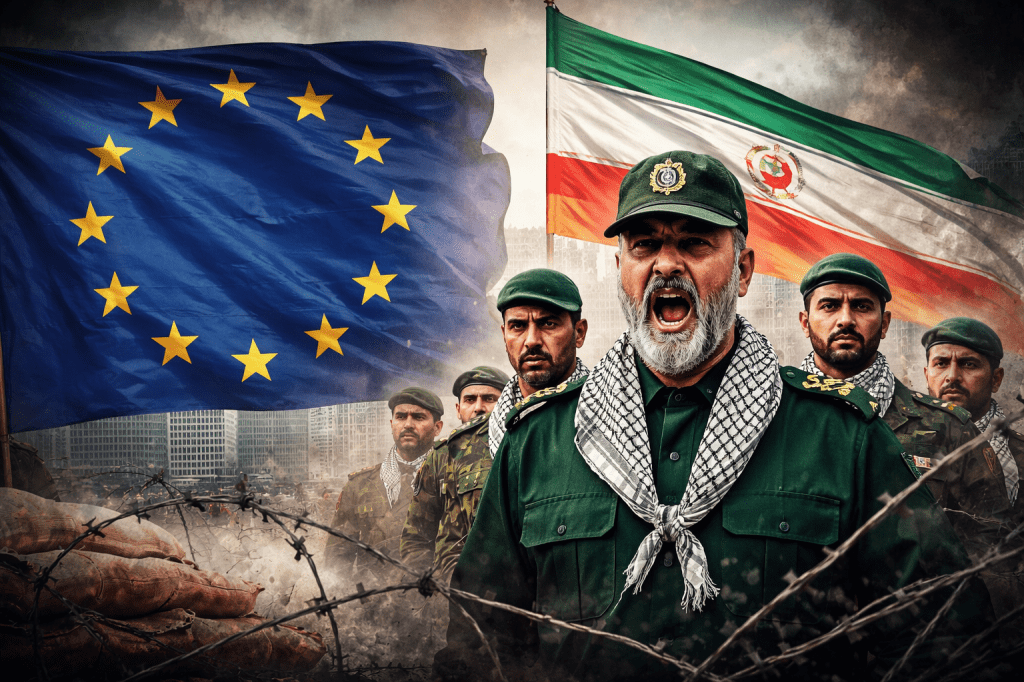
The European Union’s designation of Iran’s Islamic Revolutionary Guard Corps (IRGC) as a terrorist organization marks a historically significant pivot in Western policy toward Tehran. After years of hesitation, Brussels has finally aligned itself more closely with the United States, Canada, and Australia in recognizing that the IRGC’s actions—both at home and abroad—warrant the strongest possible international response.
For decades, the IRGC has been the backbone of the Islamic Republic’s theocratic rule. It serves not just as a military force but as an ideological enforcer: suppressing internal dissent with brutal force, entrenching Iran’s regional proxies, and advancing Tehran’s ambitions from Beirut to Baghdad. Its involvement in deadly crackdowns on protest movements, most recently against widespread demonstrations that have gripped Iran, has underscored the Guard’s readiness to violently silence popular demands for freedom.
A Long-Overdue Realignment
The designation is more than symbolic. By placing the IRGC on the same list as al-Qaeda and ISIS, the EU has equipped itself with legal tools to freeze assets, impose travel bans, and criminalize material support within its jurisdictions. That’s not just rhetoric—those are tangible levers to constrain a force that has repeatedly demonstrated disdain for human rights and democratic aspirations.
Some European skeptics worried that labeling part of a sovereign state’s military as terrorist could shut the door on diplomacy. But diplomacy without accountability is hollow. For too long, European capitals engaged with Tehran as if its internal repression and external adventurism were entirely separate from legitimate negotiation. The decision to reframe the IRGC accurately acknowledges that these facets of Iran’s behavior are inseparable.
Iran’s Threats Underscore The Rightness of the Move
Predictably, Tehran reacted with alarm, denouncing the EU’s decision as “illogical,” “spite-driven,” and a prelude to unspecified “consequences.” This bluster is revealing. When a regime that routinely imprisons journalists and executions dozens of protestors decries accountability, it betrays a fundamental discomfort with transparency and legitimate international norms.
European leaders should recognize that threats from Tehran are not new. Tehran’s support for Hezbollah, its role in destabilizing Iraq and Syria, and its challenging of Gulf security are all well-documented elements of its foreign policy. These are precisely the behaviors that have led multiple democracies to classify the IRGC and its affiliates as terrorist entities or state sponsors of terror. The EU’s move simply brings the bloc into the reality that others have already long acknowledged.
Supporting Iranians, Not the Regime
Critically, this decision also communicates solidarity with the Iranian people. Inside Iran, citizens have risked everything to protest economic mismanagement, corruption, and violent repression. By acting, the EU signals that Western alliances are with the aspirations of individuals yearning for dignity and freedom—not with entrenched theocrats who would crush them.
No Blind Escalation — But No Appeasement Either
A thoughtful foreign policy does not mean reflexive escalation. There remains space for diplomacy where it advances de-escalation, protects Western interests, and promotes human rights. But diplomacy without consequence only encourages further aggression. Europe’s designation of the IRGC is a judicious balance: it raises the costs of egregious behavior while leaving channels open where meaningful negotiation can occur.
In an era of mounting global challenges, Western democracies must act with clarity and principle. By finally designating the IRGC as a terrorist organization, the European Union has taken a step toward that higher standard—one that reinforces international norms, backs the bravery of everyday Iranians, and aligns the continent with a broader transatlantic consensus that tyranny must be confronted, not accommodated.
 Republic Dispatch