By Republic Dispatch Staff
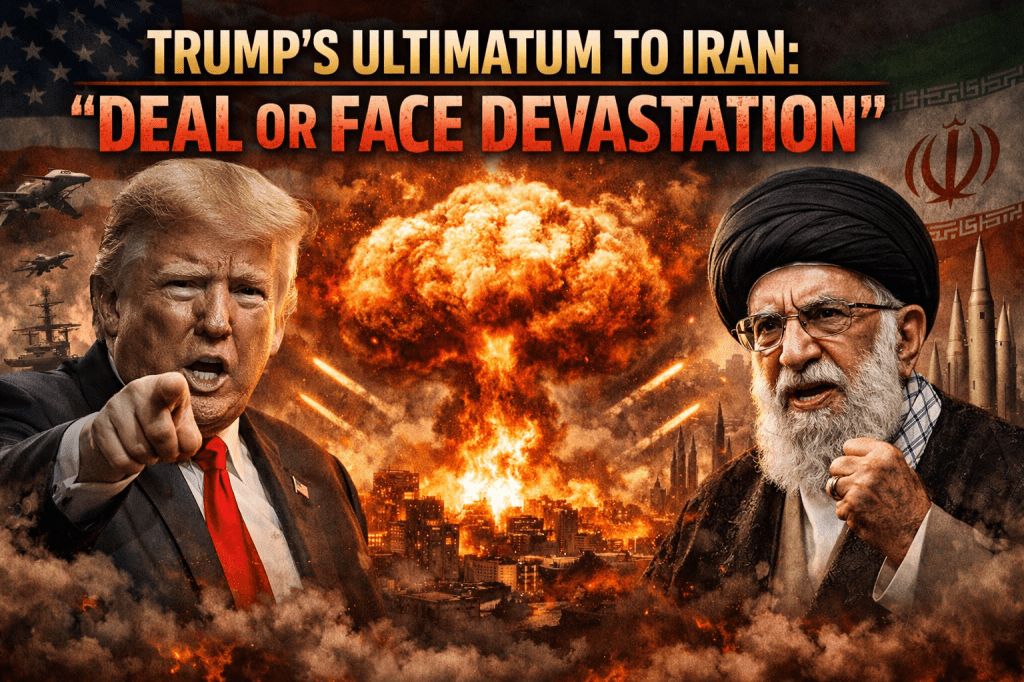
President Donald Trump has issued one of the sternest warnings to the Iranian regime in years: Tehran must return to the negotiating table and agree to a comprehensive nuclear deal, or face military consequences far worse than last year’s strikes on Iranian nuclear facilities. The president cited a recent U.S. military buildup in the Middle East — including a carrier strike group led by the USS Abraham Lincoln — as a real demonstration of U.S. resolve.
Trump’s rhetoric is intentionally calibrated: he pairs diplomacy with deterrence — offering Iran a “fair and equitable” path to negotiate, while clearly signaling that American patience has limits. In his own words, “Time is running out” to avert a broader confrontation.
This line of communication reflects a center-right strategic posture: the U.S. should pursue diplomacy, but not at the expense of undermining deterrence or inviting emboldened adversaries. Iran’s previous absolution of nuclear restrictions under prior deals demonstrated the risks of appeasement; Trump’s stance is designed to avoid repeating that pattern.
Iran’s Response: Defiance and Denial
Tehran has rejected the ultimatum. Iranian officials, including Foreign Minister Abbas Araqchi, stress that no negotiations are underway and have dismissed diplomacy conducted under threat as inherently ineffective.
More alarmingly, Iran’s leadership has publicly vowed to defend itself “with fingers on the trigger”, pledging fierce retaliation should the United States initiate military action.
This reaction underscores a core challenge of the Trump administration’s strategy: Iran may see defiance — even at great risk — as a means of domestic consolidation and regional signaling. A regime facing internal economic woes and civil unrest might double down on external confrontation to deflect from internal fractures.
A Calculated Risk or Unnecessary Brinkmanship?
Critics — particularly on the diplomatic left — argue that such ultimatums risk unintended escalation and could spiral into a broader Middle East conflict. They note that Tehran’s defiance is predictable if it believes its nuclear and missile programs are central to regime survival.
However, from a center-right national security perspective, Trump’s approach aims to correct a decades-long flaw: negotiating with adversaries without credible consequences. The 2015 nuclear deal, championed by previous administrations, failed to dismantle Iran’s long-term nuclear ambitions or curb its regional aggression. Trump’s tougher stance is intended to reset the terms of engagement with real deterrence behind diplomatic overtures.
The Broader Strategic Picture
This confrontation cannot be viewed in isolation:
- The U.S. military buildup in the region reflects credible deterrence, not capricious saber-rattling — bolstering U.S. forces to protect American personnel and allies.
- Iranian societal pressures — from devastating economic sanctions to ongoing civil unrest — compound the regime’s geopolitical choices, making Tehran unpredictable.
- Trump’s ultimatum sends a message not just to Iran, but to global partners: American leadership remains vigilant and unwilling to allow nuclear proliferation unchecked.
What Comes Next?
The best outcome — aligning with conservative realpolitik — would be negotiations that produce verifiable restraints on Iran’s nuclear and missile programs, backed by enforceable mechanisms and credible deterrence. That requires Tehran to accept terms it has historically resisted.
If negotiations fail, Trump faces a choice: rely solely on sanctions and international pressure, or act militarily with clear objectives and exit strategies. The president’s current posture suggests he prefers exhausting all diplomatic options first — but leaves open the possibility of force if Tehran continues to flout international norms.
Conclusion
President Trump’s Jan. 28 ultimatum to Iran reflects a center-right foreign policy approach rooted in deterrence-backed diplomacy. It recognizes the limits of past agreements, the necessity of credible threats, and the importance of preventing nuclear proliferation. While fraught with risk, this strategy aims to shift the calculus in Tehran and protect U.S. security interests without defaulting to appeasement.
The world watches closely — and whether this tough stance forces Iran back to meaningful dialogue or escalates tensions further remains one of the most consequential foreign policy challenges of 2026.
 Republic Dispatch