
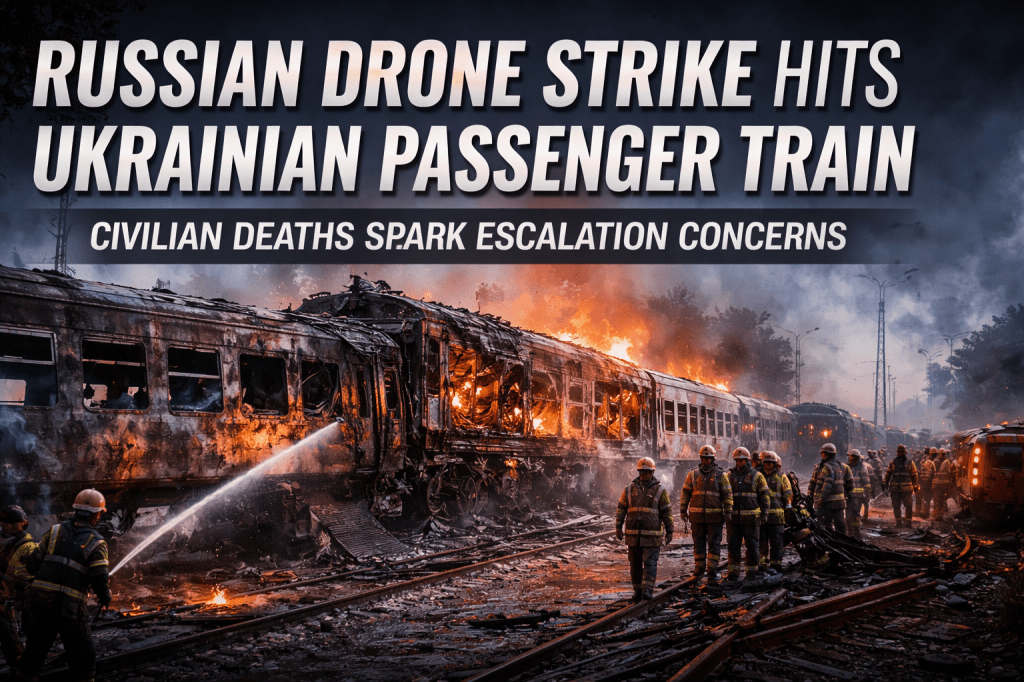
A Russian drone strike on a civilian passenger train in Ukraine that killed at least five people is not just another tragic data point in the conflict—it is a criminal escalation that further erodes any pretense that Moscow is abiding by the laws of war.
The attack, which struck a moving passenger train far from active combat zones, targeted civilians engaged in routine travel. There has been no credible evidence presented that the train had any military purpose.
What Happened
According to Ukrainian officials and emergency responders, a Russian drone struck a civilian passenger train traveling through central Ukraine on Tuesday. The blast ripped through multiple carriages, triggering fires and injuring dozens of passengers.
The victims were civilians—commuters, families, and ordinary travelers—with no known connection to military operations. Emergency crews described chaotic scenes as passengers attempted to flee burning rail cars.
Why This Matters Under International Law
Civilian passenger trains are explicitly protected under international humanitarian law, including the Geneva Conventions. Attacking civilian transportation infrastructure without clear military necessity constitutes a potential war crime.
There was no indication the train was transporting troops, weapons, or military supplies. In legal terms, this removes ambiguity: absent military necessity, the strike is either reckless or deliberate—both of which carry criminal implications.
This was not incidental damage from nearby fighting. It was a direct strike on civilian transit.
A Pattern, Not an Isolated Incident
The train attack fits a broader pattern of Russian strikes on civilian infrastructure throughout Ukraine, including apartment buildings, hospitals, power facilities, and evacuation routes.
Russia’s increasing reliance on long-range drones—many derived from Iranian designs—has lowered operational costs while increasing civilian exposure. These systems are often deployed deep inside Ukrainian territory, far from active front lines, where civilian harm is foreseeable.
From a criminal accountability standpoint, repetition matters. Patterns of conduct strengthen the case that civilian harm is not accidental but systemic.
Criminal Accountability and Deterrence
For a center-right audience focused on rule of law, national sovereignty, and deterrence, the implications are serious. When a state actor can strike civilian trains without consequences, international norms erode rapidly.
Documentation of these incidents is already underway, and future prosecutions—through international tribunals or national courts exercising universal jurisdiction—remain possible. History shows that accountability may be delayed, but it is not guaranteed to disappear.
Sanctions alone do not address criminal liability. Without legal consequences, such attacks risk becoming normalized tactics rather than condemned violations.
The Strategic Risk of Normalization
Treating this strike as just another battlefield incident obscures what it actually represents: the intentional—or recklessly indifferent—targeting of civilians.
If passenger trains can be hit without consequence in Ukraine, similar tactics will be tested elsewhere. That is not alarmism; it is how unchecked violations propagate.
This was not collateral damage. It was an attack on civilians in transit. Failing to call it what it is—a criminal act—undermines the legal and moral boundaries that restrain war from devolving into atrocity.
 Republic Dispatch