
By Republic Dispatch Staff
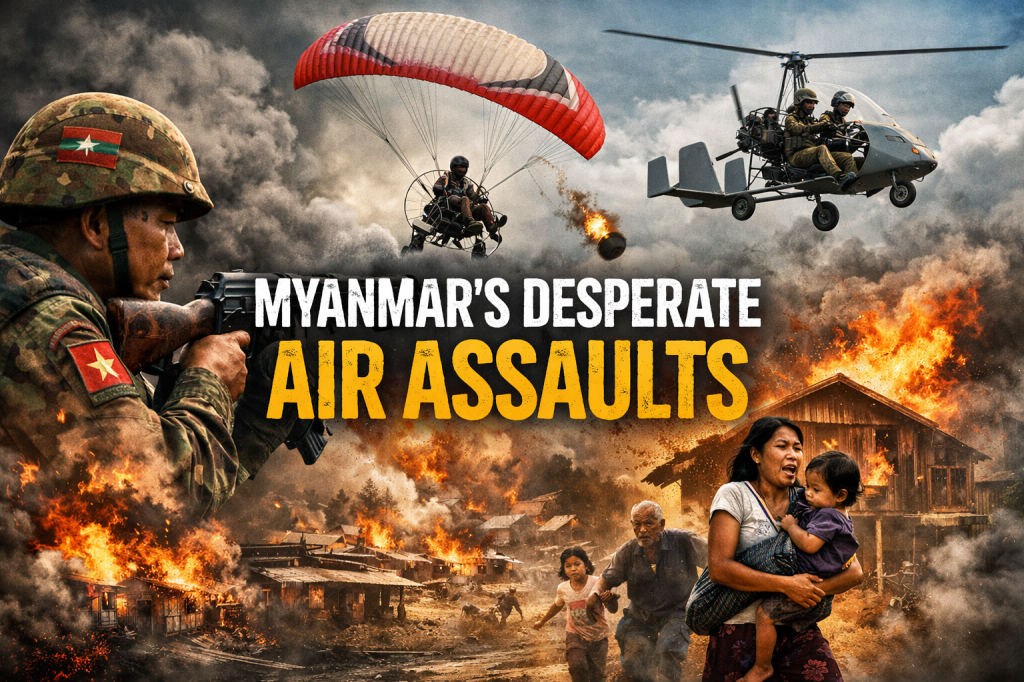
The latest reports out of Myanmar should alarm anyone who still believes the country’s military junta is a stabilizing force. According to international reporting, the armed forces are now using paramotors and gyrocopters—ultra-light civilian aircraft typically associated with recreation—to carry out aerial attacks on opposition-held areas and civilian populations.
This is not innovation. It is desperation.
Since seizing power in a 2021 coup, the military regime led by Min Aung Hlaing has steadily lost territorial control to resistance forces and ethnic militias. Traditional air power—fighter jets and helicopters—has already been used extensively, often with devastating consequences for civilians. But as sanctions, maintenance challenges, and battlefield losses degrade the junta’s conventional capabilities, it appears the regime is improvising.
Weaponizing Hobby Aircraft
Paramotors and gyrocopters are slow, lightweight, and cheap. They are also nearly useless against organized air defenses—except when those defenses don’t exist. In Myanmar’s fractured countryside, where villages lack protection and radar coverage is nonexistent, these aircraft can be flown low and quietly, dropping small munitions or firing improvised weapons before disappearing.
That tactic tells us two things:
First, the junta is no longer prioritizing military victory over legitimacy—it is prioritizing terror. These platforms are ill-suited for decisive battlefield gains but highly effective for intimidating rural populations and punishing communities suspected of aiding opposition forces.
Second, the Myanmar military is running out of options. When a state army resorts to repurposed hobby aircraft to attack its own people, it signals severe strain on logistics, training, and morale.
A Regime at War With Its Population
This is part of a broader pattern. Since the coup, the junta has relied on scorched-earth tactics: village burnings, arbitrary arrests, airstrikes on non-military targets, and collective punishment. International condemnation has been strong but largely toothless. Regional actors have hesitated, and Western sanctions—while justified—have not altered the regime’s calculus.
From a center-right perspective, this matters for reasons beyond human rights rhetoric. Myanmar sits at a strategic crossroads between India, China, and Southeast Asia. Continued instability fuels refugee flows, arms trafficking, and regional insecurity. Worse, a weakened but brutal junta becomes more dependent on external patrons willing to ignore atrocities—most notably Beijing and Moscow.
The Strategic Failure of Half-Measures
The use of paramotors is not just a war crime risk; it is a strategic indictment of the international community’s failure to impose real costs. Sanctions without enforcement, diplomacy without leverage, and statements without follow-through have created a vacuum in which the junta adapts rather than collapses.
A serious response would focus on:
- Disrupting supply chains for aviation fuel, spare parts, and dual-use components.
- Targeted financial pressure on military-owned conglomerates that bankroll operations.
- Support for documentation and accountability, ensuring these attacks are recorded for future prosecutions.
A Warning Sign, Not a Footnote
The image of a modern state bombing villages from lawn-chair aircraft should not be dismissed as a curiosity. It is a warning sign. Regimes that lose legitimacy and territory often grow more reckless, not more restrained.
Myanmar’s junta is not stabilizing the country—it is degrading it. And the shift to improvised aerial terror shows just how far it is willing to go to cling to power.
 Republic Dispatch