By Republic Dispatch Staff
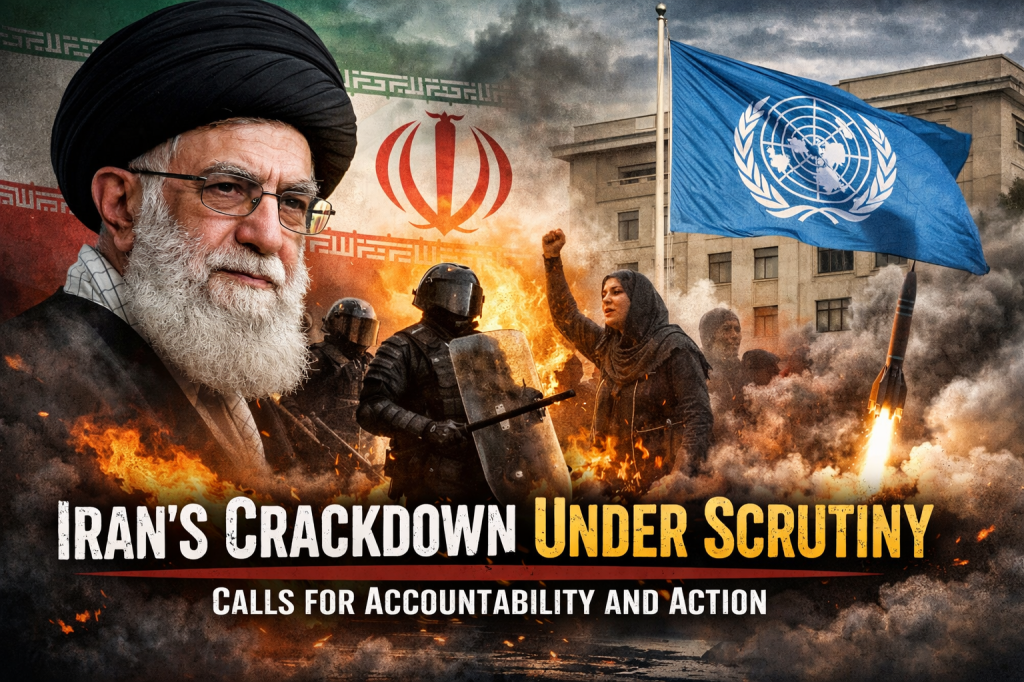
On January 23, the United Nations Human Rights Council adopted a resolution to extend an independent investigation into human-rights violations by Iran’s Islamic Republic and to launch an urgent inquiry into the regime’s brutal suppression of internal protests.
This decision — supported by 25 countries with seven opposing and 14 abstentions — represents not just another U.N. procedural vote, but a rare moment of international focus on the grave abuses carried out by Tehran’s clerical leadership.
Why This Matters
For years, Western policymakers and conservative observers alike have warned that Iran’s theocratic regime poses a threat not only to regional stability, but to basic human dignity at home. From systemic suppression of dissent to rigged elections and religious persecution, the Islamic Republic’s track record has long underscored the incompatibility of authoritarian clerical rule with fundamental freedoms.
The recent protests, prompted by economic hardship and political repression, were met with extreme force: eyewitness testimony includes credible reports of torture, sexual violence, forced confessions on state television, and the use of metal pellets against unarmed civilians, leaving hundreds with severe injuries.
That alone should alarm anyone committed to a rules-based international order.
The U.N. Response: Better Late Than Never — But Far From Enough
While extending a fact-finding mission might seem procedural, the timing and symbolism are significant. Western nations and human-rights advocates have repeatedly criticized the U.N. for uneven attention to abuses, especially when contrasted with the speed with which the council mobilizes over flashpoints like the Israeli-Palestinian conflict.
Anne Herzberg, a human-rights lawyer, rightly pointed out that the council’s sluggish response to Iran’s systematic cruelties — after weeks of delay — stands in stark contrast to how quickly it convenes on other conflicts. This disparity feeds a broader narrative: global institutions too often prioritize geopolitics over principle.
For conservative observers, this is a familiar frustration. Diplomacy rooted in moral clarity — not moral equivalence — demands that we call out tyranny wherever it occurs, without hesitation or political calculus.
Iran’s Obstruction and Propaganda
Predictably, Tehran rejected the legitimacy of the proceedings, framing them as politically motivated and driven by its adversaries. Iranian diplomats even accused the U.N. of hypocrisy, arguing that concern for protesters is a pretext for supporting “aggression,” referencing Israel’s actions in the Middle East.
This kind of defensive deflection is familiar from authoritarian regimes: when confronted with credible allegations of abuse, the instinct is to muddy the waters, blame external enemies, and question the motives of critics.
But the facts on the ground — documented testimonies, overwhelmed hospitals, and widespread internet blackouts — paint a much more sobering picture of a government willing to use brute force to retain power.
The Broader Strategic Context
Iran’s foreign policy and regional ambitions continue to fuel instability. Tehran’s indirect and direct confrontations with Israel — including past missile barrages and proxy conflicts — underscore the regime’s willingness to export conflict even as it represses dissent at home.
This dual threat — authoritarian repression internally and destabilizing behavior externally — makes the need for accountability all the more urgent. Nations committed to human rights and stability should welcome the U.N.’s decision as a pragmatic tool to shine light into one of the world’s most opaque regimes.
What Should Come Next
A fact-finding mission with teeth requires more than words. The U.N. must:
- Ensure transparent reporting and allow verified access for independent investigators.
- Support accountability mechanisms that can lead to tangible consequences for perpetrators of abuse.
- Encourage coalition pressure from democratic nations to reinforce that repression has political and diplomatic costs.
For center-right policymakers and voters alike, this is not just about condemning violations in far-off countries. It’s about affirming that the global order should uphold human dignity, and that autocracies should face consequences when they trample the basic liberties of their own citizens.
The fight for freedom in Iran — often led by brave citizens risking everything — deserves the world’s attention, not excuses.
 The Republic Dispatch