
By Republic Dispatch
The revelation that Bangladeshi migrant workers seeking civilian jobs in Russia were instead pushed toward combat roles in Ukraine is not just a humanitarian scandal—it is a warning flare about how modern wars are increasingly fueled by deception, labor exploitation, and the moral vacuum surrounding Russia’s war effort.
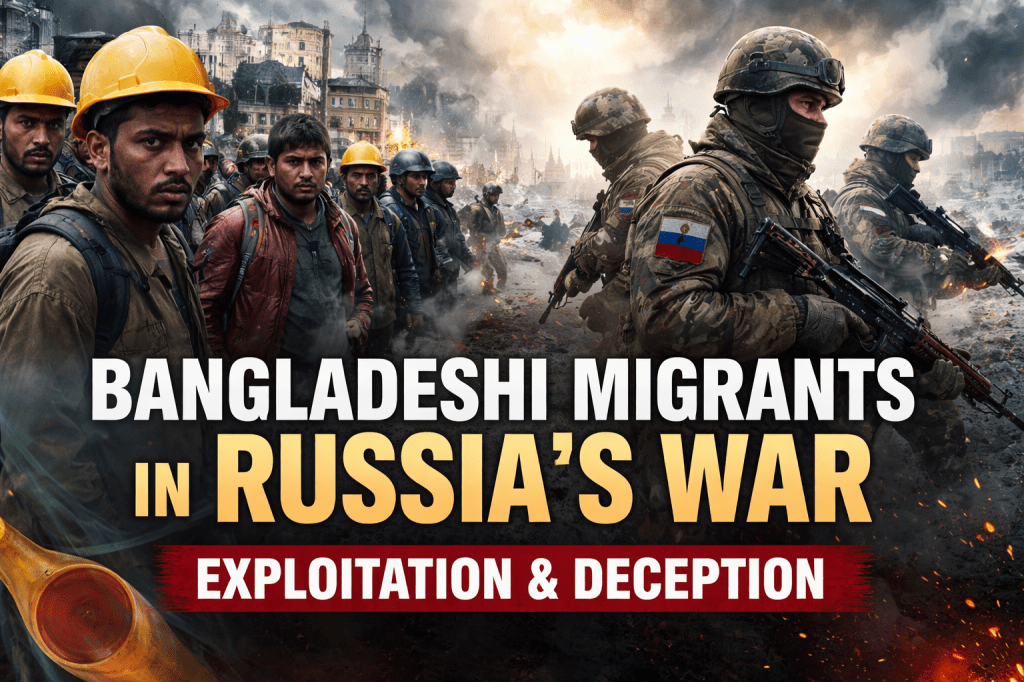
According to reporting referenced by ABC News, men from Bangladesh believed they were traveling to Russia for construction or factory work. Instead, many found themselves coerced, pressured, or maneuvered into military service connected to the invasion of Ukraine—a conflict now well into its grinding, manpower-intensive phase.
This is not an isolated mishap. It is a symptom of a war machine scraping the bottom of the barrel.
A War That Can’t Find Its Own Fighters
Russia’s recruitment crisis has been apparent for months. Casualties have been staggering, domestic enthusiasm for enlistment has waned, and the Kremlin has avoided a full national mobilization that could provoke public unrest. Instead, Moscow has quietly expanded recruitment to prisoners, ethnic minorities, and now foreign laborers—often through opaque or outright deceptive means.
Targeting migrant workers is especially cynical. These men typically arrive indebted, vulnerable, and dependent on employers or intermediaries. In such conditions, “choice” becomes a legal fiction. When the alternative is detention, deportation, or financial ruin, coerced enlistment begins to resemble human trafficking rather than voluntary service.
From a center-right perspective grounded in rule of law and national sovereignty, this is not strength—it is decay.
Exploitation Masquerading as Opportunity
The Bangladeshi workers’ experience exposes a darker truth about Russia’s labor pipeline. Migrants are not merely economic inputs; they have become strategic assets to be repurposed when convenient. Promises of legal status, wages, or protection can quickly morph into ultimatums once workers are on Russian soil.
This model mirrors the Kremlin’s broader approach to governance: contracts without enforcement, promises without accountability, and power exercised without restraint. It also undercuts Moscow’s claims that its war effort is legitimate, popular, or sustainable.
If a war requires tricking foreign laborers into the trenches, it has already failed the moral test.
Why This Matters Beyond Ukraine
This episode should concern policymakers far beyond Eastern Europe. It highlights how authoritarian states can weaponize global labor flows, exploiting economic desperation created by poverty, instability, or weak governance elsewhere.
For countries that export labor—including Bangladesh—the case raises urgent questions about worker protections, recruitment oversight, and diplomatic leverage. For Western democracies, it reinforces the need to scrutinize not just weapons transfers and sanctions, but also the human supply chains that enable prolonged conflict.
A world where migrant workers are quietly converted into cannon fodder is not one that respects borders, contracts, or human dignity.
The Strategic Takeaway
Russia’s reliance on foreign workers for combat roles signals weakness, not resilience. It suggests a state running out of willing citizens, moral legitimacy, and sustainable options. Wars fought this way tend to end badly—not just militarily, but reputationally and economically.
The tragedy of Bangladeshi workers caught in Ukraine’s killing fields is ultimately a story about power used irresponsibly. And it is a reminder that in modern conflicts, exploitation is often the clearest indicator of a regime in trouble.
Republic Dispatch will continue tracking how labor, migration, and coercion are reshaping the geopolitics of war—and what that means for a world already strained by conflict and instability.
 Republic Dispatch