By Michael Phillips | Republic Dispatch
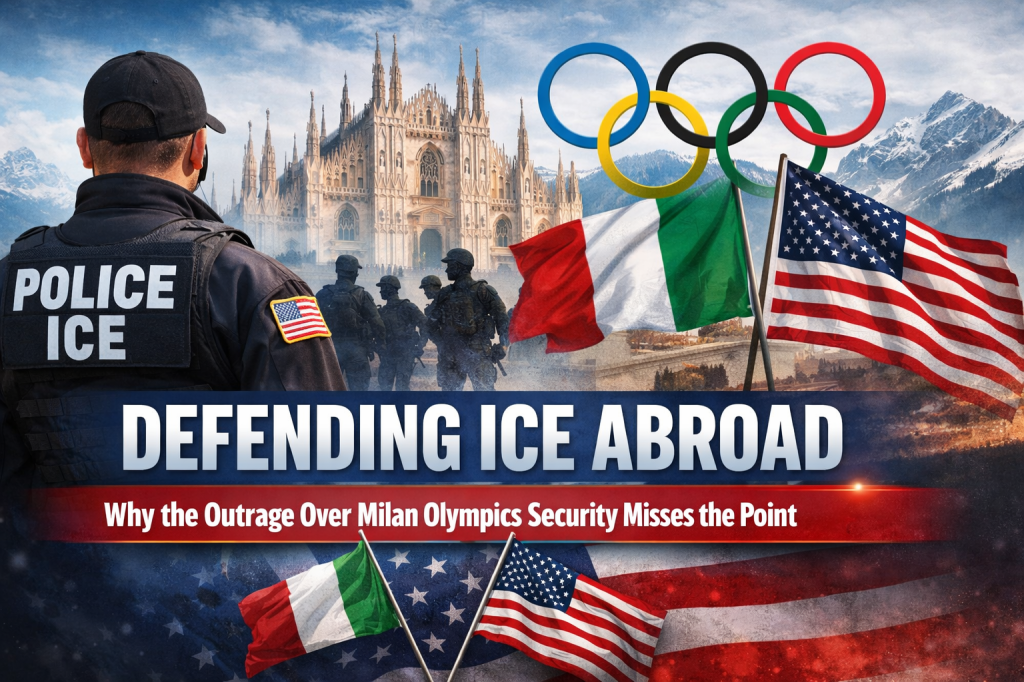
Reports that agents from U.S. Immigration and Customs Enforcement will assist with security planning for the 2026 Winter Olympics have triggered a wave of political outrage in Europe. Much of it is loud, ideological, and untethered from reality.
At its core, this controversy is not about security practices—it is about symbolism, politics, and the export of America’s domestic immigration debates onto an international stage.
What ICE Is Actually Doing in Italy
Despite alarmist claims, ICE agents are not being deployed to enforce U.S. immigration law in Italy.
Their role, according to U.S. officials, is limited to:
- Protective security coordination for the U.S. delegation
- Intelligence and threat assessment support
- Liaison work with host-nation security services
This function is carried out primarily by Homeland Security Investigations (HSI), ICE’s investigative arm, which routinely works alongside foreign law enforcement on terrorism, organized crime, and diplomatic protection.
This is standard protocol for Olympic Games involving senior U.S. officials. It is neither novel nor aggressive.
The Political Overreaction Abroad
The backlash from some European officials—particularly in Milan—has been strikingly disproportionate. Public denunciations branding ICE as a “militia” or suggesting it represents a threat to Italian sovereignty are not serious arguments; they are political theater.
European governments regularly cooperate with U.S. federal agencies, including ICE, behind closed doors. What has changed is not the mission—but the optics. ICE has become a cultural lightning rod, and some leaders see political advantage in condemning it publicly, regardless of the facts.
This is not diplomacy. It is posturing.
Olympic Security Is Not a Theoretical Exercise
The Olympics are among the most complex security operations in the world. They involve:
- Decentralized venues
- Massive international travel flows
- High-profile political figures
- Persistent terrorism and organized crime risks
Italy has already acknowledged the challenge of securing events spread across Cortina d’Ampezzo and northern Italy’s transport corridors. In that context, rejecting experienced U.S. security personnel on ideological grounds is not principled—it is reckless.
Security professionals understand this. Political leaders playing to activist audiences often do not.
The Double Standard No One Wants to Acknowledge
European nations routinely deploy their own intelligence and security officers abroad to protect officials and athletes. The United States is afforded no special exemption from that same right.
The objection is not to foreign security personnel in general—it is to this agency, at this political moment.
That double standard exposes the controversy for what it is: an objection to American border enforcement policy masquerading as concern over Olympic security.
Why ICE’s International Role Is Misrepresented
ICE’s investigative personnel are often quietly praised by foreign counterparts for professionalism and effectiveness. Public condemnation tends to come not from security officials but from politicians seeking moral distance from U.S. domestic debates.
This selective outrage ignores the reality that transnational crime, terrorism, and human trafficking do not respect borders—and that ICE is frequently involved in combating all three.
Demonizing the agency does nothing to improve security cooperation. It only weakens it.
A Center-Right Perspective: Sovereignty Cuts Both Ways
From a center-right standpoint, the issue is straightforward:
- The United States has a responsibility to protect its officials abroad
- ICE agents are operating under diplomatic protocols
- Italy retains full sovereignty and operational control
Treating this arrangement as a scandal undermines trust between allies and trivializes serious security planning.
The Real Risk Is Ideological Theater
The greatest danger surrounding the Milan Olympics is not ICE’s involvement. It is the willingness of political leaders to turn legitimate security coordination into an ideological spectacle.
The Olympics should be a showcase of international cooperation—not a stage for exporting political grievances.
If global leaders want safe Games, the answer is simple: less theater, more professionalism, and far more honesty about what ICE agents are actually doing in Italy.
Why This Matters for U.S. Sovereignty
At stake in the controversy over U.S. Immigration and Customs Enforcement participation in Olympic security is more than diplomatic etiquette—it is the principle of U.S. sovereignty itself.
The United States has an inherent right to protect its officials, athletes, and diplomatic personnel abroad. That responsibility does not disappear at foreign borders, nor does it require ideological approval from foreign political leaders. ICE agents assigned to the 2026 Winter Olympics are operating under established diplomatic agreements and in coordination with Italian authorities—not in defiance of them.
When foreign officials attempt to dictate which U.S. agencies are acceptable for American security operations, they are effectively asserting influence over U.S. internal governance decisions. That sets a dangerous precedent. If accepted, it would allow external political pressure to shape how the United States safeguards its people overseas.
There is also a strategic dimension. The United States routinely permits allied security services to operate in support roles on American soil during major international events. Mutual respect for sovereignty requires reciprocity—not selective outrage based on political branding.
Reducing ICE’s role to a cultural or ideological controversy undermines the seriousness of international security cooperation. More importantly, it erodes the principle that the United States—not foreign political movements—determines how it fulfills its obligations to protect American lives.
In an era of rising geopolitical risk, defending that principle is not optional. It is foundational.
 Republic Dispatch