By Republic Dispatch Staff
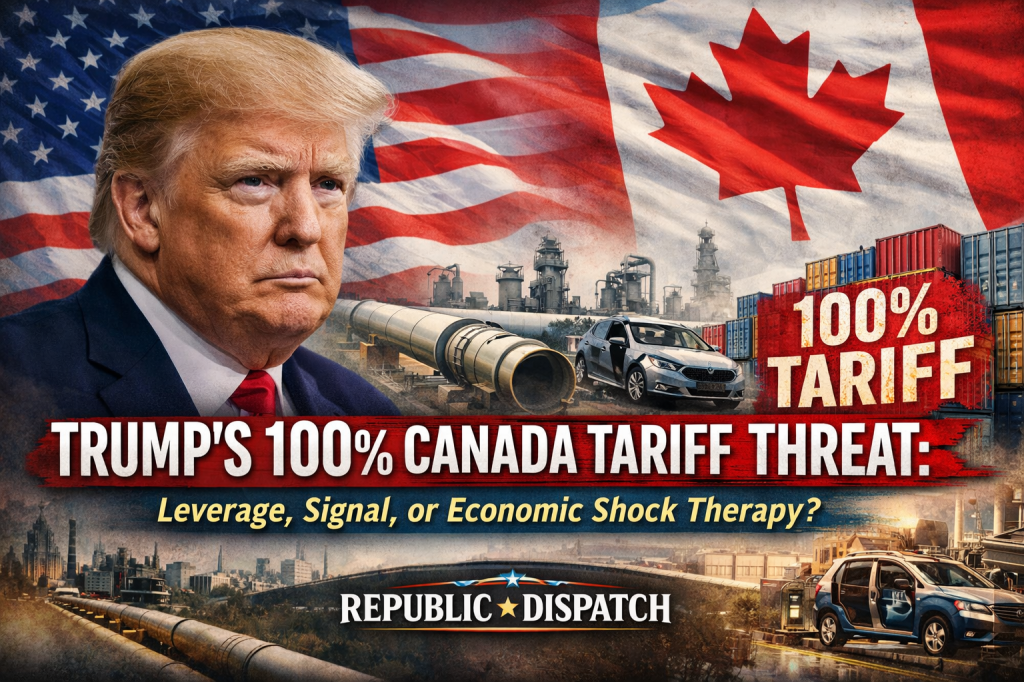
President Donald Trump has once again jolted global markets and allied capitals—this time by floating the possibility of a 100 percent tariff on Canadian imports, a move that would represent one of the most aggressive trade threats ever aimed at America’s closest economic partner.
According to reporting by the Washington Post, the threat emerged amid escalating disputes over trade imbalances, industrial policy, and what Trump has long framed as “structural unfairness” in North American trade. Whether the proposal is intended as a negotiating tactic or a genuine policy option, its implications are serious—and deserve scrutiny beyond the usual “Trump chaos” narrative.
Why Canada—and Why Now?
Canada is not China. It is not an adversarial economy exploiting American openness while hollowing out U.S. manufacturing. It is America’s largest trading partner, a key supplier of energy, agriculture, automobiles, and raw materials, and a core pillar of continental economic integration.
So why aim the rhetorical bazooka north?
From a center-right perspective, three explanations stand out:
- Leverage Politics
Trump has always treated tariffs as leverage rather than doctrine. A maximalist threat—especially one that dominates headlines—can force concessions before talks even begin. - Industrial Nationalism Signaling
Trump’s economic worldview prioritizes domestic production over frictionless trade. A Canada threat reinforces the message that no country, ally or not, gets a pass if Washington believes U.S. workers are losing. - Davos Contrast
The timing coincides with global elite gatherings like the World Economic Forum, where Trump has increasingly positioned himself as the anti-consensus figure—skeptical of technocratic globalism and blunt about national power.
The Real Economic Risk
A 100 percent tariff on Canadian goods would not be a symbolic jab. It would be an economic earthquake.
- Energy prices could spike, particularly in northern U.S. states dependent on Canadian oil, gas, and electricity.
- Auto manufacturing—deeply integrated across the U.S.-Canada border—would face immediate disruptions.
- Agricultural markets would see retaliatory pressure, hitting American farmers already sensitive to trade instability.
Center-right economics traditionally favors predictability, capital stability, and allied coordination. A sudden tariff of this magnitude cuts against all three.
Allies Are Not Adversaries
There is a legitimate conservative argument for rebalancing trade, enforcing reciprocity, and resisting protectionist industrial subsidies abroad. Canada, like the U.S., has used industrial policy and regulatory barriers that deserve challenge.
But equating Canada with strategic competitors risks collapsing an important distinction: competition vs. confrontation.
Tariffs aimed at hostile or predatory economies can be a tool of statecraft. Tariffs aimed at allies, especially at extreme levels, risk becoming a tax on American consumers rather than a pressure point on foreign governments.
The Strategy Question
Trump’s defenders argue—often correctly—that his threats are rarely his endpoints. Many of his toughest trade stances in his first term resulted in renegotiations rather than economic rupture.
The concern here is scale.
A 100 percent tariff is not a scalpel. It is a sledgehammer.
If the goal is to extract concessions from Ottawa, a calibrated approach—targeted tariffs, sector-specific pressure, or dispute resolution mechanisms—would maintain leverage without detonating supply chains.
A Warning for 2026 Trade Policy
This episode underscores a broader reality of Trump’s second term: economic nationalism is no longer theoretical. It is central to his governing philosophy, even when it collides with long-standing alliances.
For conservatives, the challenge is not choosing between free trade absolutism and blind protectionism—but insisting on strategic restraint, especially with allies whose cooperation matters for energy security, defense, and continental resilience.
The tariff threat may yet fade, as many Trump salvos do. But the signal is unmistakable: under Trump, no relationship is immune from renegotiation, and economic power remains his preferred instrument.
Whether that ultimately strengthens American leverage—or undermines American stability—depends on how often threats turn into policy.
 Republic Dispatch