By Republic Dispatch Staff
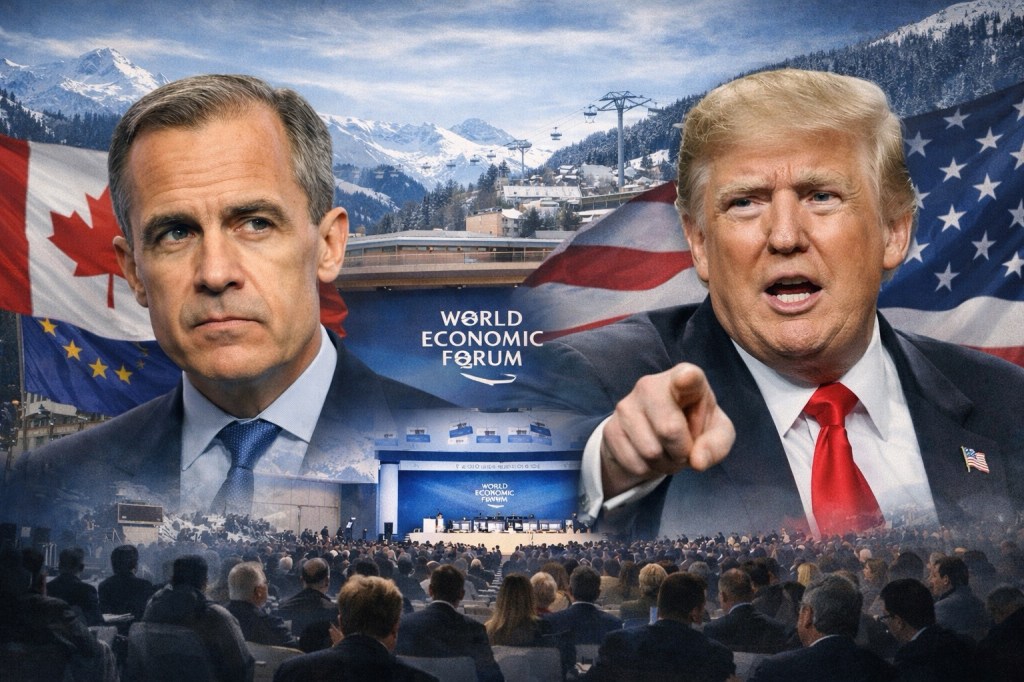
As the World Economic Forum convenes once again in Davos, one theme is impossible to miss: Canada’s governing and elite class is deeply uneasy about the return of Donald Trump—and increasingly unsure how to respond.
According to The Wall Street Journal, Canada’s presence in Davos has been shaped less by confidence than by concern, particularly as former central banker Mark Carney re-emerges as a key voice attempting to position Canada as a “steady” counterweight to Trump’s nationalist, transactional worldview. The problem for Ottawa—and for Davos regulars—is that this strategy appears rooted in a fading global consensus rather than current political reality.
A Globalist Reflex in a Post-Globalist Moment
Carney, long celebrated in elite international circles for his roles at the Bank of Canada, the Bank of England, and as a climate finance advocate, embodies the Davos-era belief that global coordination, technocratic governance, and climate-first economics are inevitable and morally superior.
But Trump’s second-term resurgence has scrambled that assumption.
Rather than retreating from global leadership, Trump has reasserted it on explicitly American terms—pressuring allies on defense spending, rethinking trade relationships, and openly challenging the legitimacy of institutions like the WEF that operate with little democratic accountability.
For Canada’s leadership class, this presents a dilemma: they are culturally and economically aligned with Davos, yet structurally dependent on Washington.
Trump’s Leverage—and Canada’s Vulnerability
The WSJ reporting underscores a quiet fear among Canadian officials: Trump’s return means unpredictability, leverage, and consequences. Trade, energy exports, defense cooperation, and Arctic policy are all areas where the U.S. holds overwhelming influence—and Trump has shown he is willing to use it.
Carney’s messaging in Davos seeks to reassure global investors and policymakers that Canada remains a stable, climate-aligned, rules-based actor. But stability, in this context, increasingly sounds like resistance to democratic disruption rather than responsiveness to voter concerns.
Trump’s critique—shared by many center-right voters across North America—is not that cooperation is bad, but that unaccountable global institutions have overridden national sovereignty, hollowed out middle classes, and insulated elites from the costs of their own policies.
Davos vs. Democracy
The deeper tension exposed in Davos this year is not simply Trump vs. Canada. It is Davos vs. democracy.
Carney’s worldview assumes continuity: that voters will eventually fall back in line, that nationalist movements are temporary disruptions, and that global governance can be nudged back on track by the right mix of expertise and messaging.
Trump’s continued appeal suggests the opposite. Voters are not rejecting competence—they are rejecting systems that feel rigged, distant, and dismissive of national interest.
Canada’s anxiety at Davos reflects a broader Western elite concern: what happens when the global consensus no longer commands consent?
A Strategic Misread
From a center-right perspective, Canada’s Davos posture looks less like prudence and more like miscalculation. Trump is not an aberration to be managed; he is a political force reshaping the terms of engagement.
By doubling down on Davos orthodoxy and figures like Carney, Canada risks signaling that it is more invested in elite approval abroad than political legitimacy at home—or pragmatic alignment with its most important ally.
If Davos is meant to be a forum for understanding the world as it is, not as elites wish it to be, then Canada’s strategy this year suggests it is still living in the pre-2016 past.
And Trump, once again, is the inconvenient reminder that the past isn’t coming back.
 Republic Dispatch