By Republic Dispatch Staff
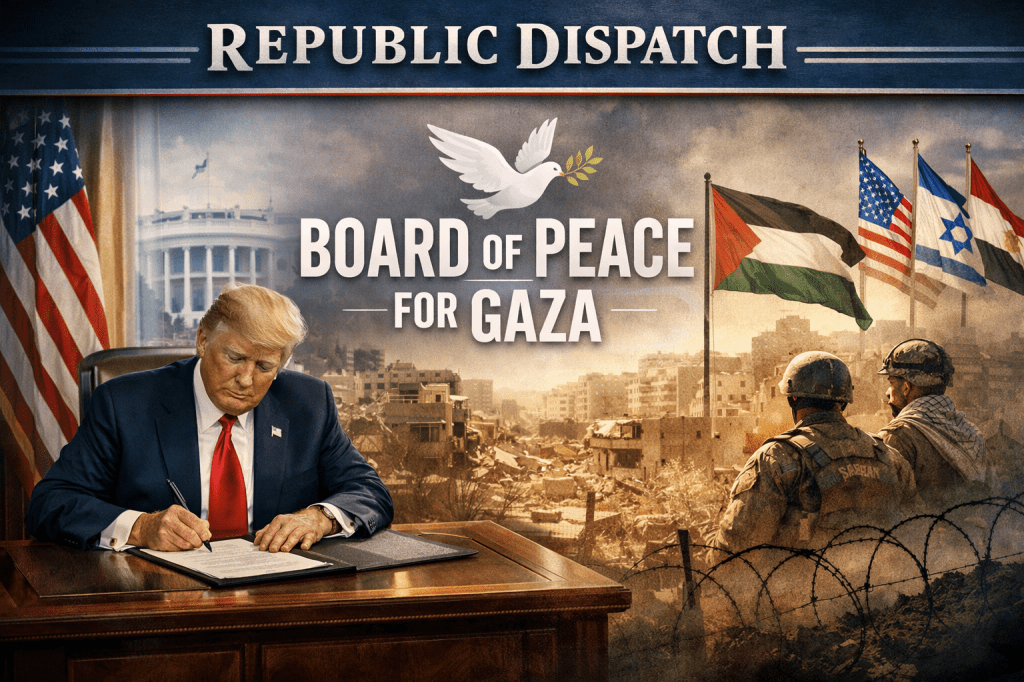
In a rare and symbolically charged ceremony at the White House, President Donald Trump formally ratified the creation of a new international “Board of Peace” intended to oversee reconstruction, governance, and humanitarian coordination in Gaza Strip.
The administration framed the move as a turning point—an attempt to chart a postwar path that avoids both permanent occupation and the re-empowerment of extremist groups. Whether it proves durable or merely aspirational remains an open question.
A Governance Experiment, Not a Peace Treaty
Unlike traditional Middle East peace initiatives, the Board of Peace is not a treaty, ceasefire agreement, or final-status framework. Instead, it is a governance mechanism—designed to manage Gaza’s recovery while keeping Hamas permanently sidelined.
According to the White House, the board will include regional stakeholders, international partners, and technocratic administrators tasked with overseeing aid distribution, infrastructure rebuilding, and transitional civil authority. The administration emphasized that the structure is meant to be temporary, with the long-term goal of restoring dignity and self-governance for Gazans without creating a security vacuum.
From a center-right perspective, this distinction matters. The Trump administration is signaling a preference for order before ideology—prioritizing stability, security, and accountability over abstract peace processes that historically collapsed under the weight of unresolved power dynamics.
Security First, Then Sovereignty
Senior officials stressed that the Board of Peace is explicitly conditioned on security guarantees. Hamas and affiliated militant groups are excluded entirely, and no aid or authority flows without enforcement mechanisms.
This approach aligns with a long-standing conservative critique of Middle East diplomacy: that well-intentioned humanitarian efforts often fail because they ignore hard security realities on the ground. The administration argues that past international interventions collapsed precisely because they empowered actors unwilling or unable to prevent violence.
In this sense, the Gaza board reflects a continuation—not a repudiation—of Trump-era foreign policy principles: deterrence, conditional engagement, and skepticism toward open-ended international missions.
Regional Buy-In Remains the Key Variable
What the ceremony could not resolve is the most important question: who enforces compliance?
While the White House referenced coordination with regional partners, the long-term success of the Board of Peace depends on sustained cooperation from Israel, neighboring Arab states, and major donors—many of whom have competing interests and deep mistrust born of decades of failed initiatives.
Absent regional buy-in, the board risks becoming another international body with lofty mandates but limited authority. With it, however, the framework could represent a meaningful shift away from cycles of destruction followed by unaccountable reconstruction.
A Political Signal as Much as a Policy One
Domestically, the move allows Trump to position himself as both tough and constructive—rejecting terrorism while presenting a humane alternative to perpetual conflict. Internationally, it sends a signal that Washington intends to remain the central broker in Middle East stabilization efforts, rather than deferring to multilateral institutions with uneven records.
Whether the Board of Peace becomes a genuine pathway to stability or another footnote in Middle East diplomacy will depend less on ceremony and more on enforcement, funding discipline, and political will.
For now, the administration has made its bet: that governance, not slogans, is the missing ingredient in Gaza’s future.
 The Republic Dispatch