
By Republic Dispatch Staff
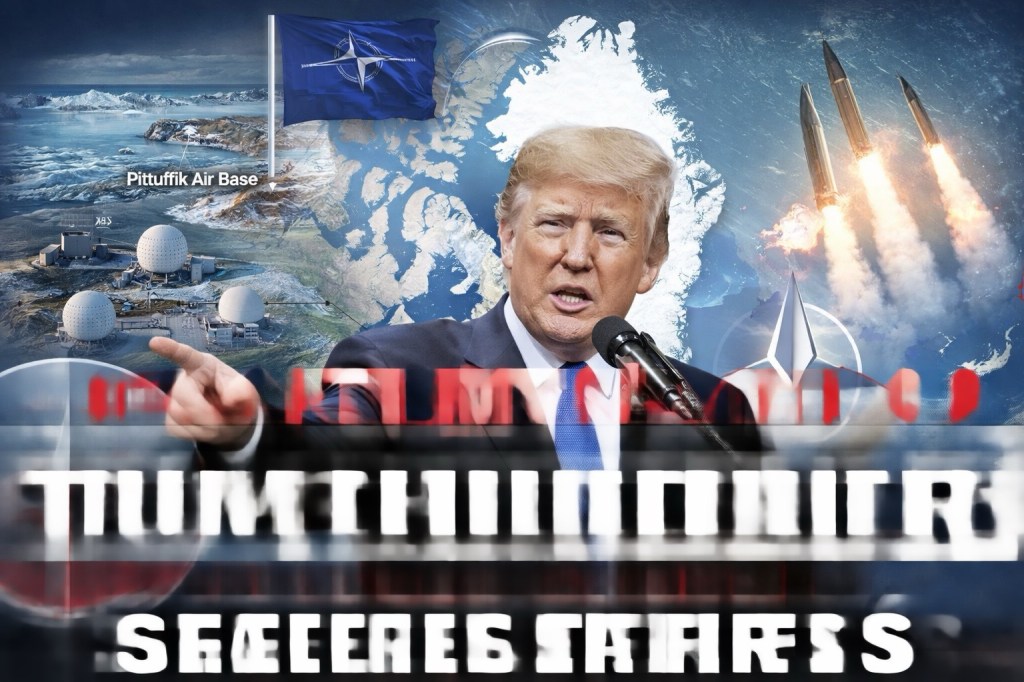
President Donald J. Trump on Tuesday announced what he described as a “framework of a future deal” involving Greenland and the broader Arctic region, following a meeting with NATO Secretary General Mark Rutte. The announcement, made via Truth Social and mirrored across platforms, immediately reverberated through diplomatic and financial circles—most notably because Trump also said he would suspend previously threatened tariffs on European allies.
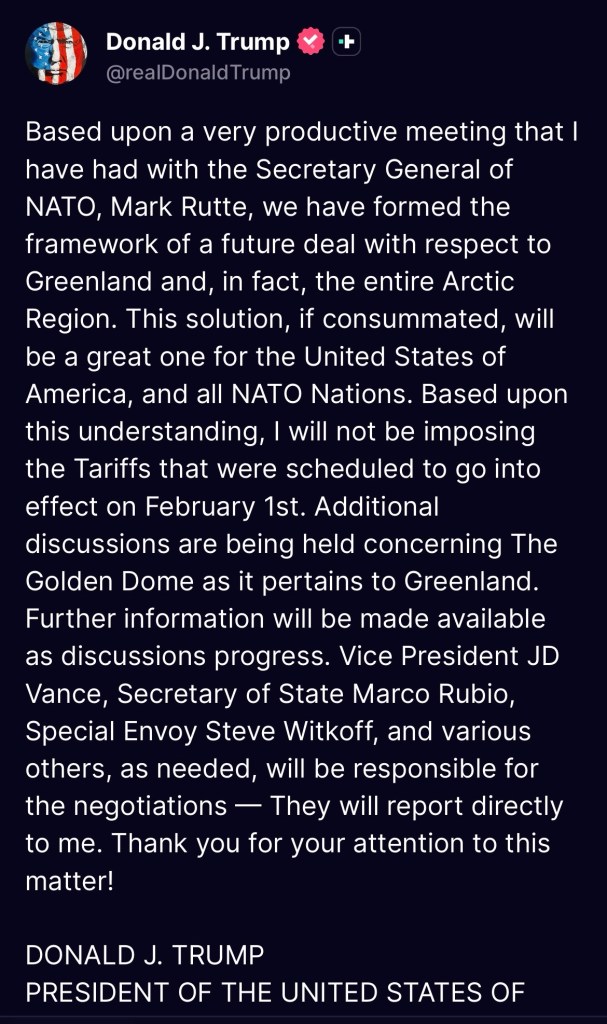
The statement marks the most concrete signal yet that Trump’s long-running Greenland push—first floated during his initial term—has evolved into a broader Arctic security negotiation involving NATO, missile defense, and economic leverage.
From Tariffs to Talks
According to the post, Trump will not impose tariffs that were scheduled to take effect on February 1 against several European countries. Those tariffs had been widely interpreted as pressure on Denmark and other NATO allies resisting U.S. demands related to Greenland.
From a center-right perspective, the move fits a familiar Trump pattern: escalate publicly, apply economic leverage, then de-escalate once talks begin. Supporters argue it reflects pragmatic deal-making rather than ideological confrontation—forcing allies to the table while avoiding long-term economic damage.
Critics label it coercive. But markets responded positively to the tariff pause, reinforcing the argument that Trump’s approach—however abrasive—often aims at extracting concessions without triggering full-scale trade conflict.
Why Greenland Still Matters
Greenland, a semi-autonomous territory of Denmark, sits at the crossroads of Arctic geopolitics. Melting ice has opened new shipping routes, while Russia and China have expanded Arctic ambitions through military deployments, infrastructure projects, and research outposts.
The U.S. already operates Pituffik Space Base (formerly Thule Air Base), a cornerstone of America’s northern missile warning system. Trump has long argued that deeper U.S. control—or at least guaranteed access—is essential to prevent adversaries from exploiting the region.
From a NATO standpoint, Arctic security is no longer theoretical. Early-warning radar coverage, undersea cables, and rare earth supply chains increasingly intersect with alliance defense planning.
The “Golden Dome” Factor
Trump’s post references ongoing discussions about “The Golden Dome” as it relates to Greenland. The phrase is widely understood as shorthand for his proposed large-scale U.S. missile defense system—a next-generation shield inspired by Israel’s Iron Dome but designed to counter ICBMs, hypersonic weapons, and long-range threats.
Greenland’s geography makes it uniquely valuable for northern radar and early detection of launches from Russia or China. While critics note that full U.S. ownership is not legally required to deploy such systems, Trump’s view is that permanent control eliminates political uncertainty and secures long-term strategic advantage.
Supporters frame this as overdue realism: missile defense is not just a domestic issue but an alliance-wide necessity.
Who’s Running the Negotiations
Trump said negotiations will be handled by senior officials reporting directly to him, including Vice President JD Vance, Secretary of State Marco Rubio, and Special Envoy Steve Witkoff.
The lineup signals a blend of political authority, diplomatic experience, and transactional negotiation—very much in line with Trump’s governing style. It also suggests the White House is keeping tight control over the talks, rather than delegating them to multilateral bureaucracies.
NATO Unity—or a Stress Test?
Officially, NATO does not broker territorial changes. Rutte has emphasized alliance cohesion and shared concern over Russian and Chinese activity in the Arctic. Still, Trump’s announcement raises questions about how far NATO allies are willing to go to accommodate U.S. demands.
For center-right observers, this is less about colonial ambition and more about power realities: the U.S. remains NATO’s backbone, and Arctic defense is becoming central to Western security.
What Comes Next
No formal agreement has been announced, and Denmark and Greenland have yet to issue detailed public responses. Polling consistently shows strong opposition among Greenlanders to outright annexation, making any deal politically delicate.
But Trump’s announcement suggests the conversation has shifted—from hypothetical interest to structured negotiation. Whether the outcome is expanded basing rights, a joint defense framework, or something more ambitious, the Arctic is now firmly at the center of U.S. foreign policy in Trump’s second term.
For now, tariffs are on hold, talks are underway, and the world is watching to see whether Trump’s high-stakes Arctic gambit becomes a landmark security deal—or another test of alliance limits.
 Republic Dispatch