By Republic Dispatch Staff
The headline coming out of Washington suggested a decisive turn: House Foreign Affairs Members Call for Machado to Govern Venezuela. The reality, however, is more cautious — and more revealing of how U.S. foreign policy messaging often runs ahead of actual authority.
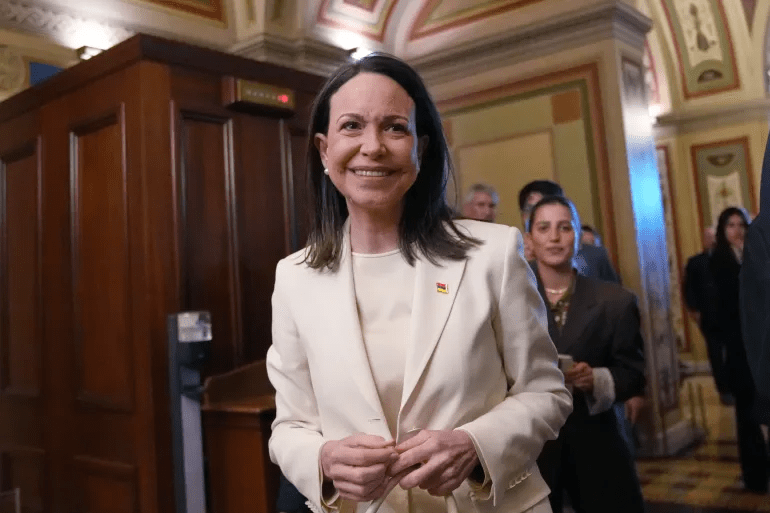
During a bipartisan meeting on Capitol Hill, Venezuelan opposition leader María Corina Machado urged U.S. lawmakers to remain committed to free and fair elections in Venezuela. While some members expressed admiration and support, Congress did not take formal action, pass a resolution, or endorse her as Venezuela’s governing authority.
The distinction matters — not just for accuracy, but for credibility.
Who María Corina Machado Is — and Why She Matters
Machado is not a fringe dissident. She is the most prominent democratic opposition figure to emerge from Venezuela’s long-running political crisis, widely recognized for her resistance to authoritarian rule and her emphasis on constitutional legitimacy.
She has:
- Rejected power seized without elections
- Insisted on democratic transition, not revenge politics
- Maintained support among Venezuelans inside and outside the country
That credibility is why members of Congress are willing to meet with her — and why her words carry weight even without formal recognition.
What Lawmakers Actually Said
According to reporting, several House Foreign Affairs Committee members expressed that Machado represents a legitimate democratic alternative to Nicolás Maduro’s regime and could play a leading role in a post-authoritarian Venezuela.
But there was:
- No committee vote
- No bipartisan resolution
- No formal call for recognition
In congressional terms, this was political signaling, not policy.
Supportive language, especially in closed-door meetings, does not equate to endorsement — and foreign governments know the difference.
The Headline vs. the Substance
The headline implied momentum toward installing Machado as Venezuela’s leader. The substance of the meeting was far narrower: Machado reiterated that only free elections can determine legitimate governance.
This mismatch reflects a common media pattern:
- Aspirational framing replaces procedural reality
- Individual lawmakers’ views are framed as institutional consensus
- Symbolism is treated as decision-making
For audiences abroad — particularly Venezuelans — this can inflate expectations the U.S. is not prepared to meet.
Congress’s Real Role — and Its Limits
Under the Constitution, Congress:
- Can authorize funding
- Can impose or lift sanctions
- Can recognize governments through formal resolutions
What it cannot do is appoint leaders of foreign countries — nor should it.
Any durable U.S. policy toward Venezuela must balance:
- Opposition to authoritarianism
- Respect for national sovereignty
- Avoidance of regime-change optics that backfire
That requires restraint, not rhetorical overreach.
Why the Right Should Care About Precision
From a center-right perspective, credibility matters as much as conviction. Overstating U.S. commitment risks:
- Weakening democratic actors when promises aren’t fulfilled
- Encouraging instability through mixed signals
- Undermining America’s standing as a rule-of-law actor
Supporting democracy does not mean anointing leaders by headline.
The Strategic Path Forward
If Congress wants to support Venezuela responsibly, it should:
- Tie sanctions relief to verifiable election benchmarks
- Demand transparent electoral conditions and monitoring
- Speak clearly about what the U.S. will — and will not — do
Machado’s call for elections aligns with those principles. Declaring her the future governor of Venezuela — without elections or authority — does not.
Bottom Line
María Corina Machado may well emerge as Venezuela’s legitimate leader. But that outcome must come through ballots, not buzz.
Congress signaling support is meaningful. Pretending it has already chosen Venezuela’s next government is not.
For a nation long scarred by strongmen, democracy must be practiced — not proclaimed.
 Republic Dispatch