By Michael Phillips | Republic Dispatch
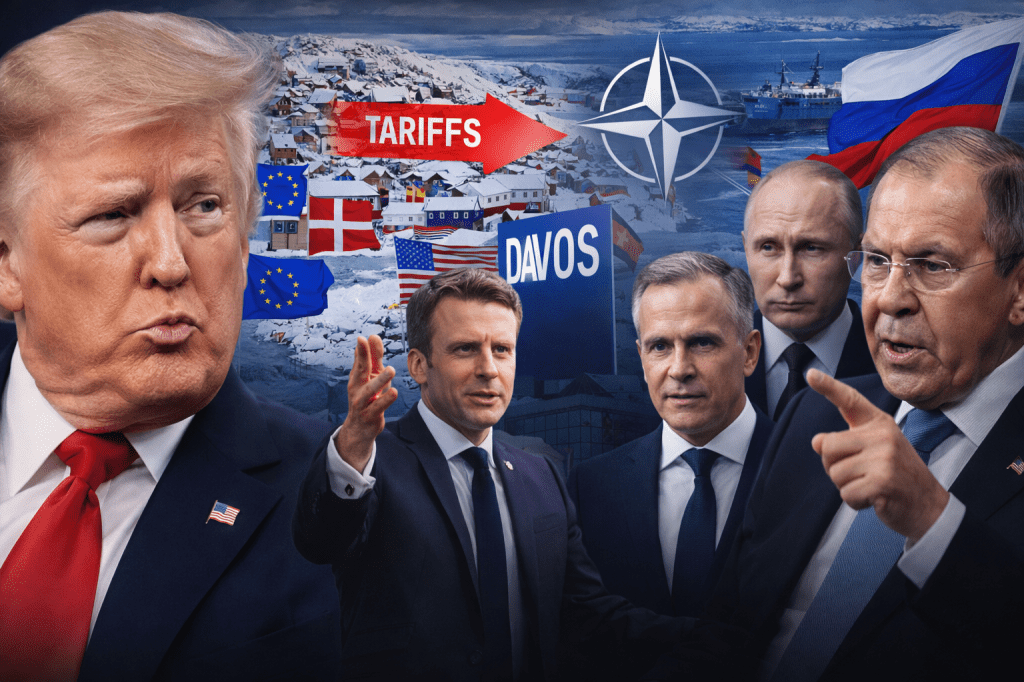
President Trump’s revived push to “acquire” Greenland has stopped being a weird throwback to 2019 and turned into a live stress test for the Western alliance system. Over the last week, the story has fused trade threats, NATO credibility, Davos stagecraft, and Russian opportunism into one escalating drama—while U.S. politicians on both sides use it as a proxy fight over America’s role in the world.
At Davos, the World Economic Forum’s usual blend of elite networking and high-minded speeches is being swallowed by one blunt question: Is the U.S. using “America First” leverage to extract concessions from allies—or normalizing territorial coercion against them?
1) The trigger: “You’ll find out,” and the credibility problem
Trump’s refusal to say how far he would go—paired with rhetoric implying tariffs and possibly force—matters less for the literal invasion scenario (still unlikely) and more for what it does to alliance psychology. When a U.S. president won’t rule out coercion against NATO-linked territory, Europe stops treating it as a negotiation and starts treating it as a contingency.
That uncertainty is the accelerant. It turns what could have been a long-running diplomatic irritant, managed quietly through defense basing and Arctic cooperation, into a credibility crisis that forces everyone to pick a posture.
2) Tariffs as a geopolitical crowbar
The administration’s tariff threat is the bridge connecting the Greenland demand to markets, parliaments, and domestic politics. Trump has publicly tied new 10% tariffs (with a stated increase to 25% later) to whether European countries “allow” a deal for Greenland. That turns sovereignty into a bargaining chip and puts U.S.-Europe trade relations on the same conveyor belt as security commitments.
The immediate “dots connecting” effect:
- Europe sees coercion (territory-by-tariff leverage).
- Markets see trade-war risk (selloffs and hedging behavior).
- Capitals see precedent (if Greenland can be pressured, what’s next?).
3) Davos becomes the amplifier, not the venue
Davos didn’t cause this—but it concentrates attention and forces leaders to signal publicly. Macron’s message (“we don’t give in to bullies,” in essence) frames the dispute as a fight about rules and legitimacy, not just bilateral bargaining.
Meanwhile, Canadian Prime Minister Mark Carney’s Davos speech broadens the frame: the “old order” is breaking down, and middle powers can’t assume safety through compliance anymore. That’s a direct acknowledgment that the dispute is reshaping alliance expectations in real time.
4) Europe’s security response: show resolve, avoid a rupture
Denmark’s answer has not been to “negotiate harder,” but to reinforce and internationalize. The Danish defense establishment has moved to expand Arctic exercises and presence “in close cooperation with allies,” a signal meant to deter coercion without naming the U.S. as the threat.
This is the tightrope:
- If Europe underreacts, it invites more pressure.
- If it overreacts, it risks accelerating the alliance rupture it wants to avoid.
5) Russia’s play: don’t intervene—just point and laugh
Moscow’s incentive is simple: let the West fracture itself. Lavrov calling it a “deep crisis” for NATO is less analysis than messaging. Russia doesn’t need to seize anything; it just needs allies to doubt one another, lose bandwidth, and shift resources inward.
In that sense, Russia is the beneficiary of the second-order effects:
- NATO unity gets questioned.
- Europe debates strategic autonomy faster.
- Ukraine and other security priorities risk dilution as attention and political capital get consumed elsewhere.
6) The U.S. domestic echo: this becomes a 2028 preview reel
The Greenland fight is also a domestic theater. On Capitol Hill, tariff threats aimed at allies inevitably boomerang into concerns about blowback, retaliation, and political cost—especially for Republicans who want to defend “strength” without owning chaos.
And Democrats are treating the moment as a character test. Gavin Newsom’s Davos comments—calling Europe “complicit” and mocking what he sees as weakness—are not just anti-Trump shots; they’re positioning for the argument that Trump’s approach turns alliances into hostages and makes adversaries stronger.
The through-line: coercion is contagious
The dots connect to one uncomfortable theme: once territorial pressure is normalized as “leverage,” every actor recalculates. Europe recalculates its dependence on the U.S. Russia recalculates how much it can exploit discord. Markets recalculates geopolitical premium. Domestic politicians recalculates how to brand “strength” versus “recklessness.”
That’s why Greenland isn’t just about Greenland. It’s about whether the West is moving from a rules-based posture to a transactional posture—and whether the transactional posture can coexist with alliance commitments built on trust.
 Republic Dispatch