
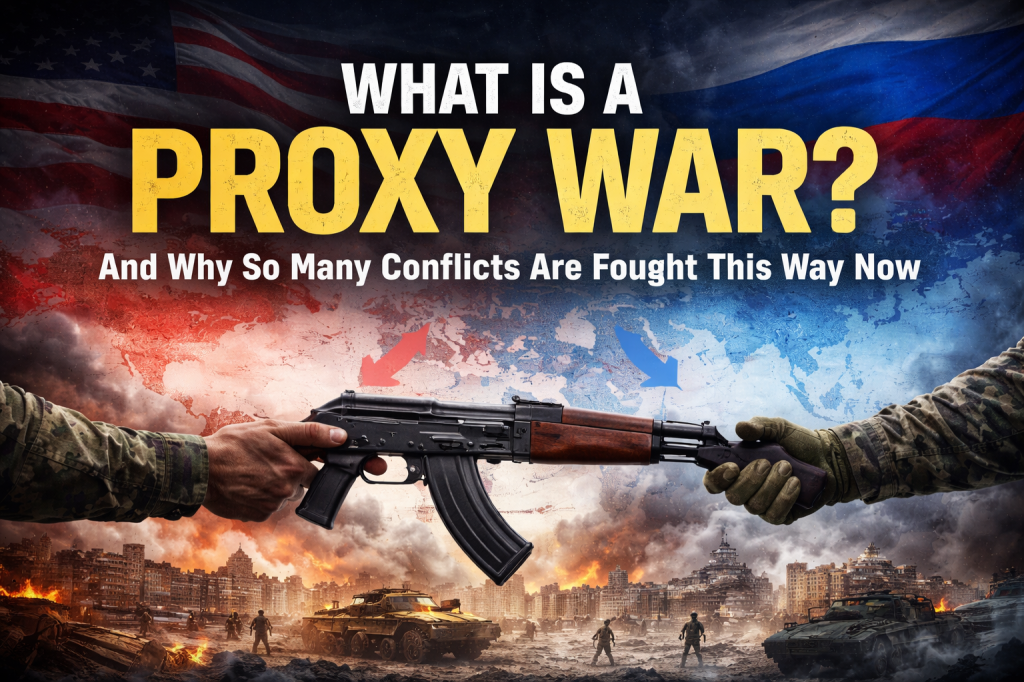
When wars break out today, they rarely look like the total wars of the 20th century. Major powers almost never declare war on each other directly. Instead, conflicts are fought through proxies—local forces, militias, governments, or armed groups backed by outside powers.
This model of conflict has become the dominant form of modern warfare. Understanding it is essential to making sense of today’s global crises.
What Is a Proxy War?
A proxy war occurs when two or more powerful states pursue their strategic goals indirectly, by supporting opposing sides in a local or regional conflict rather than fighting each other outright.
Support can include:
- Weapons and ammunition
- Training and intelligence
- Financial aid
- Political backing
- Logistical or cyber support
The key feature is distance: the major powers influence the outcome without committing large numbers of their own troops to direct combat against one another.
Why Proxy Wars Became So Common
Proxy warfare is not new, but it has become more attractive in the modern era for several reasons.
1. Nuclear Deterrence Changed the Cost of Direct War
Once nuclear weapons entered the equation, direct conflict between major powers became existentially risky. Proxy wars offered a way to compete without triggering catastrophic escalation.
The logic is simple:
If direct war is too dangerous, indirect war becomes the default.
2. Political Risk Is Lower at Home
Sending advisors, weapons, or funding abroad is politically easier than deploying large military formations.
Proxy wars:
- Reduce visible casualties
- Limit domestic backlash
- Allow leaders to deny or downplay involvement
This makes them easier to sustain over long periods.
3. They Are Cheaper—and Often More Flexible
Maintaining proxy forces costs far less than sustaining a full-scale war effort. It also allows states to:
- Scale involvement up or down quickly
- Shift strategies without formal declarations
- Exit quietly if conditions change
4. Plausible Deniability Still Matters
Even when involvement is widely suspected, the ability to deny direct responsibility remains strategically useful. It limits legal exposure, diplomatic fallout, and escalation pressure.
How Proxy Wars Work in Practice
Most proxy wars share a similar structure.
A Local Conflict With Global Stakes
The fighting usually begins as a domestic or regional dispute—civil war, territorial conflict, insurgency, or power struggle. Outside powers step in once the outcome starts to matter beyond the borders.
External Backers Pick Sides
Major powers support opposing factions based on:
- Strategic geography
- Energy resources
- Alliance networks
- Regional influence
- Ideological alignment (to a degree)
The local actors fight. The external powers shape the battlefield.
Escalation Is Carefully Managed
Proxy wars exist in a narrow band:
- Too little support risks losing influence
- Too much risks direct confrontation
This leads to incremental escalation—more advanced weapons, deeper intelligence sharing, expanded training—while avoiding overt combat between major powers.
The Cold War Blueprint
The Cold War perfected the proxy model.
Instead of fighting each other directly, global powers backed opposing sides in conflicts across:
- Asia
- Africa
- Latin America
- The Middle East
These wars were often brutal, prolonged, and devastating for local populations—but they allowed superpowers to compete without triggering nuclear war.
That basic logic never disappeared. It evolved.
Why Proxy Wars Are Increasing Again
Several modern trends have accelerated the return of proxy warfare.
Multipolar Competition
The global system is no longer dominated by a single superpower. As influence becomes more contested, proxy conflicts become a tool for shaping regional balance without open confrontation.
Fragmented States Create Openings
Weak or divided states provide fertile ground for proxy conflict. When institutions collapse or legitimacy is disputed, outside powers find willing partners on the ground.
Modern Warfare Favors Indirect Methods
Today’s conflicts combine:
- Conventional fighting
- Cyber operations
- Economic pressure
- Information warfare
Proxy forces allow states to integrate all of these without crossing formal war thresholds.
The Human Cost Is Often Ignored
Proxy wars reduce risk for major powers—but not for civilians caught in the middle.
Common consequences include:
- Prolonged fighting with no clear end
- Fragmentation of armed groups
- Weak accountability for abuses
- Infrastructure destruction
- Long-term instability even after fighting subsides
Because no single power “owns” the war, responsibility is diffuse—and resolution is harder.
Why Proxy Wars Are Hard to End
Proxy wars tend to persist longer than direct conflicts.
Reasons include:
- External backers can replenish losses indefinitely
- Local actors gain leverage by prolonging fighting
- Peace requires alignment among outside sponsors, not just local parties
When external interests diverge, compromise becomes unlikely.
What Proxy Wars Tell Us About Modern Power
Proxy warfare reflects a broader reality of international politics:
- Major powers still compete aggressively
- Direct war is too costly to risk
- Influence is pursued indirectly, persistently, and often quietly
Understanding proxy wars helps explain why conflicts drag on, why peace deals fail, and why global crises rarely resolve cleanly.
Why This Matters Now
If you want to understand modern geopolitics—why wars expand without becoming world wars, why interventions feel half-measured, and why civilian suffering often seems secondary—you need to understand proxy warfare.
It is not an exception.
It is the system.
Next in this series: How Sanctions Actually Work—and Why They Rarely Achieve Their Stated Goals
 Republic Dispatch