By Republic Dispatch Staff
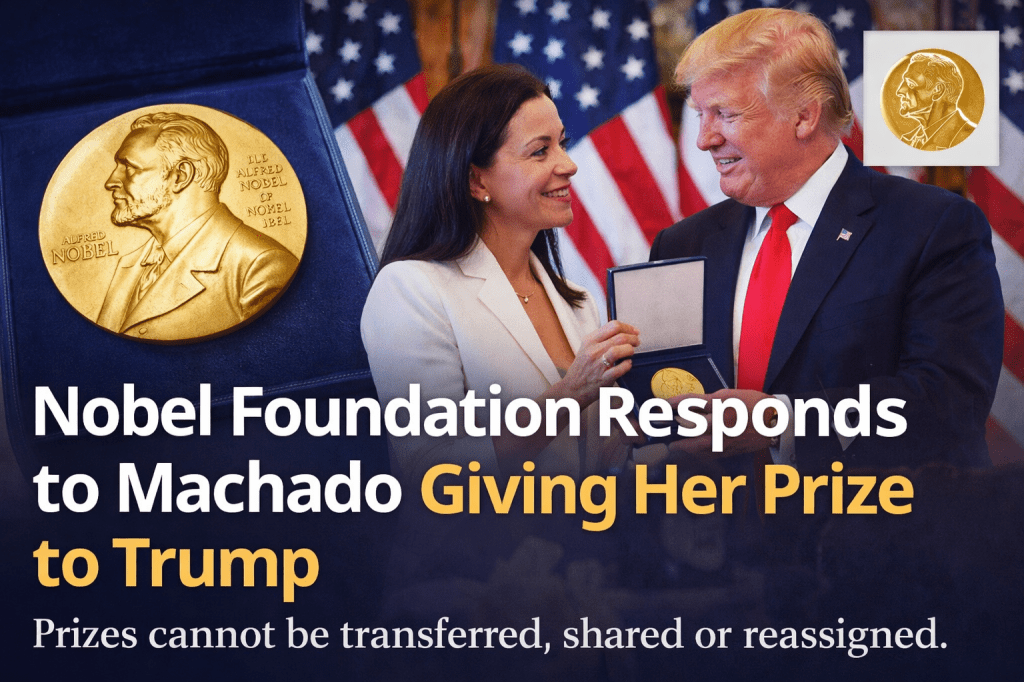
In an extraordinary moment on the international stage, Venezuelan opposition leader María Corina Machado — who was awarded the 2025 Nobel Peace Prize for her long struggle for democratic rights in her homeland — presented her Nobel Peace Prize medal to former U.S. President Donald Trump during a January meeting at the White House. Machado’s gesture was framed as a show of gratitude for Trump’s role in ending Nicolás Maduro’s authoritarian rule in Venezuela.
But that symbolic act quickly ran up against a stark institutional reality: the Nobel Peace Prize cannot be transferred, shared or reassigned. The Nobel Foundation has reaffirmed in no uncertain terms that, once conferred, a Nobel Prize remains the property of the laureate and the distinction of being the official recipient cannot be conferred on anyone else — even symbolically.
Why the Nobel Foundation Drew the Line
The Nobel Foundation’s recent statement underscores a simple but essential principle: the integrity of the Nobel Prizes rests on rigorous criteria, merit-based selection and historical continuity. Alfred Nobel’s will and the Foundation’s bylaws make clear that prizes are awarded to individuals or organizations that have “conferred the greatest benefit to humankind,” and those awards are final once announced. A laureate may choose to do what they wish with the physical medal, but the honor and title remain inseparable from the person chosen by the Nobel Committee.
In this case, while Machado may have handed over her medal to Trump — and Trump, for his part, accepted the framed token — the laureate designation still belongs solely to her. The Norwegian Nobel Committee recently reiterated that no transfer of laureate status has occurred and that the decision is “final and stands for all time.”
A Gesture That Backfired?
From a policy perspective, Machado’s decision to gift the medal appears to have been a calculated political gesture — an effort to strengthen ties with the United States and to spotlight Trump’s involvement in Venezuela’s transition away from autocracy. However, this maneuver may have been diplomatically counterproductive. Reports from Washington indicate that Trump has distanced his administration from Machado’s leadership ambitions and instead backed other actors in post-Maduro governance.
The Nobel Foundation’s response is not merely bureaucratic pedantry. It reflects a broader concern about preserving the credibility of an institution that carries outsized moral weight on the world stage. If Nobel Prizes could be redistributed by laureates at will, the prestige and meaning of these awards would be quickly diluted.
Larger Stakes for Democratic Movements
For conservatives and moderates who champion democratic movements abroad, the episode offers two key takeaways:
- Symbolism has limits. Powerful gestures resonate only when backed by a solid strategic framework. Handing a medal to a sitting or former head of state can be politically potent, but it doesn’t change the formal architecture of international honors.
- Institutions matter. The Nobel Foundation did not waver. Its swift clarification protected the Prize’s integrity and reaffirmed that global recognition must be grounded in established rules, not political opportunism.
As Venezuela navigates a fraught post-Maduro transition, acknowledgment from the Nobel Foundation — rooted in the rigor of its charter — serves as a reminder that democratic legitimacy and international legitimacy are earned through sustained action, not episodic theatrics. Machado remains a Nobel laureate; Trump does not. Whether this episode advances or detracts from Venezuela’s future, the Foundation has made clear where the prize truly resides.
 Republic Dispatch