
By Republic Dispatch
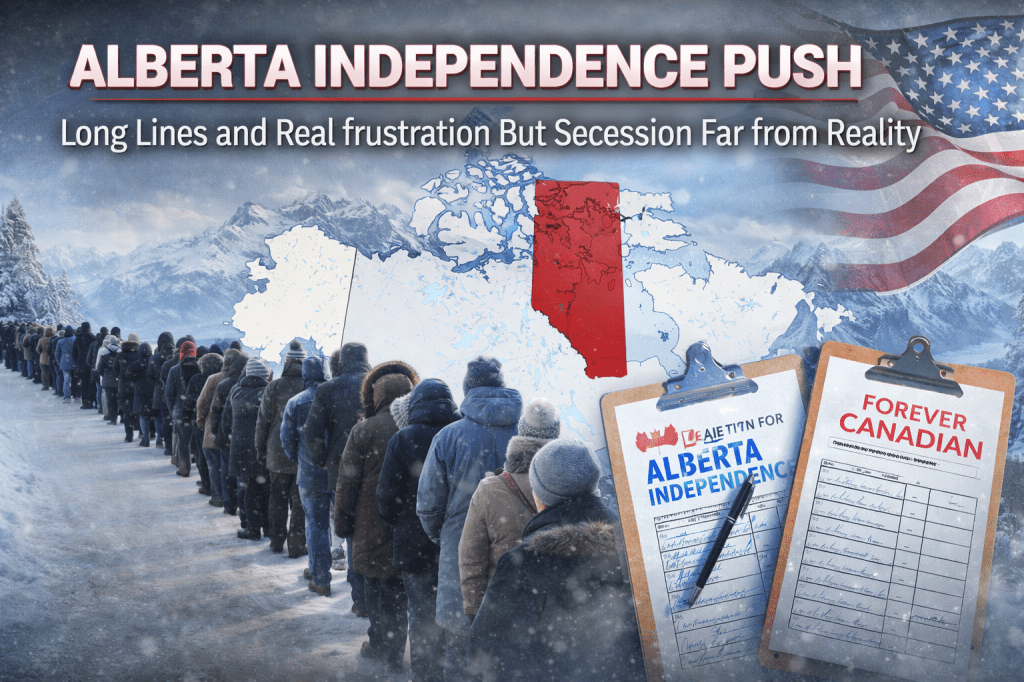
Viral images circulating this week show long lines of bundled-up Albertans standing in freezing temperatures in Edmonton, waiting hours to sign a petition calling for Alberta to separate from Canada. Social media posts—most notably amplified by U.S. commentators—have framed the moment dramatically: a province on the verge of secession, perhaps even angling to become America’s “51st state.”
The reality is more grounded, but no less politically significant.
What’s unfolding in Alberta is a legitimate, citizen-led referendum effort that reflects deep frustration with Canada’s federal system—particularly in the West. It is not, however, an imminent breakup of Canada, nor a serious bid for U.S. annexation. Still, the movement deserves attention, not dismissal.
What’s Actually Happening in Alberta
In late December 2025, Elections Alberta approved a citizen initiative petition seeking a referendum on Alberta independence. Signature collection officially began on January 3, 2026, and will continue through May 2.
To trigger a province-wide referendum, organizers must gather 177,732 valid signatures, equal to 10 percent of the votes cast in Alberta’s 2023 provincial election.
That effort is being spearheaded by grassroots groups including Stay Free Alberta, which is affiliated with the broader Alberta Prosperity Project. Events have been held across the province, including Edmonton, Red Deer, Calgary, Millet, Eckville, and smaller communities.
Reports from mid-January confirm:
- Hours-long lineups, including at Edmonton’s Rundle Park
- Hundreds to thousands of signers at individual weekend events
- Participation despite sub-zero temperatures
- Town halls focused on energy policy, taxes, and federal overreach
The viral images are real. The crowds are real. And the anger is real.
Why Alberta Is Different
Alberta has long occupied an uneasy place within Canada’s federation. It is energy-rich, export-driven, and culturally more conservative than much of the country. Tensions with Ottawa have simmered for decades over:
- Federal carbon taxes
- Restrictions on oil and gas development
- Equalization payments perceived as redistributing Alberta wealth
- Regulatory decisions made by governments with little electoral dependence on the province
These grievances intensified after recent federal elections and ongoing debates over energy policy, environmental regulation, and national economic priorities.
To many Albertans, the system feels rigged: their economic engine constrained, their political influence diluted, and their concerns routinely overridden by central Canada.
The petition campaign is less about abstract nationalism and more about leverage—forcing a conversation Ottawa has long avoided.
How Much Support Does Independence Really Have?
Despite the dramatic visuals, Alberta is not on the brink of secession.
Recent polling from early January 2026 suggests:
- 20–30% of Albertans would vote “yes” in an independence referendum
- 60% or more would vote “no”
- Support is stronger in rural areas and among conservative voters
Meanwhile, a counter-petition affirming Alberta’s place in Canada reportedly gathered over 400,000 signatures, underscoring that separatism remains a minority position.
In short: the movement is energetic, but not dominant.
The Legal and Political Reality Check
Even if the petition succeeds and a referendum is held later this year, independence would face enormous obstacles.
Under Canada’s Clarity Act and Supreme Court precedent from Quebec secession cases:
- The referendum question must be unambiguous
- A clear majority would be required
- Secession would trigger lengthy negotiations, not automatic independence
Additionally, several First Nations have already signaled opposition, citing treaty rights that predate Alberta itself. Any attempt to redraw borders without their consent would almost certainly end up in court.
And the popular U.S. talking point—that Alberta could simply become the 51st state—is largely fantasy. Annexation would require:
- Alberta first becoming an independent country
- Approval by the U.S. Congress
- Complex constitutional and diplomatic negotiations
No serious political actor on either side of the border is pursuing that path.
Why This Still Matters
It would be easy for Canadian elites—or American commentators—to dismiss this as fringe theatrics. That would be a mistake.
The Alberta independence petition is a signal flare. It reflects a population that feels unheard, economically constrained, and culturally sidelined within a centralized federal system. Whether or not separation ever happens, the underlying grievances are not going away.
If Ottawa continues to treat Western discontent as noise rather than substance, the movement will grow—not necessarily toward independence, but toward deeper institutional distrust.
For now, Alberta isn’t leaving Canada. But thousands of people standing in line for hours in the cold should tell policymakers something important:
This isn’t about flags or borders.
It’s about a federation that no longer feels mutual.
And that problem won’t be solved by ignoring it.
 Republic Dispatch