
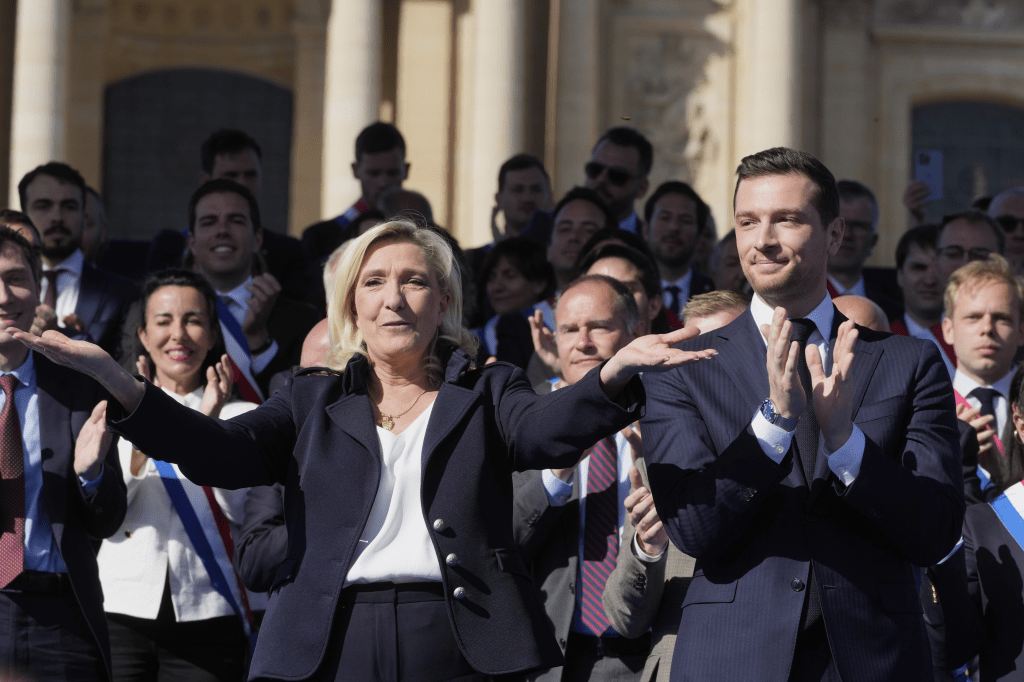
By Michael Phillips | Republic Dispatch
The political future of Marine Le Pen, one of Europe’s most durable nationalist figures, is once again in the hands of French judges — and, by extension, Europe’s institutional elite.
On January 13, Le Pen appeared before the Paris Court of Appeal to contest her 2025 conviction for misusing European Parliament funds, a case that now threatens to reshape the 2027 French presidential race and accelerate a generational shift inside France’s National Rally (RN).
At stake is not just Le Pen’s fourth presidential bid, but a broader question increasingly familiar across Europe: whether legal and regulatory systems are being used to sideline populist challengers who disrupt the Brussels consensus.
The Case at the Center of the Storm
Le Pen and more than 20 senior RN officials were convicted last year of improperly using European Parliament funds to pay parliamentary assistants who allegedly worked on party activities in France rather than EU legislative duties in Brussels or Strasbourg.
Her sentence was severe by French political standards:
- Four years in prison (two suspended, two under electronic monitoring)
- A €100,000 fine
- A five-year ban from holding public office, imposed with immediate effect
The RN party itself was fined €2 million, half of it suspended.
At the appeal hearing, Le Pen flatly rejected the premise of the case, arguing that the European Parliament itself failed to object for years. “I have no sense of having committed an offence,” she told the court, insisting the arrangements were transparent and well documented.
The appeal process runs through February, with a ruling not expected until summer 2026 — dangerously close to the 2027 presidential filing deadline.
Lawfare or Legitimate Prosecution?
From a center-right perspective, the timing and scope of the case raise uncomfortable questions.
Le Pen’s supporters argue the prosecution reflects a broader European trend: regulatory and judicial pressure applied disproportionately to nationalist or Euroskeptic movements. Similar accusations have emerged in Italy, Hungary, Poland, and even Germany, where populist parties face mounting legal scrutiny as their electoral fortunes rise.
Whether one views the case as lawful accountability or politicized lawfare often depends on where one stands on the EU itself. What is clear is that the consequences are political, not merely personal.
If the ban stands, Le Pen is effectively sidelined at the peak of her party’s momentum — and at a moment when President Emmanuel Macron is constitutionally barred from running again.
Enter Jordan Bardella
Ironically, removing Le Pen may not weaken the National Rally at all.
Her protégé and party president, Jordan Bardella, has emerged as one of the strongest contenders for 2027 in recent polling. At just 30 years old, Bardella represents a polished, media-savvy evolution of the RN brand — less burdened by the Le Pen family name, yet firmly aligned with its positions on immigration, national sovereignty, and cultural identity.
Recent French polling has shown Bardella outperforming Le Pen in hypothetical matchups, with broader appeal among younger voters, working-class constituencies, and even segments of the traditional center-right.
Bardella has publicly defended Le Pen, calling any attempt to bar her “deeply worrying for democracy,” while carefully positioning himself as a loyal successor rather than an opportunistic replacement.
What Happens Next
Several outcomes remain possible:
- Full acquittal, clearing Le Pen to run.
- Conviction upheld but ban softened, allowing her candidacy during further appeals.
- Ban shortened, narrowly reopening the door.
- Sentence confirmed or strengthened, ending her presidential ambitions outright.
Whatever the verdict, the appeal underscores a larger reality: France’s 2027 election is already underway, and it will be fought not only at the ballot box, but in courtrooms, regulatory chambers, and EU institutions.
For voters skeptical of centralized European power, the Le Pen case may reinforce a growing belief that political competition in Europe is no longer purely democratic — but increasingly procedural.
And if Marine Le Pen exits the stage, France may soon discover that her movement was never about one name alone.
 Republic Dispatch