By Michael Phillips | Republic Dispatch / Thunder Report
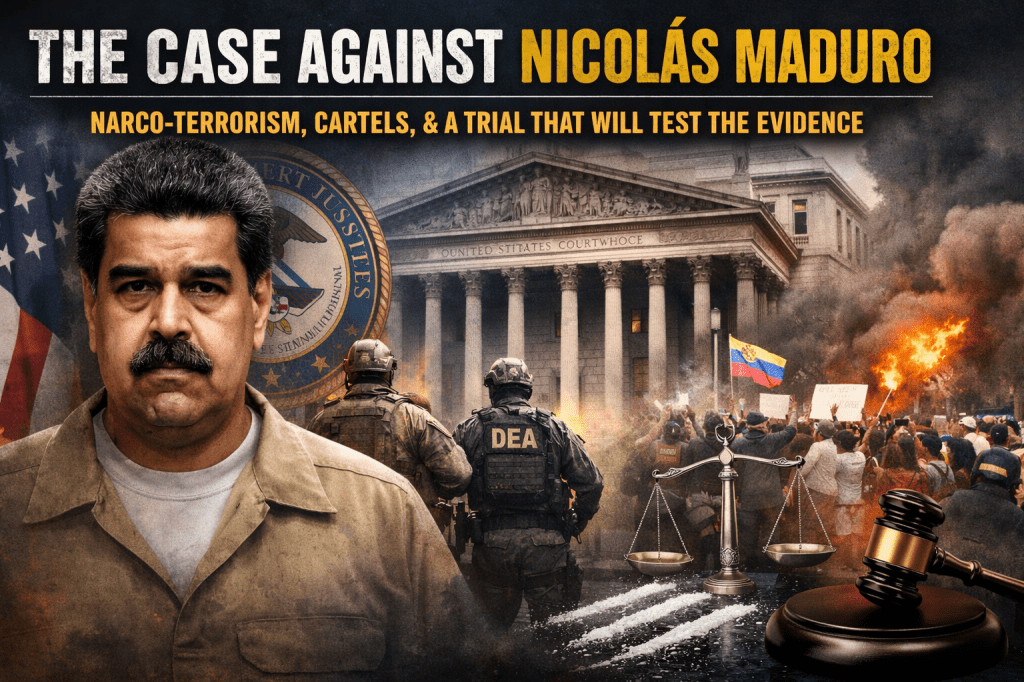
As of January 2026, the most consequential legal reckoning facing Nicolás Maduro is no longer rhetorical or diplomatic—it is criminal, concrete, and unfolding in a U.S. federal courtroom.
Following his capture by U.S. forces on January 3, Maduro now faces a sweeping federal indictment in the Southern District of New York, a case that traces back to charges first filed in 2020 and expanded in a superseding indictment unsealed after his arrest. The allegations place Maduro at the center of an international narco-terror enterprise accused of flooding the United States with cocaine while weaponizing Venezuela’s state institutions for protection and profit.
The U.S. Indictment: Narco-Terrorism at the State Level
Federal prosecutors allege that Maduro led and protected a long-running conspiracy commonly referred to as the Cartel de los Soles—a loose but pervasive network of senior Venezuelan officials, military officers, and criminal partners operating since at least 1999.
According to the indictment, the conspiracy involved cooperation with Colombia’s FARC (a U.S.-designated terrorist organization), Mexican cartels, and Venezuelan gangs such as Tren de Aragua. The government contends that these alliances enabled the production, protection, and transit of hundreds of tons of cocaine annually through Venezuelan territory, destined largely for the U.S. market.
The charges against Maduro include:
- Narco-terrorism conspiracy
- Conspiracy to import cocaine into the United States
- Possession of machine guns and destructive devices
- Conspiracy to possess machine guns and destructive devices
Each count carries potential life sentences.
Co-defendants named in the case include Maduro’s wife, Cilia Flores, his son Nicolás Ernesto Maduro Guerra, senior political figures such as Diosdado Cabello, and criminal leaders tied to transnational gangs.
Evidence the Government Plans to Present
U.S. prosecutors have assembled a case built on years of investigations, including:
- Cooperating witnesses, most notably former Venezuelan intelligence chief Hugo Carvajal, who pleaded guilty in 2025 and implicated senior leadership.
- Prior convictions, including Maduro’s nephews, convicted in 2017 for attempting to traffic nearly a metric ton of cocaine.
- DEA recordings and intercepted communications from sting operations and informants.
- Asset seizures, including a luxury aircraft linked to Maduro-associated shell companies.
- Treasury designations, including the 2025 designation of Cartel de los Soles as a terrorist-linked organization.
Even critics of U.S. foreign policy acknowledge that corruption and drug trafficking by Venezuelan officials is well documented. The legal fight will center on whether prosecutors can prove Maduro personally directed or knowingly coordinated these activities at a level sufficient to sustain the narco-terrorism charges.
Parallels to Noriega—and Key Differences
The case has drawn immediate comparisons to the 1989 capture and prosecution of Panama’s Manuel Noriega. As with Noriega, the United States is asserting jurisdiction based on the flow of narcotics into U.S. territory and the use of violence and terrorism to protect those routes.
Unlike Noriega, however, Maduro presided over a far larger state apparatus and maintained power through a mix of ideology, repression, and international alliances. That complexity will make this prosecution more legally and politically challenging—and far more consequential.
The ICC Track: Serious Allegations, No Warrant (Yet)
Separately, the International Criminal Court continues its “Venezuela I” investigation into alleged crimes against humanity committed since 2014, including torture, arbitrary detention, extrajudicial killings, and political persecution.
UN fact-finding missions and organizations such as Human Rights Watch and Amnesty International have documented systemic abuses by Venezuelan security forces. To date, however, the ICC has not issued a personal arrest warrant for Maduro, and the investigation remains ongoing amid legal challenges by Caracas.
The ICC process, slow by design, contrasts sharply with the immediacy of the U.S. criminal case now underway.
Capture, Detention, and What Comes Next
Maduro is currently being held at the Metropolitan Detention Center in New York. His initial court appearances are expected to mark the start of a lengthy pretrial process, with motions, evidentiary battles, and jurisdictional challenges likely to follow.
In Venezuela, Vice President Delcy Rodríguez has assumed interim administrative authority, while regime loyalists denounce the operation as foreign aggression. Protests and international reactions continue, underscoring the geopolitical stakes attached to what is, at its core, a criminal trial.
Why This Case Matters
For years, Washington accused Maduro’s regime of operating as a criminal enterprise. This prosecution is the first real test of whether those accusations can withstand the scrutiny of an open court.
If the evidence holds, the case will establish a precedent: that heads of state who weaponize drug trafficking and terror against the United States can be treated not merely as political adversaries, but as criminal defendants. If it fails, it will raise uncomfortable questions about the limits of lawfare, intelligence-driven prosecutions, and the credibility of U.S. claims.
Either way, the trial of Nicolás Maduro is no longer a talking point. It is a courtroom confrontation—with consequences far beyond Venezuela.
 The Republic Dispatch