
By Michael Phillips | Republic Dispatch
As 2025 draws to a close, President Donald Trump is attempting something few modern presidents have seriously tried: resolving multiple global conflicts simultaneously through direct, leader-to-leader diplomacy backed by selective military pressure. From Ukraine to Gaza to Nigeria, the administration has racked up ceasefires and tactical wins—but the hardest political questions remain unresolved.
Ukraine: Momentum Without a Signature
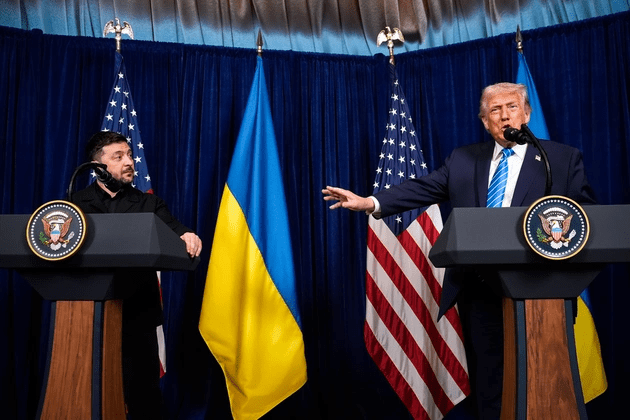
The most consequential negotiations are playing out in the Russia-Ukraine war. On December 28, Trump hosted Ukrainian President Volodymyr Zelenskyy at Mar-a-Lago for more than two hours of talks focused on a revised U.S.–Ukraine 20-point peace framework.
Both leaders struck an optimistic tone. Trump said the sides were “closer than ever” and “maybe very close” to a deal, while Zelenskyy stated the plan was roughly 90 percent agreed. U.S. security guarantees for Ukraine—long a sticking point—appear nearly finalized, potentially allowing Kyiv to maintain a large peacetime military with Western backing.
Yet the most explosive issues remain unresolved. Territorial control in the Donbas region, ceasefire sequencing, and Russian demands to limit Ukraine’s army size continue to block a final agreement. Trump has spoken directly with Russian President Vladimir Putin, describing the calls as productive, but Moscow has rejected proposals such as a temporary 60-day ceasefire and continues to insist on concessions Ukraine says it cannot legally or politically make.
Working groups are expected to continue negotiations into early 2026. For now, the war grinds on even as diplomacy intensifies.
Gaza: A Ceasefire Holding—Barely
In the Middle East, Trump’s record is more mixed but arguably more advanced. A U.S.-brokered ceasefire between Israel and Hamas, implemented in October 2025, ended large-scale fighting and led to the return of most hostages and remains—one of the administration’s most tangible diplomatic achievements.
But the truce is fragile. On December 29, Trump met Israeli Prime Minister Benjamin Netanyahu at Mar-a-Lago to press for movement into phase two of the agreement. That phase calls for Hamas’s full disarmament, an end to its governance role in Gaza, reconstruction under international oversight, and Israeli withdrawal.
Progress has stalled. Hamas refuses to fully disarm, Israel insists disarmament comes first, and governance arrangements remain unsettled. Trump has publicly signaled impatience, warning that without momentum the ceasefire risks collapse.
Nigeria: Targeted Force, Not Nation-Building
Outside the traditional flashpoints, the administration has shown a willingness to use force selectively. On Christmas Day, the U.S. conducted coordinated strikes on ISIS-linked camps in northwest Nigeria, following Trump’s designation of the country as a “Country of Particular Concern” for religious freedom violations.
The strikes—carried out with Nigerian government cooperation—were framed as targeted counterterrorism operations rather than the opening of a broader campaign. While they degraded extremist capabilities, the underlying insurgent and communal violence in Nigeria remains unresolved.
Other Flashpoints: Calm Without Closure
Elsewhere, Trump officials point to a string of ceasefires and partial stabilizations: a U.S.–Houthi truce in Yemen that reduced Red Sea shipping attacks; fragile Israel-Hezbollah and Israel-Iran ceasefires that weakened Iranian proxies; and a finalized Armenia-Azerbaijan peace agreement brokered at the White House.
These outcomes reflect a consistent strategy—personal diplomacy, pressure, and deal-making—rather than long, institution-heavy peace processes.
The Bottom Line
Trump’s approach has produced real, if uneven, results. Ceasefires have replaced open warfare in several regions, and diplomatic channels once frozen are active again. But in conflicts where territory, sovereignty, and disarmament are central—Ukraine foremost among them—personal diplomacy alone has not yet delivered final peace.
As 2026 approaches, the administration faces a familiar challenge: turning fragile pauses into durable settlements, and optimism into signed agreements. Whether Trump’s high-wire diplomacy can clear that final hurdle remains the defining foreign-policy question of his second term.
 The Republic Dispatch