By Michael Phillips | Republic Dispatch
The year 2025 marked a decisive shift in how the United States conducted itself on the world stage. Under President Donald Trump’s second administration, American foreign policy became more transactional, more unilateral, and far less constrained by post-Cold War norms.
Supporters argued the approach restored leverage and realism. Critics warned it weakened alliances and destabilized the global order. Either way, these five developments stood out as the most consequential—and controversial—foreign policy stories of the year.
1. Global Tariff Wars and Trade Retaliation
The administration’s sweeping “reciprocal tariff” strategy triggered the most aggressive trade confrontation in decades. Tariffs of up to 60% on Chinese goods—and 10–20% on allies—prompted immediate retaliation from China, the European Union, India, and others.
Beijing responded with export controls on rare earth minerals, while Europe targeted iconic American exports. Supply chains fractured, prices rose, and allies openly questioned Washington’s commitment to cooperative trade rules.
While partial tariff rollbacks followed late-year U.S.–China talks, the damage was done: trade relations became openly adversarial, and economic fragmentation accelerated.
2. The Dismantling of USAID and the Retreat of American Soft Power
One of the least debated—but most far-reaching—moves was the effective dismantling of the U.S. Agency for International Development. Billions in foreign aid programs were frozen or terminated, with USAID largely absorbed into the State Department by mid-year.
Health initiatives, food aid, and development projects vanished almost overnight. The vacuum was quickly filled by China and regional powers, particularly in Africa and Latin America.
For decades, aid had been a pillar of U.S. influence. Its abrupt rollback signaled a clear message: American engagement would now be transactional, not humanitarian.
3. Ukraine Policy Reversal and the Zelenskyy Confrontation
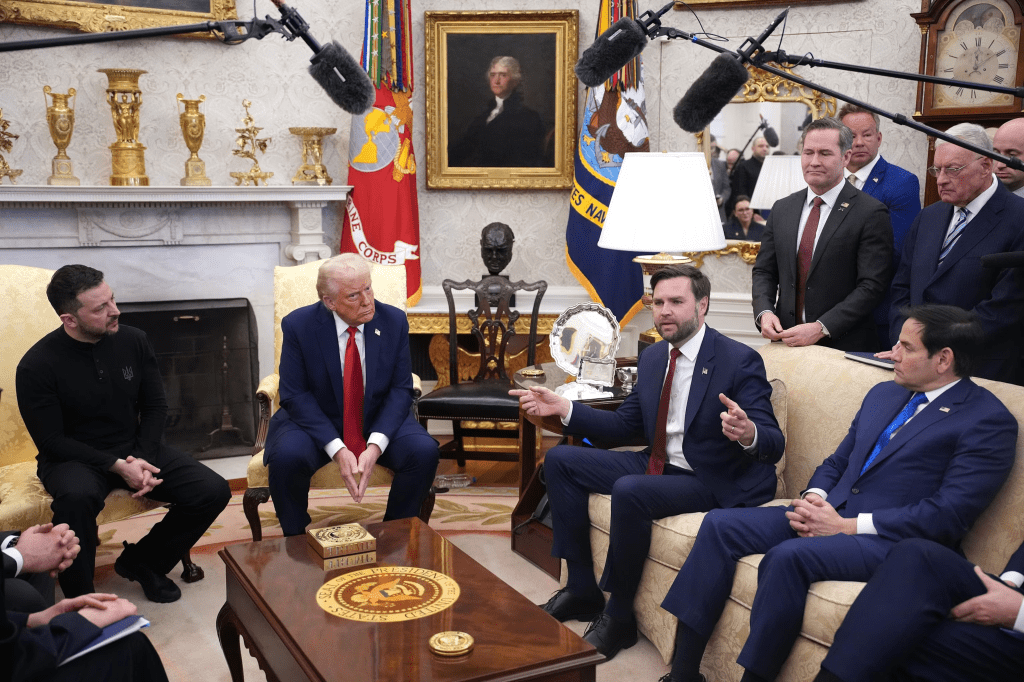
The administration’s pivot on Ukraine stunned Europe. Arms deliveries slowed, repayment demands surfaced, and a highly public Oval Office meeting saw Volodymyr Zelenskyy publicly rebuked by U.S. leadership.
The episode fractured NATO unity and forced European governments to accelerate independent defense planning. Though peace talks gained momentum later in the year, the damage to transatlantic trust lingered.
The message was unmistakable: U.S. support was no longer unconditional—and alliances would be renegotiated in real time.
4. U.S. Military Strikes on Drug Traffickers in the Americas
In a dramatic escalation of counter-narcotics policy, U.S. forces launched air and drone strikes on suspected cartel vessels in the Caribbean and eastern Pacific—often without host-nation coordination.
Over 100 people were reportedly killed, prompting outrage from Latin American governments and accusations of extrajudicial force. Venezuela, Mexico, and Brazil condemned the actions as violations of sovereignty.
Supporters called it long-overdue toughness. Critics labeled it “gunboat diplomacy,” warning it revived Cold War-era interventionism and risked regional instability.
5. Escalating U.S.–China Tensions Beyond Trade
Trade was only one front in the deepening rivalry with China. Technology restrictions, semiconductor controls, Taiwan arms sales, and diplomatic disengagement fueled a broader strategic confrontation.
China retaliated selectively, leveraging supply-chain dominance and courting non-aligned nations. While late-year summits reduced immediate escalation, the rivalry hardened into a defining feature of global politics.
By year’s end, many countries were quietly hedging—seeking alternatives to U.S. leadership while avoiding outright alignment with Beijing.
A World Reordered
Taken together, these five developments defined 2025 as a turning point. The United States asserted power more directly, demanded tangible returns from allies, and showed little patience for multilateral restraint.
Whether this approach yields long-term leverage or accelerates global fragmentation remains unresolved. What is clear is that America’s role in the world—and how others respond to it—changed fundamentally in 2025.
As 2026 approaches, unresolved trade disputes, fragile peace talks, and strained alliances suggest the aftershocks are only beginning.
 Republic Dispatch